The relationship between cognitive screeners and everyday functioning in amyloid‐positive participants from the Amsterdam Dementia Cohort
Angela van der Putten‐Toorenburg, Elke Butterbrod, Benjamin D. Schalet, Pieter J. van der Veere, Mukrabe E. Tewolde, Merel C. Postema, Elsmarieke van de Giessen, Charlotte E. Teunissen, Argonde C. van Harten, Wiesje M. van der Flier, Sietske A. M. Sikkes

TL;DR
This study shows that cognitive tests like MMSE and MoCA are only moderately linked to daily functioning in people with Alzheimer's disease, highlighting the need to assess both cognition and function.
Contribution
The study reveals that complex daily tasks are impaired even in higher cognitive performance groups, emphasizing the importance of combining cognitive and functional assessments.
Findings
MMSE and MoCA scores were moderately associated with daily functioning as measured by the A-IADL-Q-30.
Higher cognitive performance groups still showed difficulties in complex tasks like work and computer use.
Assessing both cognition and function is crucial for monitoring Alzheimer's disease progression.
Abstract
We explored the relationship between cognitive screening outcomes and everyday functioning in Alzheimer's disease (AD). A total of 1228 amyloid‐positive participants were included from the Amsterdam Dementia Cohort. Multiple linear regression analyses assessed the relationship between Mini‐Mental State Examination (MMSE), Montreal Cognitive Assessment (MoCA), and everyday functioning (Amsterdam Instrumental Activities of Daily Living Questionnaire [A‐IADL‐Q‐30]). To link cognitive screeners to functional impairment, we described difficulties across A‐IADL‐Q‐30 items by MMSE and MoCA quartiles. Both MMSE (B = 0.96, 95% confidence interval [CI]0.87–1.04) and MoCA (B = 0.79, 95% CI 0.68–0.89) were associated with A‐IADL‐Q‐30. In the lowest MMSE (0–20) and MoCA (0–16) quartiles, filling in forms (both 96%) and managing the household budget (95%–93%) were mostly affected, whereas working…
Genes, proteins, chemicals, diseases, species, mutations and cell lines named across the full text — each resolved to its canonical identifier and authoritative record.
Click any figure to enlarge with its caption.
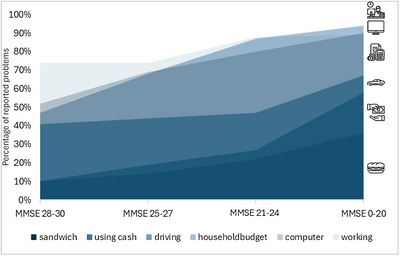 Figure 1
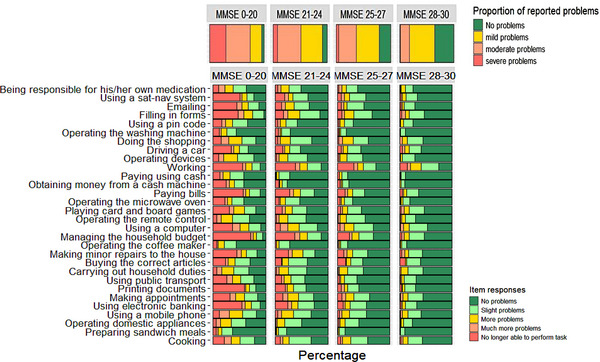 Figure 2
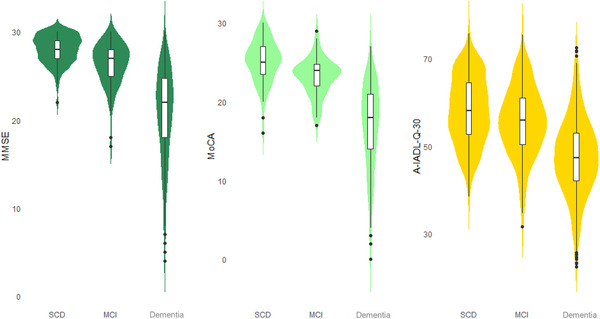 Figure 3
Peer Reviews
No public reviews on file for this paper yet. If you reviewed it on a platform where reviews are public (OpenReview, ICLR, NeurIPS, ICML), you can paste yours below so the community can read it here.
Videos
No videos yet. Explain this paper in a talk, walkthrough, or lecture? Add one.
Taxonomy
TopicsDementia and Cognitive Impairment Research · Frailty in Older Adults · Older Adults Driving Studies