Clinical spectrum, immune status, and prognostic factors of cryptococcosis: insights from a large, multi-center, ambispective cohort study in southeastern China
Lei Gu, Jing Lin, Anmao Li, Jian Yue, Wen Wen, Wei Liu, Qunying Lin, Xiangqi Chen, Xiaohong Chen, Jun Wu, Zeyi Liu, Baosong Xie, Guoxiang Lai, Jian-an Huang

TL;DR
A large study in China finds that immune status and CNS involvement strongly influence outcomes in cryptococcosis, with azole monotherapy being effective for pulmonary cases.
Contribution
The study provides real-world evidence on clinical features, immune stratification, and treatment outcomes of cryptococcosis in a non-HIV population.
Findings
Severe immunodeficiency and CNS involvement are strongly linked to poor outcomes in cryptococcosis.
Azole monotherapy was effective for pulmonary cryptococcosis across severity groups.
Quantitative and qualitative CrAg assays showed high diagnostic agreement.
Abstract
Cryptococcosis is a major opportunistic fungal infection with heterogeneous clinical outcomes; however, data on clinical features and prognostic factors in non-HIV populations remain limited. This study aimed to provide real-world evidence on the clinical characteristics, immune stratification, diagnostic performance, treatment patterns, and outcomes of cryptococcosis. We performed a multi-center ambispective cohort study of patients with cryptococcosis diagnosed between 2013 and 2025 across 48 hospitals in southeastern China, including Jiangsu and Fujian provinces. Patients were stratified according to immune status, disease type, and prognosis. Categorical variables were compared using the chi-square test or Fisher's exact test, and continuous variables were analyzed using the Mann-Whitney U test or Kruskal-Wallis test, as appropriate. A total of 396 patients were included, with a…
Genes, proteins, chemicals, diseases, species, mutations and cell lines named across the full text — each resolved to its canonical identifier and authoritative record.
Click any figure to enlarge with its caption.
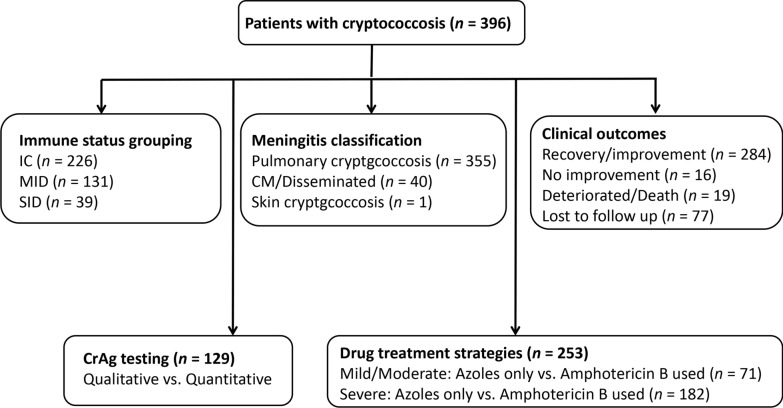 Figure 1
 Figure 2
Peer Reviews
No public reviews on file for this paper yet. If you reviewed it on a platform where reviews are public (OpenReview, ICLR, NeurIPS, ICML), you can paste yours below so the community can read it here.
Videos
No videos yet. Explain this paper in a talk, walkthrough, or lecture? Add one.
Taxonomy
TopicsFungal Infections and Studies · Nail Diseases and Treatments · Antifungal resistance and susceptibility