Epidemiology of Giardia intestinalis in non-human primates and their caregivers: A study from Czech zoos
Kristýna Brožová, Anna Šejnohová, Monika Koutenská, Zuzana Pavlíčková, Milan Jirků, Eliška Zimmelová, Oldřiška Kadlecová, Klára J. Petrželková, Kateřina Jirků

TL;DR
This study found a high presence of Giardia intestinalis in zoo primates and their caregivers, highlighting the need for better tools to track its spread between species.
Contribution
The study provides new insights into Giardia transmission dynamics in zoo environments using a One Health approach.
Findings
Giardia was detected in 47% of non-human primates and 30% of caregivers.
Assemblage B was the most common genotype identified.
Low protist load in samples hindered accurate genotyping and transmission analysis.
Abstract
Giardia intestinalis is a globally distributed protist whose epidemiology appears to be more complex than previously assumed. Recent studies suggest that it frequently asymptomatically colonizes the gastrointestinal tract of both humans and animals, yet its transmission dynamics remain poorly understood—particularly in shared environments involving close human–animal contact. Adopting a One Health perspective, this study investigated the occurrence of G. intestinalis in captive non-human primates (NHPs) and their caregivers across six zoological gardens in the Czech Republic, with a particular focus on the potential for zoonotic transmission. A total of 179 fecal samples (159 from 37 NHP species and 20 from caregivers) were analyzed using qPCR. Giardia was detected in 47 % of NHPs and 30 % of caregivers. Assemblage B was the most frequently identified genotype; however, genotyping was…
Genes, proteins, chemicals, diseases, species, mutations and cell lines named across the full text — each resolved to its canonical identifier and authoritative record.
Click any figure to enlarge with its caption.
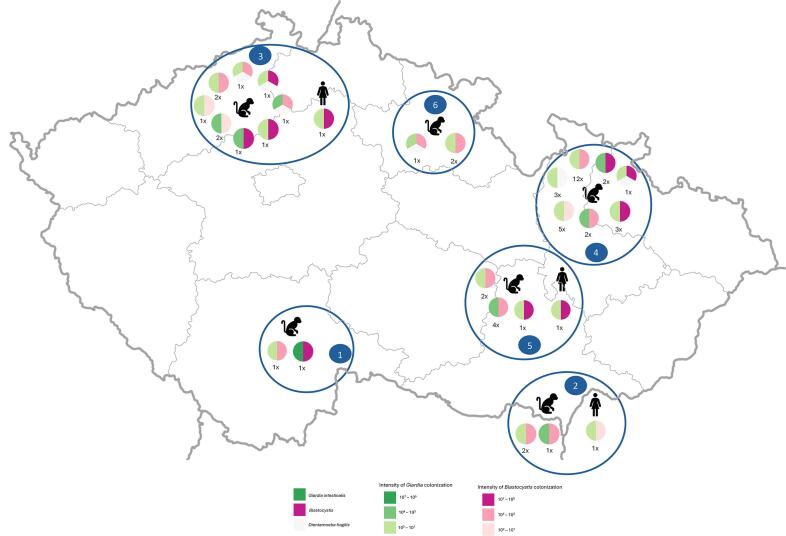 Figure 1
 Figure 2
Peer Reviews
No public reviews on file for this paper yet. If you reviewed it on a platform where reviews are public (OpenReview, ICLR, NeurIPS, ICML), you can paste yours below so the community can read it here.
Videos
No videos yet. Explain this paper in a talk, walkthrough, or lecture? Add one.
Taxonomy
TopicsParasitic Infections and Diagnostics · Amoebic Infections and Treatments · Parasites and Host Interactions