Closed-form spin-relativistic corrections from the Dirac equation enabling a modified Schrödinger solver
Mário B. Amaro, Nazeef, Camille J. Dussech, Chong Qi

TL;DR
This paper introduces a new method to include relativistic effects in quantum calculations using a modified Schrödinger equation, reducing computational costs.
Contribution
A novel closed-form framework for spin-relativistic corrections derived from the Dirac equation with an open-source solver.
Findings
A Schrödinger-like equation with spin–relativistic corrections was derived for general central potentials.
An open-source solver was developed to handle the quadratic eigenvalue problem from finite-difference discretization.
First-order corrections for energy and wavefunctions were obtained for harmonic oscillator and Coulomb potentials.
Abstract
We revisit the non-relativistic limit of the Dirac equation in finite scalar and vector potentials and derive a Schrödinger-like equation that retains leading spin–relativistic corrections in closed form. For general central potentials, we cast the radial equation into a quadratic eigenvalue problem (QEP) using a finite-difference discretization method and develop an open-source solver to address it. We study Coulomb, harmonic oscillator, Woods–Saxon, and Yukawa potentials. We further obtain first-order energy and wavefunction corrections for the three-dimensional isotropic harmonic oscillator and Coulomb potentials via perturbation theory. This framework provides a practical bridge between non-relativistic and fully relativistic treatments, enabling accurate quantification of relativistic effects without the computational cost of full four-component calculations.
Genes, proteins, chemicals, diseases, species, mutations and cell lines named across the full text — each resolved to its canonical identifier and authoritative record.
Click any figure to enlarge with its caption.
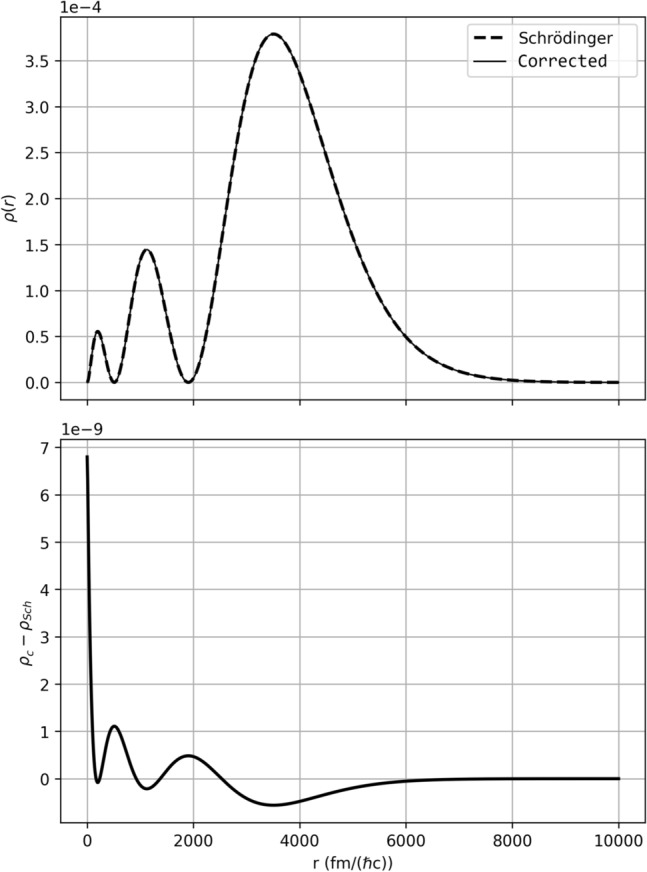 Figure 1
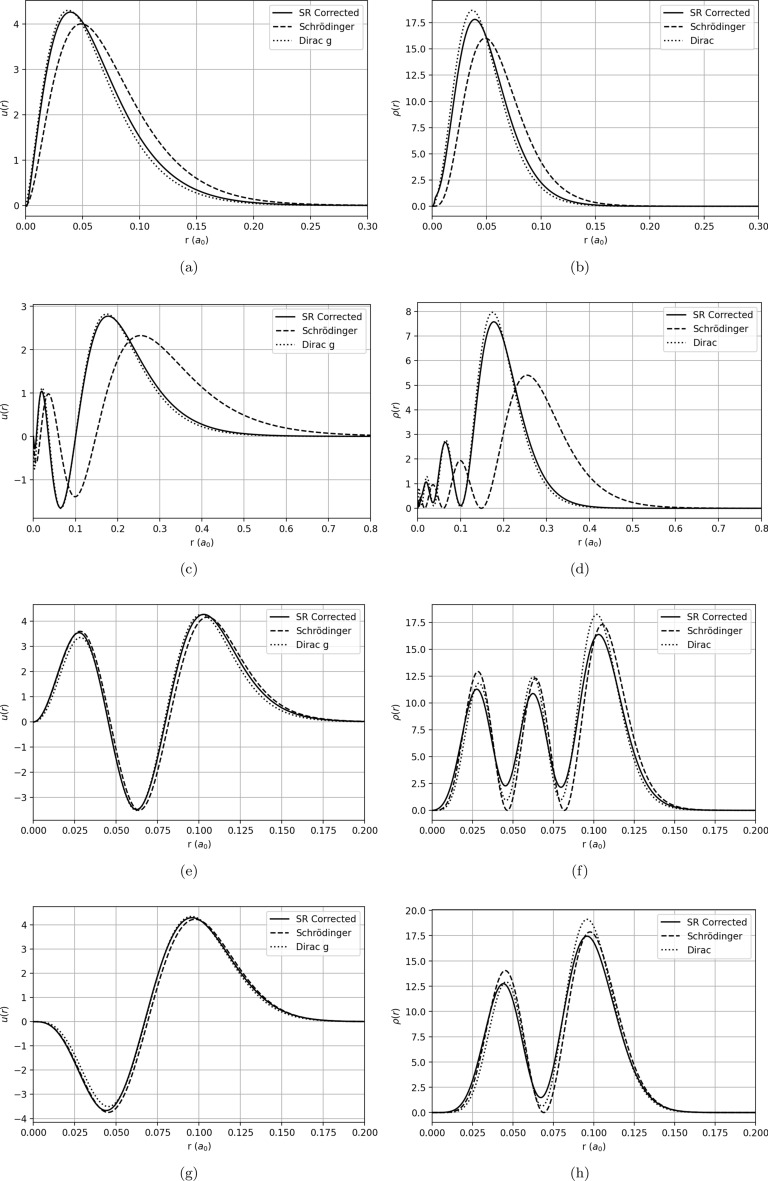 Figure 2
Peer Reviews
No public reviews on file for this paper yet. If you reviewed it on a platform where reviews are public (OpenReview, ICLR, NeurIPS, ICML), you can paste yours below so the community can read it here.
Videos
No videos yet. Explain this paper in a talk, walkthrough, or lecture? Add one.
Taxonomy
TopicsQuantum Mechanics and Non-Hermitian Physics · Atomic and Molecular Physics · Nuclear physics research studies