Single-capillary endothelial dysfunction resolved by optoacoustic mesoscopy
Hailong He, Angelos Karlas, Nikolina-Alexia Fasoula, Chiara Fischer, Ulf Darsow, Michael Kallmayer, Juan Aguirre, Hans-Henning Eckstein, Vasilis Ntziachristos

TL;DR
A new imaging technique called fRSOM enables detailed observation of microvascular endothelial function at the single capillary level, revealing disease-specific effects in smokers and CVD patients.
Contribution
The study introduces fast raster-scan optoacoustic mesoscopy (fRSOM) as a novel non-invasive method to resolve single-capillary endothelial dysfunction in vivo.
Findings
fRSOM revealed layer-specific effects of smoking and CVD on cutaneous endothelial function.
No structural microvascular changes were observed in smokers and CVD patients, suggesting MiVED is an earlier marker than morphological changes.
fRSOM outperforms traditional methods like laser Doppler flowmetry in resolving microvascular dysfunction.
Abstract
Microvascular endothelial dysfunction (MiVED) is an early marker of endothelial impairment, often preceding dysfunction in large arteries. Although MiVED assessment could reveal new insights into the pathophysiology of cardiovascular disease (CVD) or offer earlier detection and finer disease stratification, detailed in-vivo MiVED observation remains challenging due to a lack of suitable technologies. To address this gap, we hypothesized that accelerating ultra-wideband raster-scan optoacoustic mesoscopy (RSOM), i.e., fast RSOM (fRSOM), could resolve for the first time cutaneous MiVED features at single capillary resolution. We investigated whether we could record morphological features and dynamic responses during post-occlusive reactive hyperemia to achieve the most detailed observation of microvascular endothelial function to date. Our results show that using fRSOM on skin clearly…
Genes, proteins, chemicals, diseases, species, mutations and cell lines named across the full text — each resolved to its canonical identifier and authoritative record.
Click any figure to enlarge with its caption.
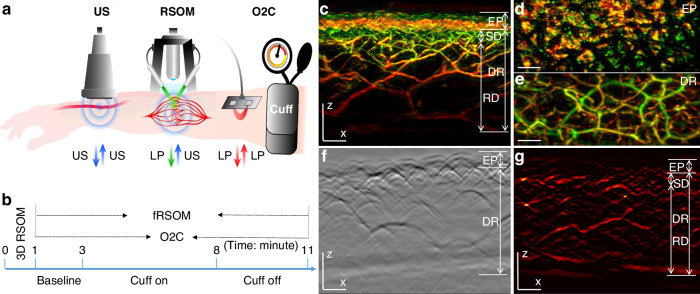 Figure 1
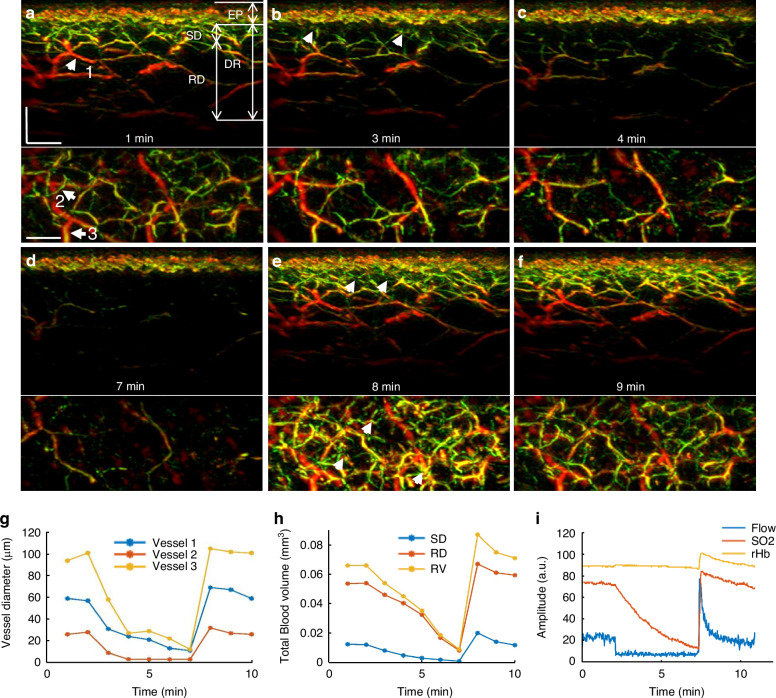 Figure 2
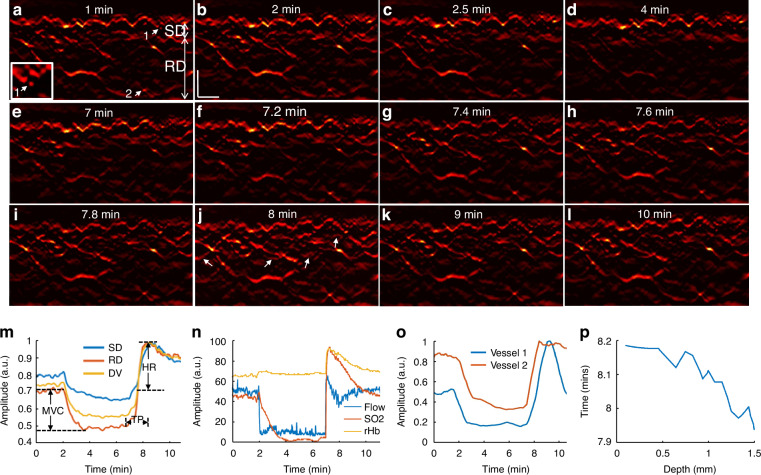 Figure 3
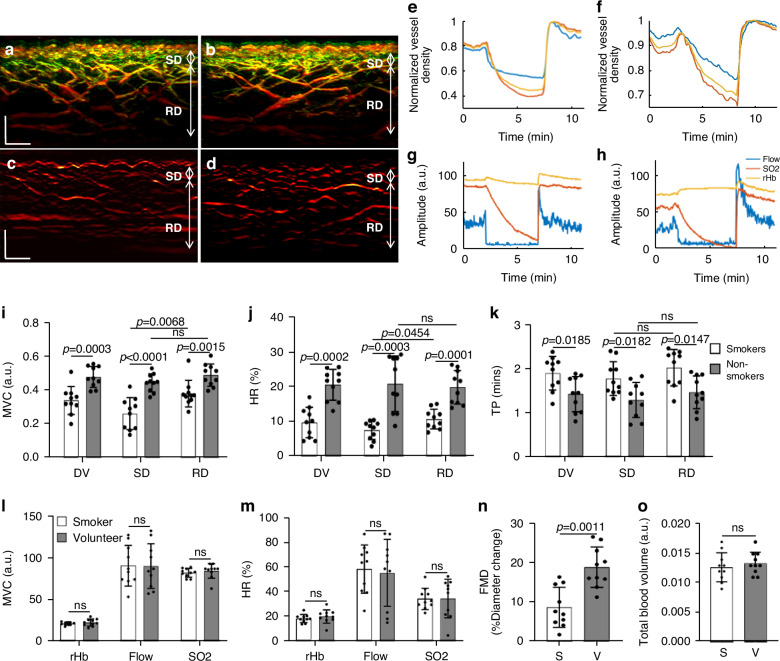 Figure 4
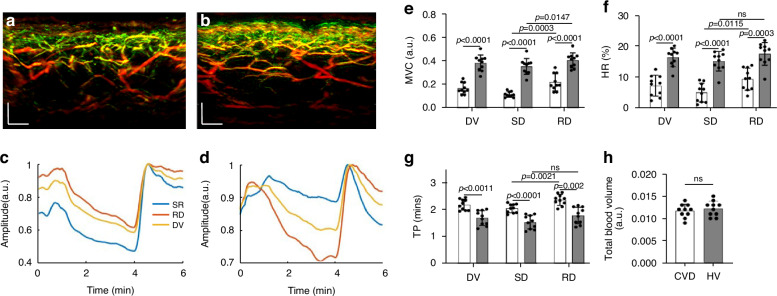 Figure 5
Peer Reviews
No public reviews on file for this paper yet. If you reviewed it on a platform where reviews are public (OpenReview, ICLR, NeurIPS, ICML), you can paste yours below so the community can read it here.
Videos
No videos yet. Explain this paper in a talk, walkthrough, or lecture? Add one.
Taxonomy
TopicsPhotoacoustic and Ultrasonic Imaging · Thermoregulation and physiological responses · Optical Coherence Tomography Applications