Demonstrating completeness in optical neural computing
Krzysztof Tyszka

TL;DR
This paper demonstrates a complete optical neural network using silicon photonics for fast and energy-efficient computing.
Contribution
The novel contribution is an integrated optical neural network with on-chip nonlinear activations for end-to-end inference.
Findings
The optical neural network uses partially coherent light for high-speed inference.
The system integrates convolutional and fully connected layers with optoelectronic nonlinear activations.
It provides a scalable platform for evaluating optical neural processing beyond traditional electronics.
Abstract
A silicon photonic deep optical neural network integrating convolutional and fully connected layers with on-chip optoelectronic nonlinear activations operates with partially coherent light to achieve high-speed, energy-efficient, end-to-end inference. This demonstration establishes a functional and scalable platform for evaluating complete optical neural processing, representing another step toward specialised, ultrafast photonic architectures beyond electronics.
Genes, proteins, chemicals, diseases, species, mutations and cell lines named across the full text — each resolved to its canonical identifier and authoritative record.
Click any figure to enlarge with its caption.
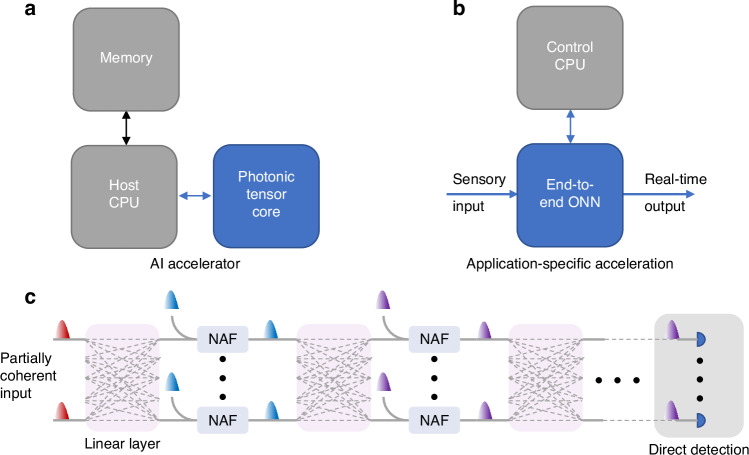 Figure 1
Peer Reviews
No public reviews on file for this paper yet. If you reviewed it on a platform where reviews are public (OpenReview, ICLR, NeurIPS, ICML), you can paste yours below so the community can read it here.
Videos
No videos yet. Explain this paper in a talk, walkthrough, or lecture? Add one.
Taxonomy
TopicsNeural Networks and Reservoir Computing · Photonic and Optical Devices · Advanced Memory and Neural Computing