Understanding water properties in tumorous murine cells using field-cycling NMR relaxometry
David Faux, Rémi Kogon, Janet Godolphin

TL;DR
This study uses a special type of magnetic resonance to detect differences in water properties between healthy and tumorous mouse cells, which could help assess tumor stages.
Contribution
The study introduces the use of field-cycling NMR relaxometry with the 3-Tau model to identify tumor-specific biomarkers based on water dynamics.
Findings
FFC NMR measurements can differentiate healthy and tumorous tissues based on frequency-dependent relaxation rates.
Two fit parameters from the 3-Tau model correlate significantly with tumor fraction and act as biomarkers.
Changes in water dynamics at solid surfaces are linked to differences in cell wall structure between healthy and pathological tissues.
Abstract
The fixed high magnetic fields (1–7 Tesla) used for magnetic resonance imaging produce resolution suitable for oncology but image contrast is insufficient to determine tumour stage. Fast field cycling nuclear magnetic resonance (FFC NMR) measurements spanning low fields (0.24 mT–0.24 T) provide frequency-dependent longitudinal relaxation rate \documentclass[12pt]{minimal} \usepackage{amsmath} \usepackage{wasysym} \usepackage{amsfonts} \usepackage{amssymb} \usepackage{amsbsy} \usepackage{mathrsfs} \usepackage{upgreek} \setlength{\oddsidemargin}{-69pt} \begin{document}\end{document} profiles which allow healthy and pathological tissue to be differentiated. In vivo FFC NMR measurements from healthy and tumorous murine tissue spanning a range of tumour fractions have been interpreted using the 3-Tau model (3TM). Each 3TM fit yields six…
Genes, proteins, chemicals, diseases, species, mutations and cell lines named across the full text — each resolved to its canonical identifier and authoritative record.
Click any figure to enlarge with its caption.
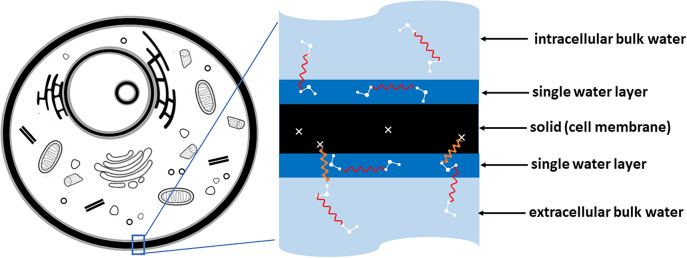 Figure 1
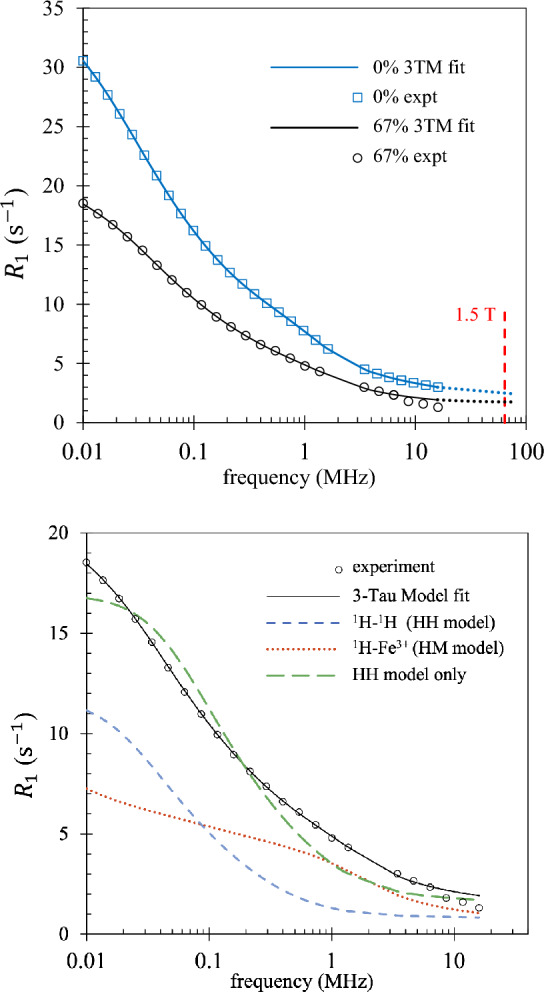 Figure 2
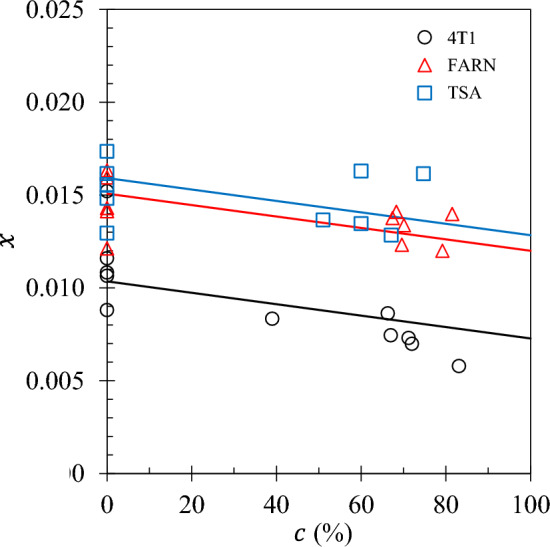 Figure 3
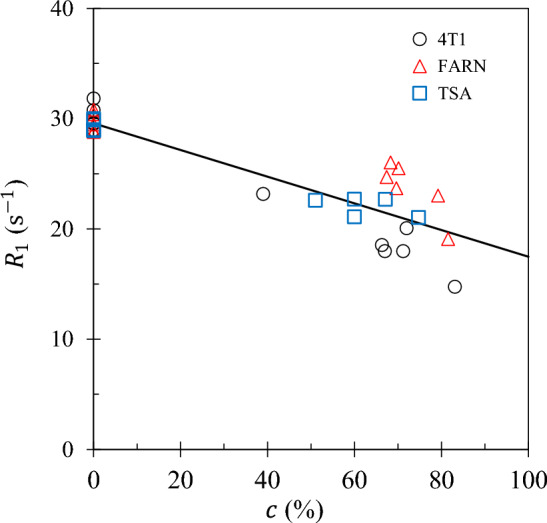 Figure 4
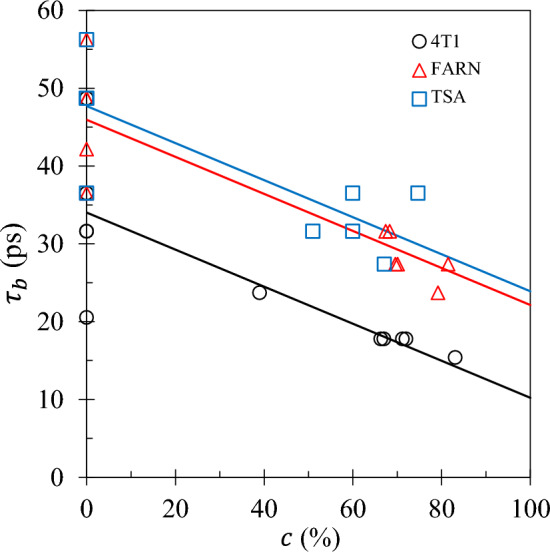 Figure 5
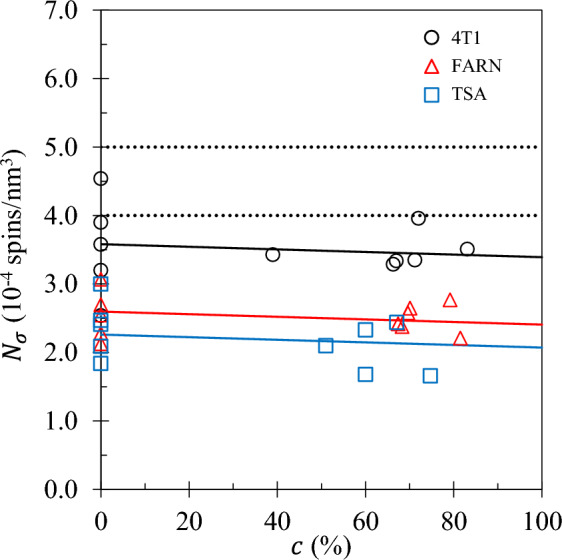 Figure 6
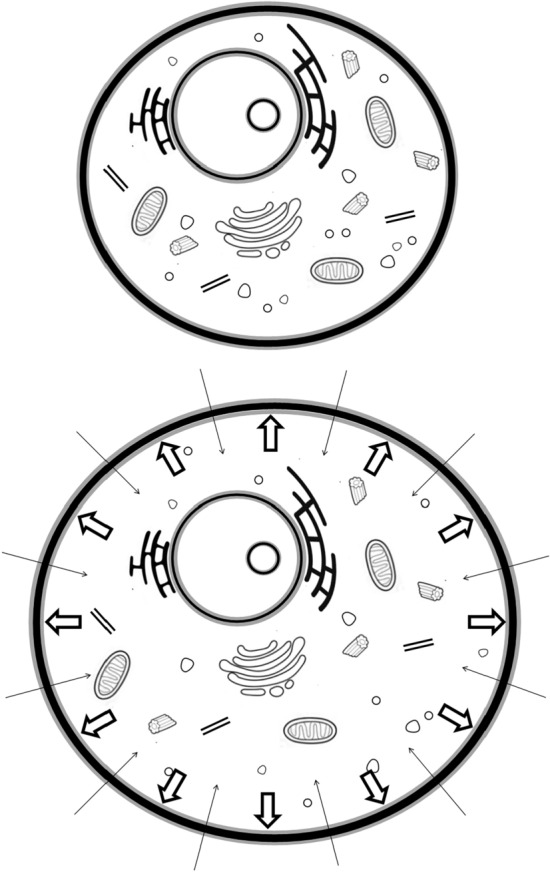 Figure 7
Peer Reviews
No public reviews on file for this paper yet. If you reviewed it on a platform where reviews are public (OpenReview, ICLR, NeurIPS, ICML), you can paste yours below so the community can read it here.
Videos
No videos yet. Explain this paper in a talk, walkthrough, or lecture? Add one.
Taxonomy
TopicsNMR spectroscopy and applications · Advanced MRI Techniques and Applications · MRI in cancer diagnosis