Programmable Bell state generation in an integrated thin film lithium niobate circuit
Andreas Maeder, Robert J. Chapman, Alessandra Sabatti, Giovanni Finco, Jost Kellner, Rachel Grange

TL;DR
This paper presents a reconfigurable quantum photonic circuit using lithium niobate to generate entangled photon pairs with high fidelity and brightness.
Contribution
The work introduces a programmable LNOI circuit that enables high-fidelity generation of Bell states with integrated photon pair sources.
Findings
The circuit achieves a source brightness of 26 MHz nm−1mW−1 with a coincidence-to-accidental ratio above 100.
Photon sources are interfered with 99.0 ± 0.7% visibility, demonstrating indistinguishability for entanglement.
Maximally entangled Bell states are prepared with fidelity above 90% using quantum state tomography.
Abstract
Entanglement is central to quantum technologies such as cryptography, sensing, and computing. Photon pairs generated via nonlinear optical processes are excellent for preparing entangled states due to their long coherence times and compatibility with fiber optic networks. Steady progress in nanofabrication has positioned lithium niobate-on-insulator (LNOI) as a leading platform for monolithic integration of photon pair sources into optical circuits, leveraging its strong second-order nonlinearity. Here, we present a reconfigurable photonic integrated circuit on LNOI, which combines two on-chip photon pair sources with programmable interferometers, enabling the generation of entangled states. The photon pair sources achieve a source brightness of 26 MHz nm−1mW−1 while maintaining a coincidence-to-accidental ratio above 100. We successfully interfere the two sources with 99.0 ± 0.7%…
Genes, proteins, chemicals, diseases, species, mutations and cell lines named across the full text — each resolved to its canonical identifier and authoritative record.
Click any figure to enlarge with its caption.
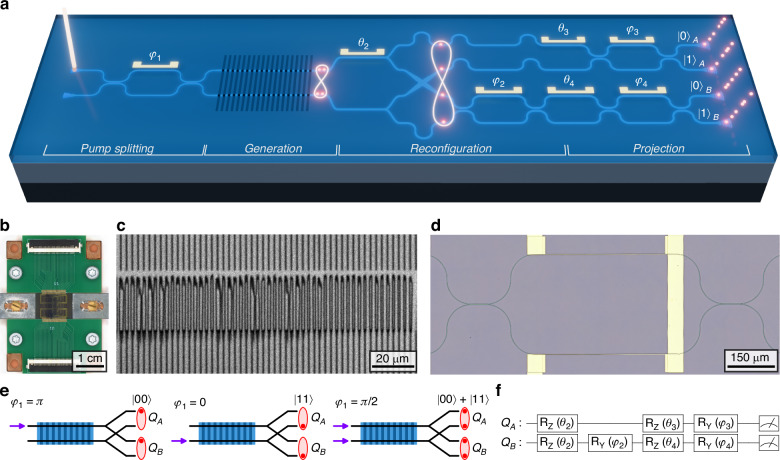 Figure 1
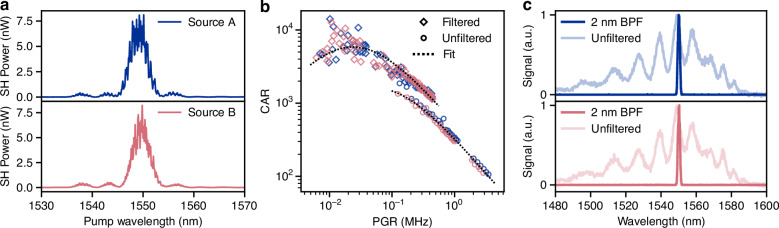 Figure 2
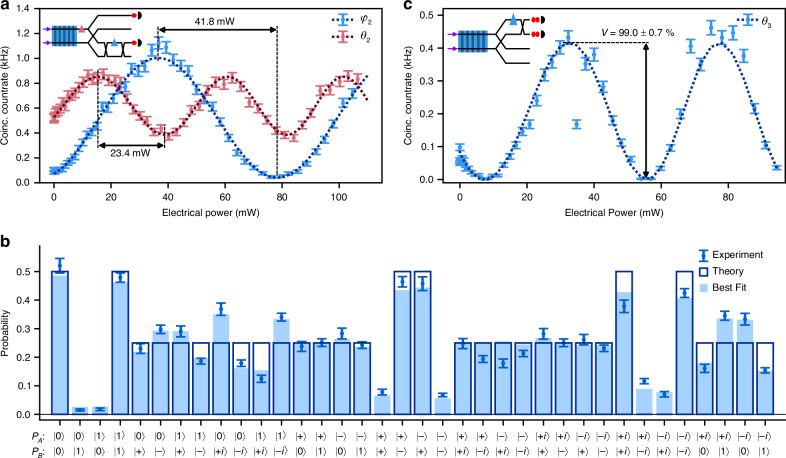 Figure 3
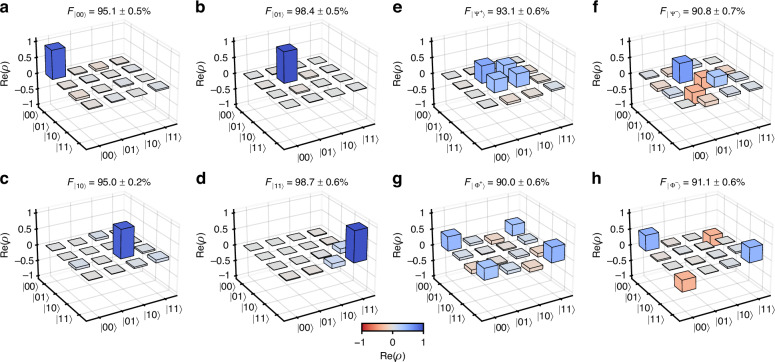 Figure 4
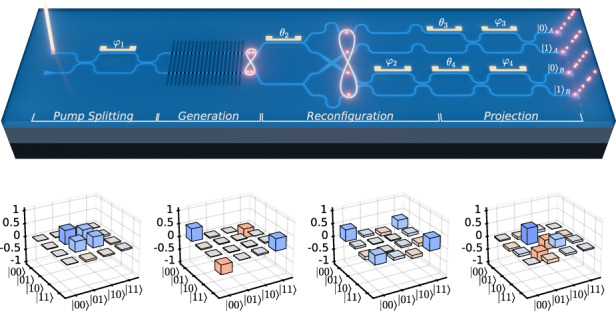 Figure 5
Peer Reviews
No public reviews on file for this paper yet. If you reviewed it on a platform where reviews are public (OpenReview, ICLR, NeurIPS, ICML), you can paste yours below so the community can read it here.
Videos
No videos yet. Explain this paper in a talk, walkthrough, or lecture? Add one.
Taxonomy
TopicsNeural Networks and Reservoir Computing · Photorefractive and Nonlinear Optics · Quantum Information and Cryptography