Early life group 2 innate lymphoid cells in health and disease
Claudia U. Duerr, Marcus A. Mall

TL;DR
This paper explores the role of group 2 innate lymphoid cells (ILC2s) in early life and their impact on health and disease.
Contribution
The paper provides a novel overview of ILC2s in childhood and adolescence, focusing on their modulation and clinical implications.
Findings
ILC2s are present early in life and can influence immune responses.
ILC2s contribute to tissue immunity and can modulate immune and non-immune cells.
The clinical implications of modulating ILC2s in early life are discussed.
Abstract
ILC2s are innate lymphoid cells that become activated by alarmins and are major producers of type 2 signature cytokines. In mice and human, ILC2s have been identified and characterized in several pre-clinical disease models and patients with a spectrum of diseases. Interest in the regulation and function of ILC2s has grown substantially in recent years due to their capability to act as first responders to external and internal stimuli and their contribution to tissue immunity in health and disease. Importantly, ILC2s are present early on during ontogeny, long lived and can orchestrate immune and non-immune cell populations highlighting their potential impact early and late in life. However, the impact of ILC2s is only starting to be appreciated in early life immune responses. Here, we provide an overview of ILC2s in childhood and adolescence in health and disease. We further discuss the…
Genes, proteins, chemicals, diseases, species, mutations and cell lines named across the full text — each resolved to its canonical identifier and authoritative record.
Click any figure to enlarge with its caption.
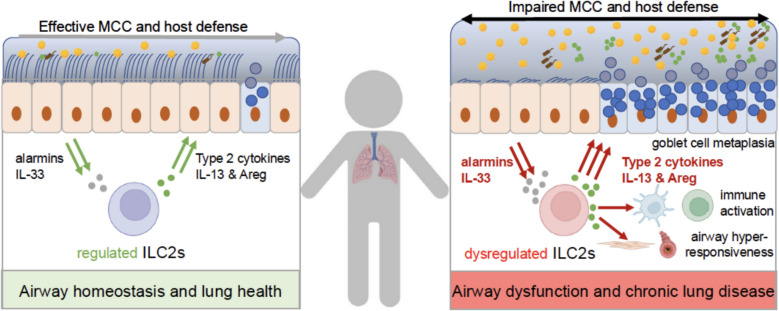 Figure 1
Peer Reviews
No public reviews on file for this paper yet. If you reviewed it on a platform where reviews are public (OpenReview, ICLR, NeurIPS, ICML), you can paste yours below so the community can read it here.
Videos
No videos yet. Explain this paper in a talk, walkthrough, or lecture? Add one.
Taxonomy
TopicsIL-33, ST2, and ILC Pathways · Eosinophilic Esophagitis · Immune Cell Function and Interaction