Can pain self-efficacy mediate the influence of pain intensity on outcomes for patients with musculoskeletal pain? A prospective mediation analysis with 12 months follow-up
Monica Unsgaard-Tøndel, Kari Anne I. Evensen, Nina Køpke Vøllestad, Hilde Stendal Robinson, Fredrik Granviken, Astrid Woodhouse, Ingebrigt Meisingset

TL;DR
This study found that pain self-efficacy slightly mediates the effect of pain intensity on outcomes for musculoskeletal pain patients, but the effect is not clinically significant.
Contribution
The study provides new evidence on the mediating role of pain self-efficacy in musculoskeletal pain outcomes over a 12-month period.
Findings
Pain self-efficacy had a statistically significant but not clinically meaningful mediating effect on health-related quality of life and function.
In patients with low pain self-efficacy, the mediating effect on patient-specific function was more pronounced.
The overall mediating effect of pain self-efficacy on outcomes was not considered clinically important.
Abstract
In longstanding pain, a core treatment aim is to minimize the effect of pain on health-related quality of life and patient-specific function. The study aim was to assess whether the effect of pain intensity on outcome is mediated through pain self-efficacy. A secondary aim was to assess the mediating effect of pain self-efficacy for a subgroup of patients with low pain self-efficacy. Prospective data of 422 patients with musculoskeletal pain seeking physical therapy was applied in analyses. The exposure was baseline pain intensity and outcomes were health-related quality of life (EQ-5D), patient-specific function (PSFS) and global perceived effect (GPE) at 12 months. The mediator was measured by the 2-item pain self-efficacy questionnaire (PSEQ-2) at baseline and 3 months. The mediating effect of pain self-efficacy on the relation between pain intensity and health-related quality of…
Genes, proteins, chemicals, diseases, species, mutations and cell lines named across the full text — each resolved to its canonical identifier and authoritative record.
Click any figure to enlarge with its caption.
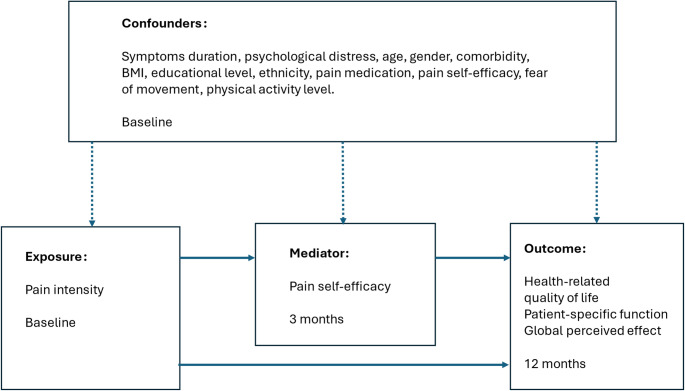 Figure 1
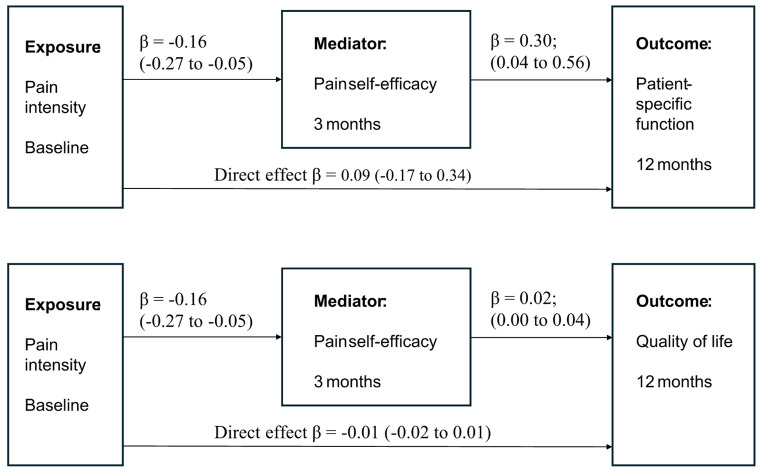 Figure 2
Peer Reviews
No public reviews on file for this paper yet. If you reviewed it on a platform where reviews are public (OpenReview, ICLR, NeurIPS, ICML), you can paste yours below so the community can read it here.
Videos
No videos yet. Explain this paper in a talk, walkthrough, or lecture? Add one.
Taxonomy
TopicsMusculoskeletal pain and rehabilitation · Pediatric Pain Management Techniques · Total Knee Arthroplasty Outcomes