Long-term outcome of catheter ablation of left fascicular ventricular arrhythmias
Ilaria My, Fabian Moser, Fabian W. Loeck, Julius Obergassel, Laura Rottner, Marc D. Lemoine, Paulus Kirchhof, Daniel Steven, Arian Sultan, Stephan Willems, Christian Meyer, Bruno Reissmann, Andreas Rillig, Andreas Metzner, Feifan Ouyang

TL;DR
This study examines the long-term success of catheter ablation for ventricular arrhythmias in the left ventricular conduction system in European patients.
Contribution
The study provides new clinical data on catheter ablation outcomes for left fascicular ventricular arrhythmias in a European cohort.
Findings
Ablation was acutely successful in 89% of patients with a median follow-up of 30 months.
Arrhythmia-free survival was 73% with few procedure-related complications.
Ventricular arrhythmias in the left posterior fascicle often presented as tachycardia, while those in the anterior fascicle were mostly PVCs.
Abstract
Due to their low prevalence in Europe, data on optimal treatment of ventricular arrhythmias (VAs) involving the left ventricular conduction system are scarce. To report on clinical and procedural characteristics and long-term outcomes of European patients undergoing catheter ablation of primary ventricular complexes (PVCs) and ventricular tachycardias (VTs) involving the left ventricular conduction system. This study includes 27 retrospectively identified Caucasian patients (10/27 (37%) women, median age 44.5 (IQR 33–55.75) who underwent electrophysiological examinations at a tertiary ablation center over a period of 14 years (between 2009 and 2022). Mapping and ablation were performed via transaortic and/or transseptal approach. Post-ablation follow-up (FU) was performed via regular Holter-ECGs and clinical evaluations, or via structured FU within the prospective TRUST registry…
Genes, proteins, chemicals, diseases, species, mutations and cell lines named across the full text — each resolved to its canonical identifier and authoritative record.
Click any figure to enlarge with its caption.
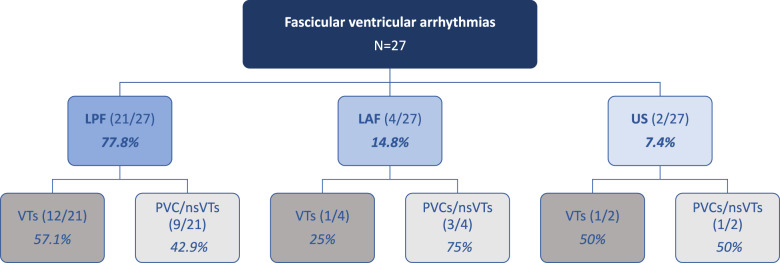 Figure 1
 Figure 2
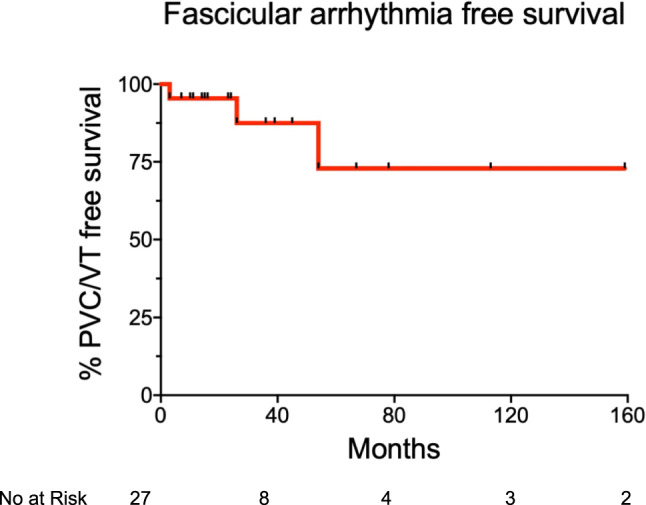 Figure 3
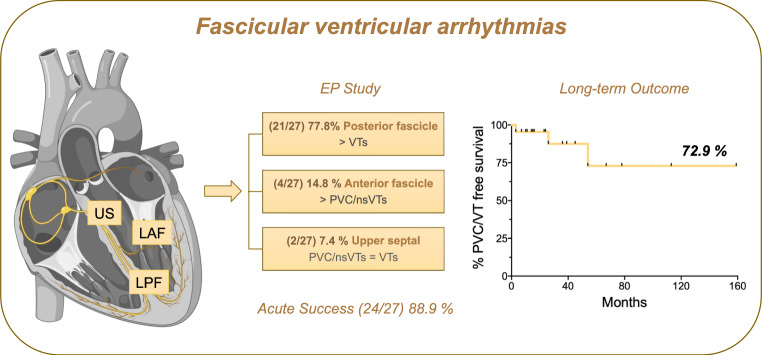 Figure 4
Peer Reviews
No public reviews on file for this paper yet. If you reviewed it on a platform where reviews are public (OpenReview, ICLR, NeurIPS, ICML), you can paste yours below so the community can read it here.
Videos
No videos yet. Explain this paper in a talk, walkthrough, or lecture? Add one.
Taxonomy
TopicsCardiac Arrhythmias and Treatments · Atrial Fibrillation Management and Outcomes · Cardiac electrophysiology and arrhythmias