Complete genome sequence of Arthrobacter globiformis bacteriophage Powelldog
Zeel Desai, Nathaniel Foret, Skylar L. Godwin, Harrison B. Huffmon, Joseph Y. Kim, Lily Y. McGuirt, Shamanasia A. Richardson, Jessica Robles Gonzalez, Daune Signorelli, Heven Siyum, Anngiselle Vallejo, Sarah R. Wigren, Sharon K. Bullock, Michelle B. Pass, Ellen M. Wisner

TL;DR
This paper presents the full genome sequence of a bacteriophage called Powelldog, isolated from soil and found to have a unique protein structure.
Contribution
The paper provides a new genome sequence with a unique putative major capsid protease fusion protein.
Findings
The Powelldog genome is 55,541 base pairs long.
It contains 91 putative protein-coding genes, all transcribed in one direction.
The genome encodes a unique putative major capsid protease fusion protein.
Abstract
Bacteriophage Powelldog, assigned to cluster AW, was isolated from dog park soil in Charlotte, NC, using the bacterial host Arthobacter globiformis NRRL B-2880. The genome is 55541 bps, containing 91 putative protein-coding genes. All genes are transcribed unidirectionally and the genome, interestingly, encodes a putative major capsid protease fusion protein.
Genes, proteins, chemicals, diseases, species, mutations and cell lines named across the full text — each resolved to its canonical identifier and authoritative record.
Click any figure to enlarge with its caption.
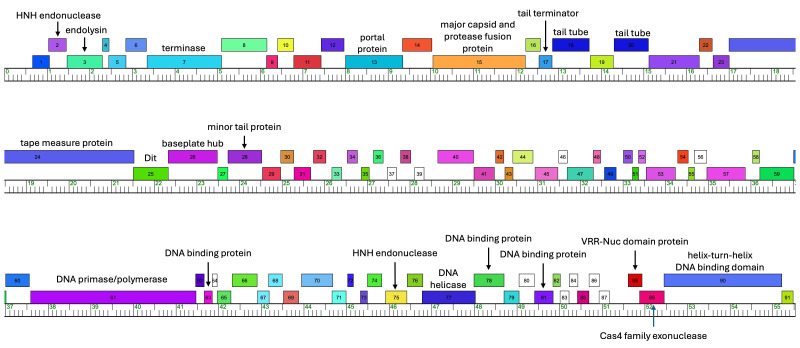 Figure 1
Peer Reviews
No public reviews on file for this paper yet. If you reviewed it on a platform where reviews are public (OpenReview, ICLR, NeurIPS, ICML), you can paste yours below so the community can read it here.
Videos
No videos yet. Explain this paper in a talk, walkthrough, or lecture? Add one.
Taxonomy
TopicsBacteriophages and microbial interactions · Genomics and Phylogenetic Studies · Enzyme Production and Characterization
Description
Bacteriophages are highly abundant viruses that infect bacteria and are actively being developed as therapeutics for treating antibiotic-resistant bacterial infections (Kasman & Porter 2022). Importantly,
- Arthrobacter * strains have been implicated in clinical cases (Busse et al. 2015). We present the annotated genome sequence of the bacteriophage Powelldog.
Powelldog was isolated from soil collected near a dog park in Charlotte, North Carolina, USA (GPS coordinates: 30.29016 N, 80.74992 W). The soil sample was washed in PYCa (peptone, yeast extract, calcium) liquid medium, the wash filtered (0.22 um pore size), and the filtrate inoculated with Arthrobacter globiformis NRRL B-2880 and allowed to incubate at 30˚C for 48 hours. The resulting culture was then spun and refiltered before the filtrate was plated in PYCa top agar with A. globiformis and incubated at 30˚C to observe for the presence of phage via plaque formation (Zorawik et al. 2024). Powelldog formed tiny, clear plaques 0.50 - 1.1 mm (n=10) in diameter, and was purified through two rounds of plating.
Genomic DNA was isolated from a lysate of Powelldog using the Promega Wizard DNA Cleanup kit, prepared for sequencing using the NEB Ultra II Library kit, and sequenced using an Illumina NextSeq 1000 XLEAP-P1 kit. This yielded 2,829,918 100-base single-end reads, generating 4,839-fold coverage. Reads were trimmed with Cutadapt 4.7 (using the option: –nextseq-trim 30) and filtered with Skewer 0.2.2 (using the options: -q 20 -Q 30 -n -l 50) prior to assembly, then assembled and checked for completeness using Newbler (v2.9) (Miller et al. 2010) and Consed (v29) (Gordon et al. 1998; Russell 2018), respectively, with default parameters. This resulted in a genome that is 55,541 base pairs long and ends in a 9 bp long 3’ single-stranded overhang (CGCCGCTCC). The genome has a 51.7% GC content, which falls within the GC content range of 47.6-70.4%, found in phages that infect A.
- globiformis * NRRL B-2880 (Russell & Hatfull 2017). Powelldog was assigned to cluster AW due to sharing greater than 35% gene content similarity to other cluster members in the Actinobacteriophage database (Pope et al. 2017; Russell & Hatfull 2017).
Glimmer v3.02 (Delcher et al. 2007) and GeneMark v2.5 (Besemer and Borodovsky 2005) were used to auto-annotate the genome. DNA Master v5.23.6 (cobamide2.bio.pitt.edu), Phamerator using Actino_draft database v596 (Cresawn et al. 2011), Starterator v596 (http://phages.wustl.edu/starterator/), BLASTp v2.16.0 using the Actinobacteriophage and NCBI non-redundant database (Altschul et al. 1990), DeepTMHMM v1.0.42 (Hallgren et al. 2022), and HHPred (Söding 2005) using PDB_mmCIF70_30_Mar, Pfam-A_v37, NCBI_Conserved_Domains (CD)_v3.19, and UniProt-SwissProt-viral70_3_Nov_2021 were used to verify the genes, their starts, and their functions. Default settings were used for all software. Ninety-one putative genes were found, of which sixty genes could not be assigned a function, and no tRNAs were identified using tRNAscanSE 2.0 (Lowe & Eddy 1997).
Powelldog, like the other 20 members of the *Arthrobacter * phage cluster AW to-date, has all identified genes transcribed unidirectionally. Assigned putative functions include multiple structure and assembly proteins. A frameshift typical of phage genes encoding the tail assembly chaperones could not be identified in Powelldog. Other notable functions include an endolysin and DNA metabolism functions such DNA helicase and Cas4 family exonuclease. Powelldog contained 10 orphams, which are genes that do not have known homologs (Figure 1; Cresawn et al. 2011). No immunity repressor or integrase functions could be identified, suggesting Powelldog is unlikely to establish lysogeny.
Nucleotide sequence accession numbers
Powelldog is available at GenBank with Accession No. PV876981 and Sequence Read Archive (SRA) No. SRX27501636.
The reference list from the paper itself. Each links out to its DOI / PubMed record.
- 1Altschul Stephen F. Gish Warren Miller Webb Myers Eugene W. Lipman David J. 1990101 Basic local alignment search tool Journal of Molecular Biology 21530022-283640341010.1016/s 0022-2836(05)80360-22231712 · doi ↗ · pubmed ↗
- 2Besemer J. Borodovsky M. 200571 Gene Mark: web software for gene finding in prokaryotes, eukaryotes and viruses Nucleic Acids Research 33Web Server 0305-1048 W 451W 45410.1093/nar/gki 48715980510 PMC 1160247 · doi ↗ · pubmed ↗
- 3Busse Hans‐Jürgen Wieser Monika Buczolits Sandra 2015318 Arthrobacter Bergey's Manual of Systematics of Archaea and Bacteria 17010.1002/9781118960608.gbm 00118 · doi ↗
- 4Cresawn SG Bogel M Day N Jacobs-Sera D Hendrix RW Hatfull GF 20111012 Phamerator: a bioinformatic tool for comparative bacteriophage genomics.BMC Bioinformatics 1239539510.1186/1471-2105-12-39521991981 PMC 3233612 · doi ↗ · pubmed ↗
- 5Delcher Arthur L. Bratke Kirsten A. Powers Edwin C. Salzberg Steven L. 2007119 Identifying bacterial genes and endosymbiont DNA with Glimmer Bioinformatics 2361367-481167367910.1093/bioinformatics/btm 00917237039 PMC 2387122 · doi ↗ · pubmed ↗
- 6Gordon David Abajian Chris Green Phil 199831 Consed: A Graphical Tool for Sequence Finishing Genome Research 831088-905119520210.1101/gr.8.3.1959521923 · doi ↗ · pubmed ↗
- 7Hallgren Jeppe Tsirigos Konstantinos D. Pedersen Mads Damgaard Almagro Armenteros José Juan Marcatili Paolo Nielsen Henrik Krogh Anders Winther Ole 2022410 Deep TMHMM predicts alpha and beta transmembrane proteins using deep neural networks 10.1101/2022.04.08.487609 · doi ↗
- 8Kasman LM Porter LD 202511 Bacteriophages.29630237 · pubmed ↗