First photographic evidence of the Egyptian fruit bat, Rousettus aegyptiacus (Pteropodidae) in the King Salman Bin Abdulaziz Royal Nature Reserve, Hail Region, Saudi Arabia
Mohammed Bakri, Mohammad Abdulhakeem, Abdulrahman Alasiri, Tariq Aloufi, Noorah Al-Sowayan, Barry W. Brook, Noorah Al-Sowayan, Maya M Juman, Noorah Al-Sowayan

TL;DR
Researchers found and photographed Egyptian fruit bats in a new area of Saudi Arabia, showing they live in arid regions.
Contribution
This is the first photographic evidence of Rousettus aegyptiacus in the King Salman Bin Abdulaziz Royal Nature Reserve.
Findings
More than 50 Egyptian fruit bats were observed roosting in a rock crevice.
The species' presence is confirmed in a previously unrecorded region of Saudi Arabia.
The findings highlight the need for further surveys to understand the species' distribution in arid habitats.
Abstract
This study aimed to document the occurrence of the Egyptian fruit bat Rousettus aegyptiacus in King Salman Bin Abdulaziz Royal Nature Reserve (KSRNR), Hail region, Saudi Arabia, where its presence had not previously been confirmed. Field surveys were conducted in the Hail region, and direct observations were documented using photographic evidence. Bats roosting in a natural crevice were photographed and assessed for colony size. More than 50 individuals, including adults and juveniles, were observed roosting in a rock crevice. The photographic documentation confirms the presence of a stable colony of R. aegyptiacus in this area, extending the known distribution of the species into a previously unrecorded region of Saudi Arabia. These findings provide the first photographic record of R. aegyptiacus in KSRNR and highlight the species’ ecological adaptation to arid habitats. The results…
Genes, proteins, chemicals, diseases, species, mutations and cell lines named across the full text — each resolved to its canonical identifier and authoritative record.
Click any figure to enlarge with its caption.
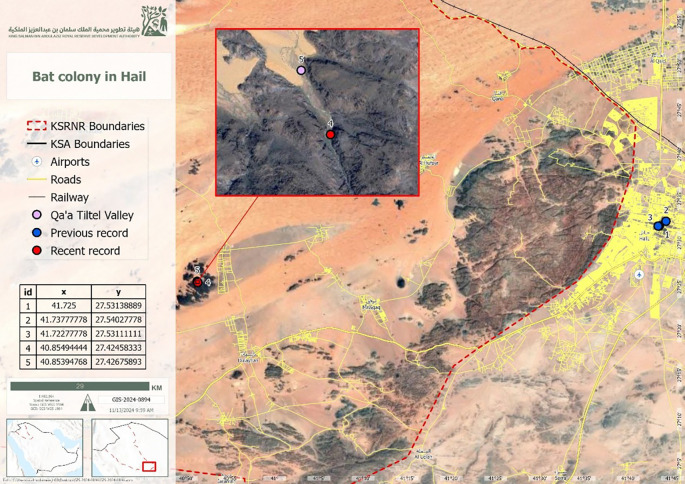 Figure 1
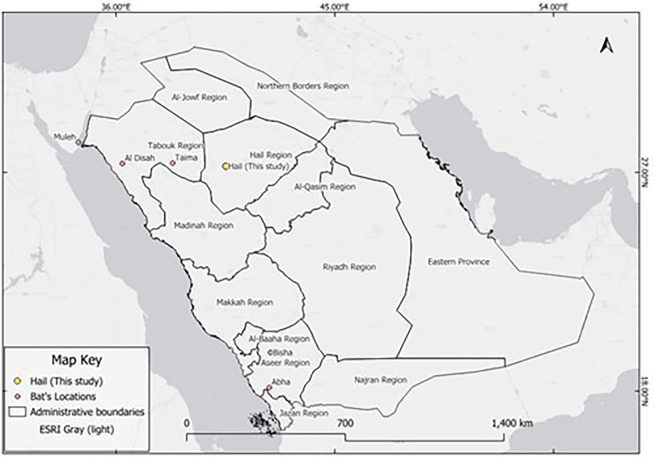 Figure 2
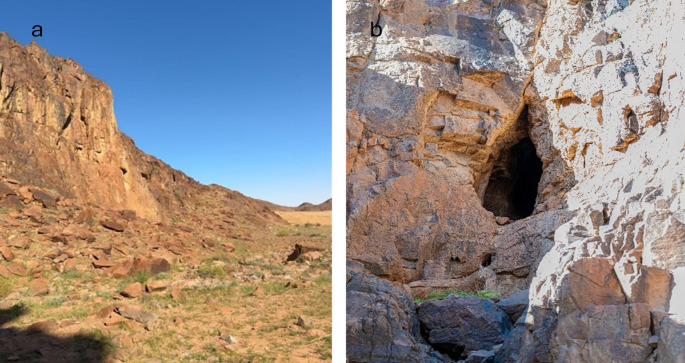 Figure 3
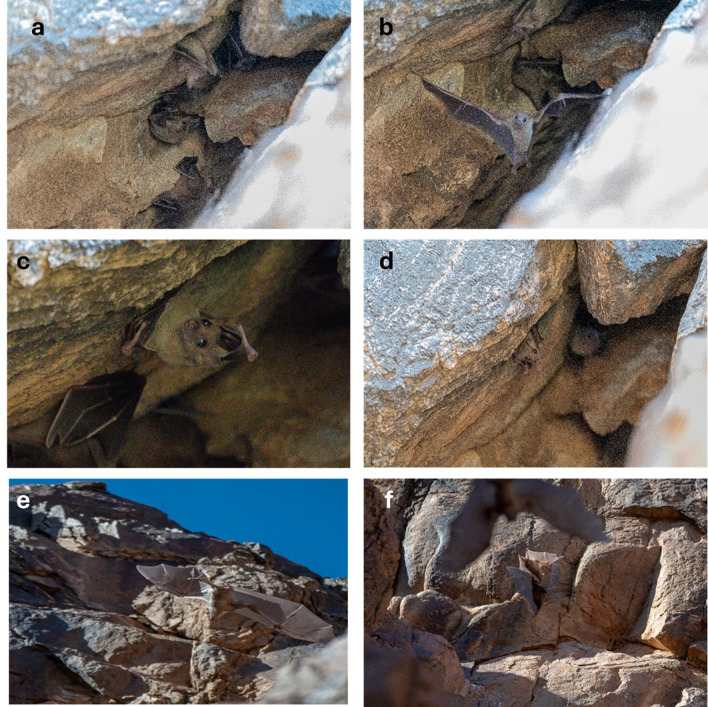 Figure 4
| Observation Date | 31 March 2024 |
| Time | 10:00 AM |
| Location | Qa’a Tiltel, Hail Region |
| Coordinates | 27°25′28.5″N, 40°51′17.8″E |
| Habitat Type | Mountain crevice in semi-desert landscape |
| Number of Individuals | >50 individuals |
| Evidence | Photographic and Video |
| Location | Latitude (N) | Longitude (E) | Reference |
|---|---|---|---|
| Taima | 27.6 | 38.6 |
|
| Al Disah | 28.7 | 36.3 |
|
| Muleh | 28.2 | 35.9 |
|
| Hail (New) | 27.42 | 40.85 | This study |
| Bisha | 19.98 | 42.59 |
|
| Abha | 18.23 | 42.51 |
|
Peer Reviews
No public reviews on file for this paper yet. If you reviewed it on a platform where reviews are public (OpenReview, ICLR, NeurIPS, ICML), you can paste yours below so the community can read it here.
Videos
No videos yet. Explain this paper in a talk, walkthrough, or lecture? Add one.
Taxonomy
TopicsBat Biology and Ecology Studies · Species Distribution and Climate Change · Wildlife Ecology and Conservation
Introduction
The Egyptian fruit bat Rousettus aegyptiacus (Geoffroy, 1810), is a frugivorous bat species widely distributed across the Afro-Palearctic region. ^ 1, 2 ^ In Saudi Arabia, its confirmed presence has been reported primarily in the southwestern and northwestern parts of the country, including records from Bisha, ^ 3 ^ Abha, ^ 4 ^ Taima, Al Disah, and Muleh. ^ 5 ^ Although some recent studies have extended this range, ^ 6, 7 ^ there remains a gap in verified documentation from desert ecosystems in north-central Saudi Arabia.
King Salman Bin Abdulaziz Royal Nature Reserve (KSRNR) spans semi-arid and mountainous landscapes that provide potential roosting and feeding sites for chiropteran species. ^ 8, 9 ^ The Aja Mountains in the Hail region, characterized by rocky outcrops and sparse vegetation, may represent suitable bat habitats that are yet to be explored. Bats, particularly those in the order Chiroptera, play crucial ecological roles and are highly sensitive to environmental changes. ^ 10 ^
This study presents the first photographic record of R. aegyptiacus in the KSRNR, confirming its presence in Hail and filling a notable gap in the known range. We discuss the potential ecological relevance of this finding and its implications for conservation and biodiversity monitoring in arid zones of Saudi Arabia.
Methods and materials
Study area
The Hail region is situated on an extensive plateau overlying the Precambrian Arabian Shield, a complex geological formation comprising igneous and metamorphic rock units that exhibit diverse topographic and geomorphic characteristics. ^ 11 ^ The study was conducted in the Qa’a Tiltel Valley (27°25′28.5″ N, 40°51′17.8″ E) ( Figure 1), on the western side of Al-Khabbah. The area is characterized by mountainous terrain and semi-desert isolation, and stands out in the landscape as gravelly and sparsely vegetated, dominated by Haloxylon salicornicom and Malva parviflora, making it an ideal niche for many animal species ( Figure 1).
Map of the King Salman Bin Abdulaziz Royal Nature Reserve, Hail Region, showing the study site.
Techniques employed
A comprehensive survey was conducted on March 31, 2024, at 9:00 am to document the presence of R. aegyptiacus in the study area. The survey included photographing the bats and recording a video using a Nikon Z5II camera with a 200-600 mm telephoto lens. This equipment allowed for detailed observation of R. aegyptiacus from a safe distance, capturing important features and behaviors. The video also enabled researchers to count the number of individuals that emerged from the cave, thereby providing visual evidence to confirm the presence of the species at the site.
Results
On March 31, 2024, at approximately 10:00 AM, a roosting colony of over 50 Rousettus aegyptiacus individuals was observed and documented in a mountain crevice in the Qa’a Tiltel area, located within the southern section of the Hail Region at 27°25′28.5″N, 40°51′17.8″E. This location falls within the protected boundaries of King Salman Bin Abdulaziz Royal Nature Reserve (KSRNR) ( Table 1).
Table 1.: Summary of Rousettus aegyptiacus observation in Hail Region.
The bats roost in a fissure at the base of a rocky hill within a semi-desert landscape sparsely vegetated with Haloxylon salicornicum and Malva parviflora. This microhabitat provides shelter and minimal disturbance, which is suitable for bat colonization.
Photographic and video documentation confirmed identification based on morphology: large body size, strong limbs, short fur with greyish-brown dorsal and ventral coloring, and yellowish markings in some individuals. Juveniles are distinguishable by their lighter color and sparse hair. ^ 12 ^ The colony generally exhibited calm behavior with occasional flights in response to disturbances.
In addition to the new Hail record, six confirmed occurrences of Rousettus aegyptiacus have been documented in Saudi Arabia, as shown in ( Table 2 and Figure 2). These include records from the northern and southern parts of the country based on photographic evidence and published reports. The distribution of R. aegyptiacus records across Saudi Arabia is shown in Figure 2.
Table 2.: Confirmed records of Rousettus aegyptiacus in Saudi Arabia with coordinates and references.
Map showing confirmed records of Rousettus aegyptiacus in Saudi Arabia. Red dots indicate locations with confirmed observations based on photographic or published records.
The bat colony was observed in a mountain crevice at 10:00 on March 31, 2024, southern Qa’a Tiltel in the Hail region, containing over 50 bat individuals, which were identified as R. aegyptiacus the roost was active inside the cave. A few bats exhibited signs of alertness during random flights, and we attempted to photograph them repeatedly.
The roost was located in a fissure near the bottom of the hill ( Figure 3a and b). Moreover, the video recordings and photos were sufficient, large, robust bats with well-developed feet, and a strong thump. The fur is short, the dorsal and ventral sides are uniformly gray or brownish colored, and the belly and throat in some individuals are yellowish. Juveniles are gray and more sparsely haired than adults. ^ 12 ^ Photographic evidence of R. aegyptiacus in the Hail region ( Figure 4a– f ) (Video 1). R. aegyptiacus was active in the cave, with some showing attentiveness and erratic flights. This discovery provides important evidence of the presence of species in this area.
(a) Entrance of the cave (image extracted from Video S2). (b) Detailed view of the cave entrance showing the roosting site and colony of R. aegyptiacus recorded in the Hail region (captured by Mohammed Bakri).
(a–f ) Different individuals of Egyptian fruit bat ( R. aegyptiacus) observed on 31 March 2024 (captured by Mohammed Bakri).
Supplementary material
A short video clip (Video S1) showing active individuals of Rousettus aegyptiacus within the cave in Qa’a Tiltel is provided as a supplementary material. The footage supports photographic documentation and confirms the roost activity in the area. And Short video (Video S2) of the roost entrance (still image used for Figure 3a).
Discussion
This report presents the first confirmed photographic evidence of the Egyptian fruit bat Rousettus aegyptiacus within the King Salman Bin Abdulaziz Royal Nature Reserve (KSRNR) in the Hail region. Although earlier surveys documented this species in neighboring areas, including Taima, Al Disah, and Muleh, ^ 5 ^ and more recently in other parts of Hail, ^ 7 ^ these records were either anecdotal or lacked detailed visual verification. This record fills a critical gap by visually confirming the presence of a stable roosting colony within the boundaries of a major conservation area.
R. aegyptiacus is known for its adaptability to diverse environments, from humid forests to arid and semiarid zones. ^ 1, 5, 13, 14 ^ Its ability to exploit rocky crevices and caves in dry mountainous areas reflects broader ecological flexibility than previously assumed. Although Harrison and Bates ^ 15 ^ and Bergmans ^ 16 ^ provided a foundational understanding of the species’ range, recent findings, including those by Benda et al. ^ 7 ^ and Al Obaid et al., ^ 6 ^ suggested a significant extension of its known habitat, particularly in less-explored northern regions.
The photographic and video documentation in this study adds empirical support to Abu Yaman’s early report by Hail, ^ 17 ^ validating historical data and establishing a visual benchmark for future surveys. This visual confirmation strengthens the case when considering the region as a part of the active range of R. aegyptiacus.
Further studies are needed to explore other potential roosting sites within the KSRNR, including the unexplored caves and valleys. Regular ecological surveys combined with acoustic monitoring and roost counts are crucial for assessing seasonal movement patterns, reproductive status, and interspecies interactions among local bat communities. Such data are essential to understand the conservation value of desert-protected areas for volant mammals.
Conclusion
Photographic documentation of *Rousettus aegyptiacus *in the King Salman Bin Abdulaziz Royal Nature Reserve (KSRNR) represents a significant record of the biodiversity of arid zones in Saudi Arabia. This confirmation of a stable colony in the Hail region expands the known geographic range of the species and emphasizes the ecological value of the KSRNR.
This finding supports earlier undocumented sightings in the region and underscores the importance of incorporating visual and photographic verification into biodiversity monitoring. As arid environments face increasing pressure from habitat loss and climate change, conservation of species such as R. aegyptiacus requires continuous ecological research and adaptive management strategies.
We recommend initiating systematic surveys across the reserve to identify additional roosting sites and monitor the population health. Integrating local communities and relevant stakeholders into awareness and conservation programmes is critical. Protecting keystone species such as R. aegyptiacus contributes to broader ecosystem sustainability goals in Saudi Arabia.
The recommendations are to conduct more thorough surveys to determine the distribution of R. aegyyeptiacus throughout various areas of Saudi Arabia in order to obtain higher data rates for this species for better understanding and conservation at the country level and in the entire Arabian Peninsula region. Furthermore, long-term monitoring programs for the population trends and habitat selection of this species have been conducted. Working with local communities and key stakeholders is critical for creating awareness, which helps them to engage in conservation initiatives. Finally, initiatives geared toward the conservation of the Egyptian fruit bat also serve broader purposes in supporting biodiversity and maintaining desert ecosystem sustainability within Saudi territory.
Ethics statement
This study was purely observational and did not involve capture, handling, disturbance, or experimental manipulation of animals. Permission to conduct observations within the King Salman Bin Abdulaziz Royal Nature Reserve was obtained from the Reserve authorities. Therefore, separate ethical approval was not required. The bats were observed and photographed from a distance in their natural habitat without any interference.
The reference list from the paper itself. Each links out to its DOI / PubMed record.
- 1IUCN: Rousettus aegyptiacus. The IUCN Red List of Threatened Species 2020: e.T 29730 A 22043105. 2020. Retrieved November 11, 2024. Reference Source
- 2Benda P Abi-Said M Bartonička T : Rousettus aegyptiacus (Pteropodidae) in the Palaearctic: list of records and revision of the distribution range. Vespertilio. 2011;15(1):3–36.
- 3Memish ZA Mishra N Olival KJ : Middle East respiratory syndrome coronavirus in bats, Saudi Arabia. Emerg. Infect. Dis. 2013;19(11):1819–1823. 10.3201/eid 1911.131172 24206838 PMC 3837665 · doi ↗ · pubmed ↗
- 4El-Mansi AA Al-Kahtani MA Abumandour MM : Comparative phenotypic and structural adaptations of tongue and gastrointestinal tract in two bats having different feeding habits captured from Saudi Arabia: Egyptian fruit bat (Rousettus aegyptiacus) and Egyptian tomb bat (Taphozous perforatus). Zool. Anz. 2019;281:24–38. 10.1016/j.jcz.2019.05.005 · doi ↗
- 5Aloufi A Amr Z Nassarat H : Bats (Mammalia: Chiroptera) from Tabuk Province, Saudi Arabia. Vertebr. Zool. 2016;66:207–215. 10.3897/vz.66.e 31554 · doi ↗
- 6Al Obaid A Shuraim F Al Boug A : Diversity and conservation of bats in Saudi Arabia. Diversity. 2023;15(6):700. 10.3390/d 15060700 · doi ↗
- 7Benda P Reiter A Uhrin M : On the distribution of the Egyptian Fruit Bat Rousettus aegyptiacus in Saudi Arabia (Mammalia: Chiroptera). Zool. Middle East. 2023;69(4):299–308. 10.1080/09397140.2023.2266911 · doi ↗
- 8Alshammari AM Ibnrahim AA : Amphibians of the Ha’il region, Saudi Arabia, with special reference to their habitat and distribution. Adv. Biores. 2018;9(1):165–172.