Cyclophosphamide for the Treatment of Refractory Immune Effector Cell-Associated Neurotoxicity Syndrome Following CD19-Targeted CAR T-Cell Therapy
Austin Frisch, Loren Marino, Deena Alsaadi, Aditya Kasarabada, Gwen Hua, Germame Ajebo, Stephen Medlin, Zartash Gul

TL;DR
A patient with severe neurotoxicity from CAR-T therapy recovered after low-dose cyclophosphamide, suggesting it could be a new treatment option.
Contribution
Demonstrates cyclophosphamide's potential as a treatment for steroid-refractory ICANS following CAR-T therapy.
Findings
A 51-year-old patient with grade 4 ICANS recovered after low-dose cyclophosphamide.
Corticosteroids, anakinra, and intrathecal chemotherapy failed to alleviate the patient's neurotoxicity.
The case suggests cyclophosphamide may preserve CAR-T function while mitigating ICANS.
Abstract
Immune effector cell-associated neurotoxicity syndrome (ICANS) is a serious complication of chimeric antigen receptor T-cell (CAR-T) therapy, associated with significant morbidity and mortality. While corticosteroids and anakinra are cornerstones of treatment, a subset of patients develop severe, steroid-refractory ICANS, highlighting a critical need for more effective therapies. We present the case of a 51-year-old male with relapsed/refractory Philadelphia chromosome-positive (Ph+) B-cell acute lymphoblastic leukemia (B-ALL) who developed grade 4 ICANS following brexucabtagene autoleucel CAR-T therapy. His neurotoxicity was refractory to high-dose corticosteroids, anakinra, and intrathecal chemotherapy. Following administration of low-dose cyclophosphamide (375 mg/m2), patient achieved full neurological recovery. This case suggests that earlier, lower-dose cyclophosphamide may be an…
Genes, proteins, chemicals, diseases, species, mutations and cell lines named across the full text — each resolved to its canonical identifier and authoritative record.
Click any figure to enlarge with its caption.
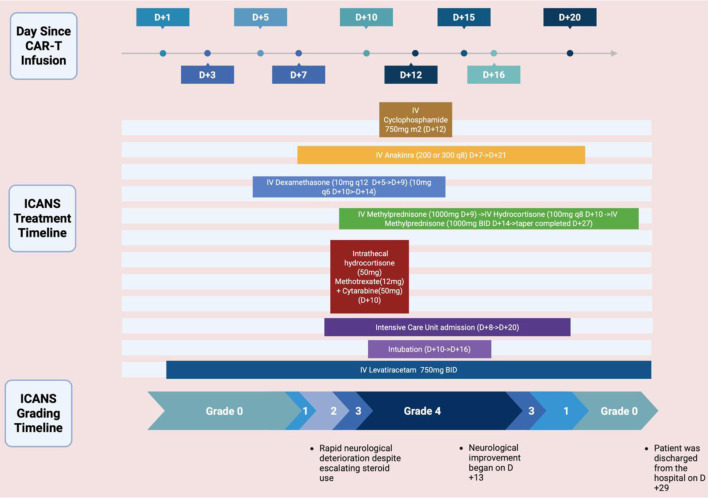 Figure 1
Peer Reviews
No public reviews on file for this paper yet. If you reviewed it on a platform where reviews are public (OpenReview, ICLR, NeurIPS, ICML), you can paste yours below so the community can read it here.
Videos
No videos yet. Explain this paper in a talk, walkthrough, or lecture? Add one.
Taxonomy
TopicsCAR-T cell therapy research · Acute Lymphoblastic Leukemia research · Genetic Neurodegenerative Diseases
Introduction
Chimeric antigen receptor T-cell (CAR-T) therapy has revolutionized the treatment of relapsed and/or refractory hematologic malignancies [1, 2]. However, its efficacy is counterbalanced by unique toxicities, primarily cytokine release syndrome (CRS) and immune effector cell-associated neurotoxicity syndrome (ICANS) [3, 4]. ICANS management remains challenging; despite a multidisciplinary approach and standard immunosuppression with corticosteroids and anakinra, outcomes for severe, refractory cases are poor, leading to prolonged hospitalization, permanent neurological damage, and high mortality [5]. This underscores an urgent need for more effective treatment strategies. The evidence for salvage therapies is limited to small series and case reports. We present a case of severe, steroid-refractory ICANS successfully treated with lower-dose cyclophosphamide, resulting in rapid and complete neurological recovery. We emphasize how lower-dose cyclophosphamide is not only novel but may offer a safety advantage over prior salvage regimens for patients suffering from ICANS.
Case Report
Investigations
A 51-year-old male with relapsed/refractory Ph+ B-ALL, previously treated with tyrosine kinase inhibitors and a pediatric-inspired regimen, was admitted for brexucabtagene autoleucel dosed at 8.8 × 10^7^/kg. His pre-infusion workup revealed minimal residual disease (MRD) positivity without central nervous system (CNS) involvement. Lymphodepletion was performed with fludarabine and cyclophosphamide per standard protocol.
On day +5, he developed grade 1 CRS (fever to 39.1 °C). This progressed to grade 2 (hypotension responsive to fluids) on day +6, managed with three doses of tocilizumab. On day +7, he developed expressive aphasia and handwriting changes (immune effector cell-associated encephalopathy (ICE) score 9/10, grade 2 ICANS), which rapidly deteriorated to agraphia and acalculia (ICE score 6/10). He was transferred to the intensive care unit (ICU) for continuous electroencephalogram (EEG) monitoring and management. Brain magnetic resonance imaging (MRI) showed no acute abnormalities.
Despite initiation of high-dose glucocorticoid and anakinra, his ICANS progressed to grade 4 by day +10, necessitating elective intubation for agitation and to facilitate a diagnostic lumbar puncture. Cerebrospinal fluid (CSF) analysis showed mild lymphocytic pleocytosis (white blood cell (WBC) 13/mm^3^), elevated protein (67 mg/dL), and normal glucose. All infectious studies (culture, polymerase chain reaction (PCR), cytology) were negative. Intrathecal methotrexate 12 mg, cytarabine 50 mg, and hydrocortisone 50 mg were administered as the third line of treatment.
Workup and diagnosis
The leading diagnosis was severe, steroid-refractory ICANS, with alternative considerations including CNS infection. CSF studies, including Gram stain, culture, meningitis and encephalitis panels, cryptococcal antigen, and mycobacterial PCR, were all negative. Flow cytometry and cytology of the CSF revealed no evidence of malignant cells. The patient was at increased risk for ICANS due to preceding CRS and the type of CAR-T product he received. Both initial and repeat brain MRI 9 days later showed no acute abnormalities. Continuous EEG monitoring demonstrated no evidence of seizure activity.
Treatment and outcomes
Due to refractory grade 4 ICANS, intravenous cyclophosphamide (375 mg/m^2^) was administered on day +12. Within 24 h, the patient’s mental status began to improve. He was successfully extubated on day +16 and achieved full neurological recovery by day +19. High-dose corticosteroids were tapered off by day +27 without rebound neurotoxicity. Figure 1 outlines the timeline of this case.
Timeline of the case including treatments administered and ICANS grading. Created in BioRender. https://BioRender.com/6uhz4jb
Discussion
ICANS is a potentially life-threatening complication of CAR-T therapy. This syndrome typically manifests within the first 1 - 2 weeks post-infusion, often coinciding with or shortly following the peak of CRS [6]. A meta-analysis from 2024 encompassing 75 trials and over 3,000 patients reported a pooled ICANS incidence of approximately 27% and a severe ICANS incidence of about 10%, with considerable variation across CAR T-cell products and patient populations [7]. Anti-CD19 constructs, particularly those with CD28 costimulatory domains, consistently show higher rates of both all-grade and high-grade ICANS than anti-B-cell maturation antigen (anti-BCMA) constructs. The clinical presentation of ICANS is remarkably heterogeneous, ranging from subtle cognitive deficits, such as impaired attention, dysgraphia, and mild expressive aphasia, to severe and life-threatening complications including global aphasia, seizures, obtundation, cerebral edema, and, in rare instances, coma [8]. Motor findings such as tremor, dysmetria, or myoclonus may also occur [8]. The patient described in this report exhibited a classic progression of these symptoms, beginning with agitation and handwriting changes and rapidly advancing to grade 4 ICANS. ICANS after CAR-T therapy is driven by a combination of disease, treatment, and patient-related risk factors. Severe or early onset CRS as well as high tumor burden are two of the strongest predictors of ICANS [9, 10]. Patient-related risk factors such as age, performance status, pre-existing neurological disease, and coagulopathy also increase vulnerability [11]. Treatment with a higher CAR-T cell dose, rapid CAR-T expansion, and constructs with CD28 co-stimulatory domains, such as brexucabtagene autoleucel, all put patients at increased risk for ICANS [10]. CD28-based CAR T cells expand more rapidly and produce a more intense cytokine surge, leading to greater endothelial activation and blood-brain barrier disruption. Regarding this case, the major risk factors for this patient were his development of CRS and the type of CAR-T cell product received.
The diagnostic approach to ICANS aims to both grade the severity and rule out differential diagnoses such as infectious encephalitis, metabolic encephalopathy, or disease progression. The ICE score is a standardized tool for bedside assessment of cognitive function [12]. Further workup typically includes EEG, which may reveal non-specific findings like generalized slowing or, less commonly, seizure activity; neuroimaging with MRI, which is often unremarkable in early stages but may show signs of edema or leukoencephalopathy in severe cases; and CSF analysis, which frequently demonstrates a mild lymphocytic pleocytosis and elevated protein, serving primarily to exclude other etiologies.
The management of ICANS is stratified based on the severity of the presentation, as outlined by consensus guidelines [12]. For grade 1 ICANS, supportive care and close monitoring are often sufficient. Grade 2 or higher typically necessitates the initiation of corticosteroids, with dexamethasone being a common first-line choice. High-grade ICANS (grades 3-4) constitute a medical emergency, requiring management in an intensive care unit, escalation to high-dose intravenous corticosteroids (e.g., methylprednisolone 1 - 2 mg/kg/day), and seizure prophylaxis.
A critical nuance in management is the limited role of tocilizumab in isolated ICANS; while paramount for treating systemic CRS, its large molecular size impedes CNS penetration, and its use can paradoxically elevate circulating interleukin-6 (IL-6) levels, which may potentially exacerbate neuroinflammation [12]. For cases refractory to initial steroid therapy, treatment options are less defined and are based on limited evidence. Options with emerging but limited evidence include the IL-1 receptor antagonist anakinra, the IL-6 ligand inhibitor siltuximab, and intrathecal chemotherapy [12]. New lines of treatment targeting endothelial activation and earlier IL-1 blockade are under active investigation to reduce the need for prolonged steroid exposure [13]. The absence of a robust, evidence-based standard of care for steroid-refractory ICANS represents a significant unmet need and is associated with high morbidity and mortality.
The use of cyclophosphamide in this context is supported by its mechanism as an alkylating agent, which targets proliferating immune cells implicated in the inflammatory cascade of ICANS. Cyclophosphamide is a cost-effective and widely available agent, offering a practical alternative to more expensive or less accessible therapies such as siltuximab and ruxolitinib, particularly in urgent or resource-limited settings. Existing literature on its use is limited to case reports, where it is typically employed as a salvage therapy at high doses (e.g., 750 to 1.5 g/m^2^) with associated risks of significant cytopenias and infectious complications [14]. Lower dosing may help mitigate the cytotoxic effects of cyclophosphamide, reducing lymphocyte depletion and thereby maintaining CAR-T persistence and function. By dampening the overactive immune response and reducing cytokine-driven endothelial activation, cyclophosphamide may help restore blood-brain barrier integrity and mitigate CNS inflammation [15]. This observation is consistent with other reports indicating that CAR-T populations may persist despite cyclophosphamide exposure [14].
Our patient had a remarkable recovery once 375 mg/m^2^ of cyclophosphamide was given despite numerous days of extended steroids, anakinra, and intrathecal chemotherapy. This case contributes to the emerging evidence on management strategies for steroid-refractory ICANS. The successful outcome with lower-dose cyclophosphamide suggests that earlier intervention at a moderated dose may be a viable therapeutic option, balancing efficacy with a potentially improved safety profile.
Conclusion
This is a rare case report detailing the successful use of a much lower-dose cyclophosphamide for refractory ICANS in a patient with Ph+ B-ALL. This case highlights that cyclophosphamide, administered earlier in the treatment algorithm, can achieve rapid neurological resolution with a manageable safety profile. It offers a promising, practical, and cost-effective salvage strategy that may help preserve CAR-T therapy. Further prospective studies are needed to validate these findings and define the optimal dosing and timing for cyclophosphamide in the management of ICANS.
Learning points
Severe, refractory ICANS is a neurological emergency that can lead to rapid clinical deterioration and death. The current management relies on steroids that induce immunosuppression while putting the patient at risk for other side effects. Cyclophosphamide is emerging as an option for severe ICANS that is resistant to steroid therapy and this case was a success story on its implementation. More research and data are needed for better treatment options and guidelines for this dangerous complication of CAR-T therapy, but the novelty and possible safety advantages of using low-dose cyclophosphamide to treat refractory ICANS hold promise.
The reference list from the paper itself. Each links out to its DOI / PubMed record.
- 1June CH Sadelain M Chimeric antigen receptor therapy N Engl J Med 20183791647310.1056/NEJ Mra 170616929972754 PMC 7433347 · doi ↗ · pubmed ↗
- 2Cappell KM Kochenderfer JN Long-term outcomes following CAR T cell therapy: what we know so far Nat Rev Clin Oncol 202320635937110.1038/s 41571-023-00754-137055515 PMC 10100620 · doi ↗ · pubmed ↗
- 3Shimabukuro-Vornhagen A Godel P Subklewe M Stemmler HJ Schlosser HA Schlaak M Kochanek Met al Cytokine release syndrome J Immunother Cancer 2018615610.1186/s 40425-018-0343-929907163 PMC 6003181 · doi ↗ · pubmed ↗
- 4Gust J Taraseviciute A Turtle CJ Neurotoxicity associated with CD 19-targeted CAR-T cell therapies CNS Drugs 201832121091110110.1007/s 40263-018-0582-930387077 PMC 7295115 · doi ↗ · pubmed ↗
- 5Wehrli M Gallagher K Chen YB Leick MB Mc Afee SL El-Jawahri AR De Filipp Zet al Single-center experience using anakinra for steroid-refractory immune effector cell-associated neurotoxicity syndrome (ICANS)J Immunother Cancer 2022101 e 00384710.1136/jitc-2021-00384734996813 PMC 8744112 · doi ↗ · pubmed ↗
- 6Bangolo A Amoozgar B Mansour C Zhang L Gill S Ip A Cho C Comprehensive review of early and late toxicities in CAR T-cell therapy and bispecific antibody treatments for hematologic malignancies Cancers (Basel)202517228210.3390/cancers 1702028239858064 PMC 11764151 · doi ↗ · pubmed ↗
- 7Han MW Jeong SY Suh CH Park H Guenette JP Huang RY Kim K Wet al Incidence of immune effector cell-associated neurotoxicity among patients treated with CAR T-cell therapy for hematologic malignancies: systematic review and meta-analysis Front Neurol 202415139283110.3389/fneur.2024.139283139474369 PMC 11518750 · doi ↗ · pubmed ↗
- 8Grant SJ Grimshaw AA Silberstein J Murdaugh D Wildes TM Rosko AE Giri S Clinical presentation, risk factors, and outcomes of immune effector cell-associated neurotoxicity syndrome following chimeric antigen receptor T cell therapy: a systematic review Transplant Cell Ther 202228629430210.1016/j.jtct.2022.03.00635288347 PMC 9197870 · doi ↗ · pubmed ↗