Functional neurological disorder: an evolutionary perspective
Akihiro Nishi, Jon Stone

Abstract
Genes, proteins, chemicals, diseases, species, mutations and cell lines named across the full text — each resolved to its canonical identifier and authoritative record.
Click any figure to enlarge with its caption.
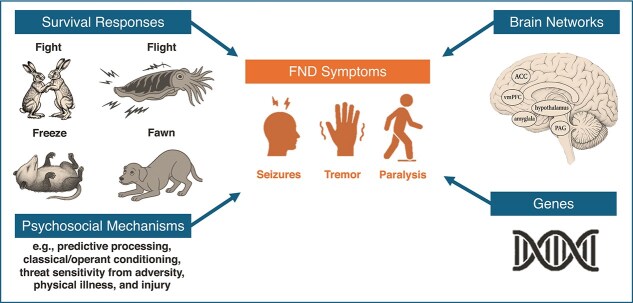 Figure 1
Peer Reviews
No public reviews on file for this paper yet. If you reviewed it on a platform where reviews are public (OpenReview, ICLR, NeurIPS, ICML), you can paste yours below so the community can read it here.
Videos
No videos yet. Explain this paper in a talk, walkthrough, or lecture? Add one.
Taxonomy
TopicsPsychosomatic Disorders and Their Treatments · Obsessive-Compulsive Spectrum Disorders · Fibromyalgia and Chronic Fatigue Syndrome Research
Functional neurological disorder (FND) is among the commonest disorders in neurological practice with an estimated prevalence of 80–140 per 100 000 individuals and a female predominance of ~70% [1]. It is characterized by symptoms involving an excess or decrease in voluntary movement or sensory pathways such as seizures, paralysis, tremor, and visual loss leading to disability and distress [1]. FND has been documented worldwide since antiquity [1, 2]. Formerly known as hysteria and conversion disorder, FND lies at the neurology-psychiatry interface and has long been stigmatized and neglected. In recent years, the field has undergone a renaissance, with a growing consensus that FND has characteristic clinical features that allow a rule-in diagnosis [2].
Magnetic resonance imaging (MRI) and other investigations are typically normal, but functional MRI and neurophysiological studies shed light on new underlying mechanisms of FND [1, 3]. At the brain network level, data suggest a breakdown in communication between the recently evolved prefrontal cortex and more conserved brain regions like amygdala, periaqueductal gray (PAG), and insula, governing threat detection. FND symptoms are hypothesized to arise from mismatches between predicted and ‘bottom-up’ sensory experience, with associated disruption in sense of agency (the feeling that one has initiated and is in control of one’s own movements and their outcomes) [1, 3]. This pattern is distinct from feigning [2]. Psychosocial mechanisms—sometimes related to stress and past adversity—also play an important role in many people with FND.
Some studies have explored genes potentially involved in FND (e.g. TPH2 in the serotonin pathway) [4]. In addition, many common FND comorbidities such as anxiety and nociplastic pain (pain from chronic alteration of central nervous system processing, not from inflammation or injury [5]) have a strong genetic basis. However, genome-wide association studies specific to FND are lacking, and there is no evidence that any gene involved in FND has undergone a selective sweep (a sign of past natural selection).
The reference list from the paper itself. Each links out to its DOI / PubMed record.
- 1Hallett M, Aybek S, Dworetzky BA et al. Functional neurological disorder: new subtypes and shared mechanisms. Lancet Neurol 2022;21:537–50. 10.1016/s 1474-4422(21)00422-135430029 PMC 9107510 · doi ↗ · pubmed ↗
- 2Edwards MJ, Yogarajah M, Stone J. Why functional neurological disorder is not feigning or malingering. Nat Rev Neurol 2023;19:246–56. 10.1038/s 41582-022-00765-z 36797425 · doi ↗ · pubmed ↗
- 3Kozlowska K, Scher S. Recent advances in understanding the neurobiology of pediatric functional neurological disorder. Expert Rev Neurother 2024;24:497–516. 10.1080/14737175.2024.233339038591353 · doi ↗ · pubmed ↗
- 4Asadi-Pooya AA, Hallett M, Mirzaei Damabi N et al. Genetics of functional seizures; a scoping systematic review. Genes (Basel) 2023;14:1537 10.3390/genes 14081537 PMC 1045445637628589 · doi ↗ · pubmed ↗
- 5Fillingim M, Tanguay-Sabourin C, Parisien M et al. Biological markers and psychosocial factors predict chronic pain conditions. Nat Hum Behav 2025;9:1710–25. 10.1038/s 41562-025-02156-y 40355673 PMC 12367528 · doi ↗ · pubmed ↗
- 6Schneider G, Levin L, Herskovitz M. Psychogenic nonepileptic seizures: are they a freeze reaction? Epilepsy Behav 2022;129:108655. 10.1016/j.yebeh.2022.10865535299088 · doi ↗ · pubmed ↗
- 7Roelofs K . Freeze for action: neurobiological mechanisms in animal and human freezing. Philos Trans R Soc Lond Ser B Biol Sci 2017;372:20160206. 10.1098/rstb.2016.020628242739 PMC 5332864 · doi ↗ · pubmed ↗
- 8Lopresti-Goodman SM, Bezner J, Ritter C. Psychological distress in chimpanzees rescued from laboratories. J Trauma Dissociation 2015;16:349–66. 10.1080/15299732.2014.100367325893315 · doi ↗ · pubmed ↗