The role of lipids in the effect of APOE2 on cognitive function: a causal mediation analysis
Qingyan Xiang, Judith J. Lok, Nicole Roth, Stacy L. Andersen, Thomas T. Perls, Zeyuan Song, Anatoli I. Yashin, Jonas Mengel-From, Gary J. Patti, Paola Sebastiani

TL;DR
This study explores how specific lipid molecules mediate the effect of the APOE2 gene variant on cognitive function, identifying potential therapeutic targets.
Contribution
The study identifies seven lipid species that mediate the protective and harmful effects of APOE2 on cognitive performance.
Findings
APOE2 carriers performed the Clock Drawing Test faster than APOE3 carriers.
Two lipids (CE 18:3 and TG 56:5) protectively mediated APOE2's effect on cognitive function.
TG 56:4 had a deleterious effect, increasing ink-time in the test.
Abstract
Extensive research has examined the direct effect of APOE alleles on cognitive decline. However, there is limited investigation into the effect of APOE that is explained or mediated through molecular pathways, such as lipids. In this study, we performed a causal mediation analysis to estimate both the direct effect of APOE2 and its indirect effect through 24 lipid species on cognitive function, measured from the digital Clock Drawing Test (CDT) in 1228 Long Life Family Study (LLFS) participants. Results showed that APOE2 carriers completed the CDT significantly faster compared to common APOE3 carriers. Primary analysis identified two lipids (CE 18:3 and TG 56:5) protectively mediated the effect of APOE2 on cognitive function, resulting in shorter CDT think-time, ink-time, and total-time; conversely, TG 56:4 deleteriously mediated the effect of APOE2, resulting in increased ink-time.…
Genes, proteins, chemicals, diseases, species, mutations and cell lines named across the full text — each resolved to its canonical identifier and authoritative record.
Click any figure to enlarge with its caption.
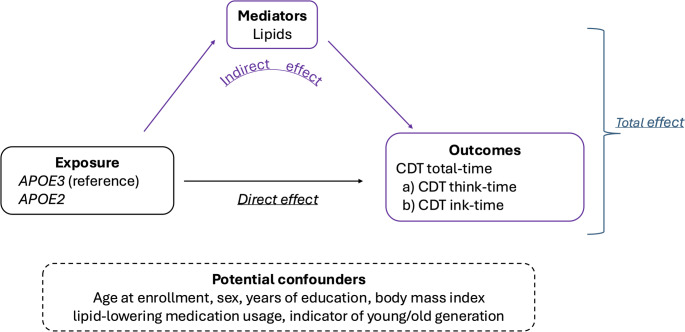 Figure 1
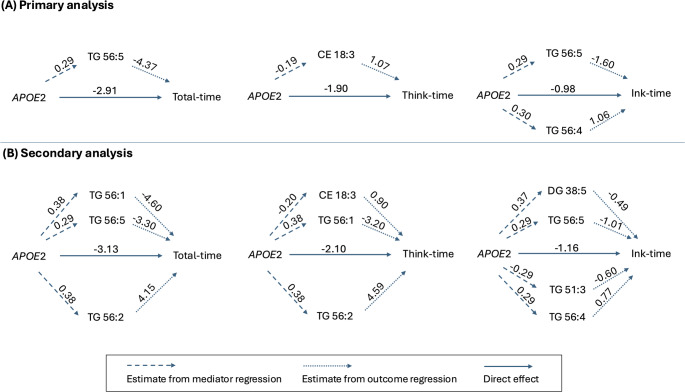 Figure 2
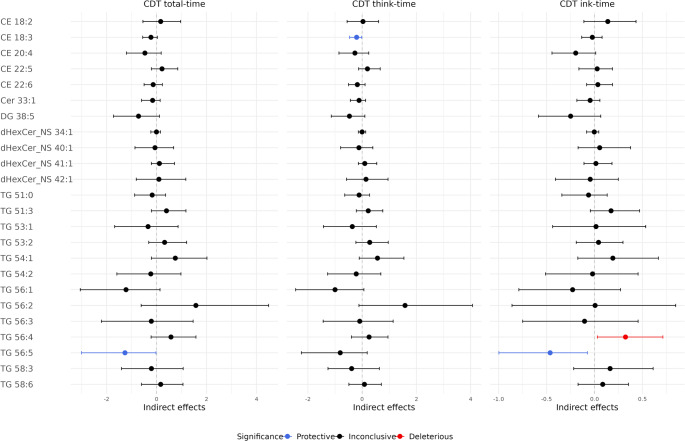 Figure 3
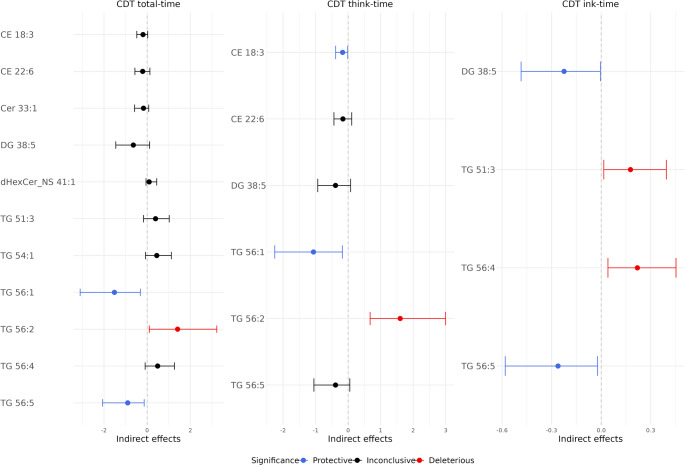 Figure 4
- —http://dx.doi.org/10.13039/100000049National Institute on Aging
- —http://dx.doi.org/10.13039/100000001National Science Foundation
Peer Reviews
No public reviews on file for this paper yet. If you reviewed it on a platform where reviews are public (OpenReview, ICLR, NeurIPS, ICML), you can paste yours below so the community can read it here.
Videos
No videos yet. Explain this paper in a talk, walkthrough, or lecture? Add one.
Taxonomy
TopicsHormonal Regulation and Hypertension · Metabolomics and Mass Spectrometry Studies · Fatty Acid Research and Health
Introduction
The apolipoprotein E (APOE) gene, a crucial gene in lipid metabolism, has been extensively studied for its association with cognitive function and late-onset Alzheimer’s Disease (AD) [1–4]. The APOE gene has three well-characterized alleles—e2, e3, and e4—that are defined by combinations of the Single Nucleotide Polymorphisms (SNPs) rs7412 and rs429358. Among these alleles, the e3 allele is the most common in Non-Hispanic and White individuals and is considered neutral. The e4 allele is considered as a major genetic determinant for AD risk and cognitive decline [5–7], and the e2 allele is associated with increased human longevity [8] and decreased risk for AD and cognitive decline [9–13].
Extensive research has focused on the direct effect of APOE alleles on the risk for AD and cognitive decline. However, there have been limited investigations on the effect of APOE that is explained or mediated through molecular pathways [14–16], such as lipids. APOE plays an important role in lipid metabolism, as the previous research showed that different APOE alleles are associated with replicated lipid profiles [14, 17, 18]. Compared to genes, lipids are modifiable risk factors for cognitive decline [19]. Therefore, characterizing the role of lipids as mediators can improve our understandings of the mechanism of APOE on cognition, which provides insights for developing new therapeutics that target these lipid pathways.
In this study, our objective is to investigate the effect of APOE2 on cognitive function and to examine whether this effect is mediated through lipid metabolites. We analyzed the data from Long Life Family Study (LLFS) [20], an observational study of families of participants with exceptional longevity, whose cognitive function is assessed by the Clock Drawing Test (CDT). The CDT is a widely used screening tool for global cognitive dysfunction, where faster CDT completion time have been associated with better processing speed and logical memory [21]. Three metrics were derived from the digital version of CDT: think-time, ink-time, and their sum as total-time. Focusing on a list of 24 lipids previously identified as significantly associated with APOE2 [22], we performed a causal mediation analysis to estimate (1) the direct effect of APOE2, (2) the indirect effects of APOE2 through these lipids, and (3) the total effect of APOE2 on CDT think-, ink-, and total-time among 1228 LLFS participants.
Methods
Participants
Long Life Family Study (LLFS)
The LLFS is a multicenter, multigeneration study that enrolled 4,953 family members from 539 families who exhibit healthy aging and longevity. Participants were first enrolled between 2006 and 2009 at three American field centers (in Boston, Pittsburgh, and New York) and a Danish field center. The second in-person visit was completed during 2014–2017 for participants using the same protocols. Further details on the LLFS study can be found in reference [20]. All participants provided informed consent through their local Institutional Review Board, and the genetic and phenotypic data generated through 2017 are available through dbGaP (dbGaP Study Accession: phs000397.v1.p1). New data generated after 2017 are distributed through the ELITE portal: https://eliteportal.synapse.org/Explore/Projects/DetailsPage?shortName=LLFS.
APOE genotype data
APOE alleles were determined from genotypes of two SNPs, rs7412 and rs429358, that were generated using Whole Genome Sequencing [20]. The e2 allele was defined by the combination rs7412=T and rs429358=T; the e3 allele was defined by the combination rs7412=C and rs429358=T; and the e4 allele by rs7412=C and rs429358=C. This study focused on the comparison between genotype group APOE3 versus genotype group APOE2 in LLFS participants, where the genotype groups were defined as: APOE3=e3e3 (reference group) and APOE2=e2e2 or e2e3. Carriers of one or more copies of the e4 alleles were excluded.
Lipid
For lipid measurements, this study used blood collected during the first in-person visit between 2006 and 2009. Lipids were analyzed from plasma by liquid chromatography/mass spectrometry (LC/MS) as described previously [17, 22]. Lipids were first isolated by using solid-phase extraction kits. Then, they were separated by reversed-phase chromatography prior to being measured on an Agilent 6545 quadrupole time-of-flight mass spectrometer at Washington University in St Louis. Samples were analyzed in batches of approximately 90. Pooled samples, reference materials, and internal standards were used for quality control and batch correction, thereby ensuring high data quality. We processed the data with a combination of XCMS, DecoID, and Skyline to facilitate removal of background, annotation of adducts, and compound identification [24, 25]. We normalized data by using a random forest-based approach for batch correction which we previously found to be the optimal approach for this data [26]. We identified lipids based on retention time and fragmentation pattern matches both in-house and public databases formed from analysis of authentic standards. For retention time matches, we allowed a 30s tolerance between reference and observed retention times. For MS/MS matches, a normalized dot-product score of >80 was required. We reviewed all identifications manually after applying the cutoffs listed previously to ensure accurate matches. According to the Metabolomics Standard Initiative [27], these identifications correspond to high-confidence Level 1 and Level 2 identifications. A detailed description of these methods was described in a prior report [28].
In this analysis, we used 24 lipids that were associated with APOE2 at 5% false discovery rate, as reported in Sebastiani et al. (2024) [22]. Supplementary Table 1 includes the estimated association between APOE2 and each lipid, as well as adjusted p-values. All lipids were log-transformed and standardized for the mediation analysis.
Clock Drawing Test (CDT)
The CDT is a common screening test for global cognitive dysfunction and for a range of neurological and psychiatric illnesses [29]. It was added to the neuropsychological assessment protocol at the second in-person assessment and administered using a digital pen that recorded spatial-temporal features of the test performance. Participants were given a piece of specially formatted paper that can be read by the digital pen folded down to 8 by 5.5 inches. In the Command Condition the examiner read the instructions “I’d like you to draw a clock, put in all of the numbers, and set the hands to ten after eleven.” Immediately following, the Copy Condition was administered. On the other side of the paper, a picture of a clock with the hands set to 11:10 was displayed and the examiner instructed “Please copy this clock.” Each condition was discontinued if the participant was unable to complete their drawing within 5 min. Only data from the more cognitively demanding Command Condition were used in this analysis.
Digital features of the CDT were extracted by digital software developed by Massachusetts Institute of Technology and Lahey Hospital and Medical Center [30]. Think-time, the time spent holding the pen without drawing, was conceptualized to capture cognitive processing while the participant is planning the next component to draw [31]. Ink-time, the time spent drawing on the paper, was developed to capture motor aspects of test performance. In a separate study [32], thinking time and ink time were extracted from a coding test and found to correlate with cognitive processing and motor function, respectively, in line with their conceptualization. We also computed an additional metric of total-time using the sum of think-time and ink-time.
Statistical analysis
To study how the effect of APOE on cognition is mediated by lipids, we performed a causal mediation analysis to estimate the direct and indirect effects of APOE2 on CDT performance. The causal mediation analysis (Fig. 1) included these primary components:
- Exposure: APOE2 genotype group versus APOE3 genotype group (reference group).
- Mediators: Lipids level data that were log-transformed and then standardized.
- Confounders measured at baseline: age at enrollment, sex, education, body mass index (BMI), lipid-lowering medication usage, and indicator of young/old generation based on whether the birth year > 1935 (see Supplementary Fig. 1 for the distribution of birth year in LLFS participants).
- Outcomes: CDT total-time derived by summing (a) CDT think-time and (b) CDT ink-time.
Fig. 1. Components of the mediation analysis in this study: exposure, mediators, potential confounders, and outcomes. CDT Clock Drawing Test
In this analysis, the lipids (mediators) are measured at the first visit and the CDT results (outcomes) are measured at the second visit, satisfying the temporal ordering assumption of the mediation analysis, where the causal sequences follow exposure →mediator →outcome.
We used a regression-based approach for the causal mediation analysis with multiple mediators, as described in references [33, 34]. First, we fit the mediator regression model for each of the lipids, where the independent variable was the APOE genotype group, adjusted for all the confounders. Next, we fit the outcome regression model for each CDT outcome separately, where the independent variables were the APOE genotype group and all lipids simultaneously, adjusted for all the confounders. Then, we combined the estimates from both mediator and outcome regression models [33] to estimate the direct effect and indirect effect of APOE2 on the CDT times. We include the modeling details for this mediation analysis in the supplementary file. In addition, to account for within-family correlations, we used generalized estimating equations to estimate standard errors in all regression models with an exchangeable covariance matrix based on family IDs.
We also performed a secondary analysis including a subset of lipids instead of all lipids. We applied a backward stepwise variable selection in the outcome regression model based on the Akaike Information Criterion (AIC) to select lipids. We then repeated the entire causal mediation analysis only including the lipids retained in the regression models after variable selection. Finally, we performed a sensitivity analysis by excluding the variable of lipid-lowering medication usage in the models, and we repeated the mediation analysis.
In reporting the mediation analysis results, we present:
- Direct effect of APOE2 on the CDT times.
- Individual indirect effect mediated through each lipid, where APOE2 affects each lipid, which in turn affects the CDT time.
- Combined indirect effect, the sum of all individual indirect effects via lipid pathways.
- Total effect, the sum of the direct effect and the combined indirect effect.
- Mediated proportion, the proportion of total effect that is mediated through all lipid pathways, that we calculated as the combined indirect effect divided by the total effect.
We generated 95% confidence intervals (CI) for these effect estimates using the bootstrap with Efron’s percentile method [35] using 1500 replicates. Whether a 95% CI includes zero will be used to assess the statistical significance. We used R 4.1.3 for all analyses and all scripts are available from QM&DS Tufts Medical Center github (https://github.com/QM-DS-Tufts-Medical-Center).
Results
Participant and lipid characteristics
Our analysis included 1228 participants with APOE genotype data and plasma lipids measured at the first visit and CDT data from the second visit. Table 1 summarizes the characteristics of the LLFS participants included in this analysis. Among those participants, APOE3 carriers and APOE2 carriers had similar ages at enrollment, years of education, and BMI. However, APOE3 carriers included a higher proportion of females (58% versus 54%) and those who takes lipid lowering medications (32% versus 18%), compared to APOE2 carriers.
Table 1. Characteristics of participants who were included in the analysisCharacteristicOverall, N = 1228APOE3, N = 988APOE2, N = 240Age at enrollment63.0 (57.0, 70.0)63.0 (57.0, 70.0)62.0 (56.0, 70.0)Age at visit two72.0 (65.0, 79.0)72.0 (66.0, 79.0)71.0 (65.0, 80.0)Sex Female702 (57%)573 (58%)129 (54%) Male526 (43%)415 (42%)111 (46%)Years of education14.0 (10.0, 15.0)14.0 (10.0, 15.0)14.0 (10.0, 14.0)BMI26.8 (24.2, 29.9)26.8 (24.2, 29.8)26.9 (24.5, 30.1)Lipid-lowering medication usage359 (29%)317 (32%)42 (18%)CDT total-time32.5 (26.0, 41.9)33.1 (26.3, 42.3)30.3 (25.1, 41.0) Think-time18.7 (14.0, 25.7)18.8 (14.1, 25.9)18.3 (13.9, 24.4) Ink-time13.6 (10.8, 16.8)13.7 (11.0, 16.9)12.9 (10.0, 16.1)Continuous variables are summarized with median and interquartile range. Discrete variables are summarized with count and percentage. APOE3 = e3e3, APOE2 = e2e2 or e2e3BMI body mass index, CDT Clock Drawing Test
Table 2 lists the 24 lipid species that were included in the analysis. These lipids include sterol lipids (CEs), sphingolipids (DGs), glycerolipids (TGs), dHexCer_NS 34:1, dHexCer_NS 40:1, dHexCer_NS 41:1, and dHexCer_NS 42:1.
Table 2. List of 24 lipid species used in the mediation analysisStandardized nameSuper classCE 18:2Sterol LipidsCE 18:3Sterol LipidsCE 20:4Sterol LipidsCE 22:5Sterol LipidsCE 22:6Sterol LipidsCer 33:1SphingolipidsDG 38:5GlycerolipidsdHexCer_NS 34:1NAdHexCer_NS 40:1NAdHexCer_NS 41:1NAdHexCer_NS 42:1NATG 51:0GlycerolipidsTG 51:3GlycerolipidsTG 53:1GlycerolipidsTG 53:2GlycerolipidsTG 54:1GlycerolipidsTG 54:2GlycerolipidsTG 56:1GlycerolipidsTG 56:2GlycerolipidsTG 56:3GlycerolipidsTG 56:4GlycerolipidsTG 56:5GlycerolipidsTG 58:3GlycerolipidsTG 58:6Glycerolipids
Primary analysis of digital CDT.
Mediator regression and outcome regression
Supplementary Table 2 shows the results of the mediator regression that describes the associations between APOE2 and lipids (log scale and standardized). Consistent with previous work [17], the estimated associations between APOE and the 24 lipids were almost all statistically significant. Supplementary Table 3 shows the results of the outcome regression, which shows that APOE2 had a statistically significant protective association that leads to reduced total-, think-, and ink-time, after adjusting for all lipids and confounders. Among all the lipids, CE 18:3 was positively associated with think-time \documentclass[12pt]{minimal} \usepackage{amsmath} \usepackage{wasysym} \usepackage{amsfonts} \usepackage{amssymb} \usepackage{amsbsy} \usepackage{mathrsfs} \usepackage{upgreek} \setlength{\oddsidemargin}{-69pt} \begin{document}$$(\beta =1.07,\;p=0.03)$$\end{document} ; TG 56:4 was positive associated with ink-time \documentclass[12pt]{minimal} \usepackage{amsmath} \usepackage{wasysym} \usepackage{amsfonts} \usepackage{amssymb} \usepackage{amsbsy} \usepackage{mathrsfs} \usepackage{upgreek} \setlength{\oddsidemargin}{-69pt} \begin{document}$$(\beta=1.06,\;p=0.03)$$\end{document} ; and TG 56:5 was negatively associated with total-time \documentclass[12pt]{minimal} \usepackage{amsmath} \usepackage{wasysym} \usepackage{amsfonts} \usepackage{amssymb} \usepackage{amsbsy} \usepackage{mathrsfs} \usepackage{upgreek} \setlength{\oddsidemargin}{-69pt} \begin{document}$$(\beta=-4.37,\;p=0.05)$$\end{document} and ink-time \documentclass[12pt]{minimal} \usepackage{amsmath} \usepackage{wasysym} \usepackage{amsfonts} \usepackage{amssymb} \usepackage{amsbsy} \usepackage{mathrsfs} \usepackage{upgreek} \setlength{\oddsidemargin}{-69pt} \begin{document}$$\left(\beta=-1.60,\;p<0.01\right).$$\end{document} No other lipid species was significantly associated with any of the CDT times.
Individual indirect effect of APOE2 on CDT times through lipids
Figure 2A shows the significant direct effect of APOE2 and the significant indirect effects through lipid-mediated pathways. Figure 3 and Table 3 show all individual indirect effects of APOE2 on the CDT times through each lipid pathway. Note that if the estimate of an indirect effect is negative (< 0), it indicates a protective indirect effect of the lipid, as this pathway mediate the effect of APOE2 to reduce the CDT time. Conversely, a positive estimate indicates a deleterious effect. For example, regarding the total-time in Fig. 2A, compared to APOE3, APOE2 was associated with increased TG 56:5, but increased TG 56:5 led to a reduction in total-time. Therefore, the effect of APOE2 on cognitive function was partially mediated through this protective pathway of APOE2 → TG 56:5 → total-time.
Fig. 2. Mediation analysis results: significant direct and indirect effects in primary analysis (A) and secondary analysis (B). The numbers on the dashed lines represent the estimated associations between APOE2 and the lipids from mediator regression, and on the dotted lines represent the estimated associations between the lipids and the CDT times from outcome regression. The solid lines represent the direct effect of APOE2 on CDT times. Protective lipids reducing CDT times are above the solid arrow in the middle, e.g., CE 18:3; Deleterious lipids increasing CDT times are below the solid arrow in the middle, e.g., TG 56:4
From Fig. 3 and Table 3, three lipid species appeared to significantly mediate the APOE2 effects: CE 18:3, TG 56:5, and TG 56:4. For the protective pathways, the indirect effect of APOE2 through CE 18:3 reduced think-time by 0.2 s (estimate: −0.20; CI: −0.46, −0.01). The indirect effect through TG 56:5 significantly reduced total-time by 1.26 s (estimate: −1.26; CI: −3.00, −0.02) and significantly reduced ink-time by 0.46 s (estimate: −0.46; CI: −1.00, −0.07). For the deleterious pathway, the indirect effect of through TG 56:4 significantly increased ink-time by 0.32 s (CI: 0.03, 0.71).
Fig. 3. Primary analysis of indirect effects of APOE2 on CDT times through each lipid pathway. Blue color indicates statistically significant protective lipids, which mediated the effect of APOE2 to reduce CDT times. Red color indicates statistically significant deleterious lipids, which mediated the effect of APOE2 to increase CDT times
Table 3. Primary analysis of estimated indirect effects of APOE2 on CDT times through each lipid pathwayIndirect effect estimates (95% CI)Total-timeThink-timeInk-timeCE 18:20.16 (−0.55, 0.96)0.03 (−0.56, 0.60)0.14 (−0.11, 0.43)CE 18:3–0.23 (−0.56, 0.03)−0.20 (−0.46,** −0.01)−0.02 (−0.13, 0.08)CE 20:4−0.47 (−1.20, 0.18)−0.27 (−0.86, 0.24)−0.20 (−0.44, 0.01)CE 22:50.22 (−0.21, 0.85)0.19 (−0.13, 0.67)0.03 (−0.16, 0.19)CE 22:6−0.14 (−0.50, 0.23)−0.18 (−0.50, 0.11)0.03 (−0.08, 0.19)Cer 33:1−0.16 (−0.60, 0.14)−0.11 (−0.43, 0.13)−0.05 (−0.18, 0.06)DG 38:5−0.72 (−1.72, 0.12)−0.47 (−1.14, 0.10)−0.25 (−0.58, 0.07)dHexCer_NS 34:10.00 (−0.23, 0.16)0.00 (−0.14, 0.13)0.00 (−0.08, 0.04)dHexCer_NS 40:1−0.06 (−0.86, 0.68)−0.12 (−0.80, 0.39)0.05 (−0.17, 0.38)dHexCer_NS 41:10.11 (−0.21, 0.72)0.10 (−0.14, 0.54)0.01 (−0.11, 0.18)dHexCer_NS 42:10.09 (−0.81, 1.17)0.14 (−0.58, 0.95)−0.04 (−0.41, 0.25)TG 51:0−0.18 (−0.88, 0.36)−0.11 (−0.64, 0.27)−0.06 (−0.34, 0.13)TG 51:30.40 (−0.21, 1.17)0.22 (−0.22, 0.76)0.17 (−0.04, 0.47)TG 53:1−0.34 (−1.68, 0.86)−0.36 (−1.42, 0.52)0.02 (−0.44, 0.53)TG 53:20.32 (−0.31, 1.20)0.28 (−0.23, 0.96)0.04 (−0.19, 0.30)TG 54:10.75 (−0.21, 2.02)0.57 (−0.11, 1.54)0.19 (−0.17, 0.67)TG 54:2−0.23 (−1.59, 0.97)−0.22 (−1.27, 0.69)−0.02 (−0.51, 0.45)TG 56:1−1.22 (−3.05, 0.14)−1.00 (−2.45, 0.06)−0.23 (−0.79, 0.27)TG 56:21.57 (−0.62, 4.48)1.58 (−0.12, 4.07)0.01 (−0.86, 0.85)TG 56:3−0.21 (−2.21, 1.46)−0.09 (−1.44, 1.14)−0.10 (−0.75, 0.45)TG 56:40.58 (−0.22, 1.57)0.25 (−0.39, 0.95)0.32 (0.03, 0.71)TG 56:5– 1.26 (−3.00**,** −0.02)−0.81 (−2.24, 0.19)−0.46 (−1.00**,** −0.07)**TG 58:3−0.21 (−1.40, 1.06)−0.39 (−1.26, 0.63)0.16 (−0.22, 0.61)TG 58:60.16 (−0.60, 1.06)0.08 (−0.49, 0.71)0.09 (−0.17, 0.35)95% confidence intervals (CI) are generated using bootstrap percentile method. Protective lipids mediated the effect of APOE2 to reduce CDT times, while deleterious lipids mediated the effect of APOE2 to increase CDT times. Bold font indicates that the effect estimate is statistically significant
Total and combined effects of APOE2 on CDT times
Table 4 summarizes the overall results of the mediation analysis. Compared to APOE3, APOE2 carriers completed the CDT test 3.98s faster in total-time (estimate: −3.98; CI −6.33, −1.36). This reduced time can be decomposed into a significant direct effect of 2.91s (estimate: −2.91; CI: −5.26, −0.59) and an insignificant combined indirect effect through all lipids of 1.07s (estimate: −1.07; CI: −2.63, 0.58); Though not significant, the combined indirect effect contributed to 27% (–13%, 82%) mediated proportion.
Table 4. Summary of mediation analyses of APOE2 on the CDT times with 95% CIDigital CDTTotal-timeThink-timeInk-timePrimary analysis (95% CI) Direct effect−2.91 (−5.26, −0.59)−1.90 (−3.60, −0.22)−0.98 (−1.80, −0.18) Combined indirect effect−1.07 (−2.63, 0.58)−0.89 (−2.28, 0.42)−0.17 (−0.68, 0.37) Mediated proportion27% (−13%, 82%)32% (−15%, 89%)15% (−36%, 71%) Total effect−3.98 (−6.33, −1.36)−2.78 (−4.80, −0.69)−1.15 (−2.02, −0.23)Secondary analysis (95% CI) Direct effect−3.16 (−5.39, −1.01)−2.19 (−3.81, −0.64)−1.06 (−1.88, −0.28) Combined indirect effect (%)−0.81 (−1.82, 0.29)−0.57 (−1.19, 0.06)−0.09 (−0.31, 0.15) Mediated proportion20% (−10%,59%)21% (−3%, 52%)8% (−18%, 40%) Total effect−3.97 (−6.35, −1.50)−2.76 (−4.52, −1.02)−1.15 (−2.01, −0.33)Negative estimates shows that the APOE2 carriers has a shorter CDT completion time compared to APOE3. Direct effect: the effect of APOE2 on the CDT time that do not involve lipids. Combined indirect effect: the sum of indirect effects via all lipid pathways. Mediated Proportion: the percentage of the total effect mediated by the combined indirect effects. Total effect: the sum of the direct effect and the combined indirect effectCDT Clock Drawing Test, CI confidence interval
Consider the two components of total-time. First, the think-time of APOE2 carriers was 2.78s faster than APOE3 carriers (estimate: −2.78; CI: −4.80, −0.69). This reduced time can be decomposed into a direct effect of 1.90s (estimate: −1.90; CI: −3.60, −0.22) and a combined indirect effect mediated through all lipids of 0.89s (estimate: −0.89; CI: −2.28, 0.42; mediated proportion: 32%). Second, the ink-time of APOE2 carriers was 1.15s faster than APOE3 carriers (estimate: −1.15; CI: −2.02, −0.23). This reduced time can be decomposed into a direct effect of 0.98s (estimate: −0.98; CI: −1.80, −0.18) and a combined indirect effect of 0.17s (estimate: −0.17; CI: −0.68, 0.37; mediated proportion: 15%).
Secondary and sensitivity analysis
Secondary analysis
For each CDT outcome, we performed a variable selection of lipids using the outcome regression model, and we repeated the entire causal mediation analysis using the lipids that remained in the final selected model. Importantly, after variable selection, each CDT outcome model can include different numbers of final lipids. Results of the mediator regression and the outcome regression in the secondary analyses for these CDT times are shown in Supplementary Tables 4–5.
Figure 2B shows the significant indirect effects through lipid-mediated pathways in the secondary analysis. Figure 4 and Table 5 show all indirect effects of APOE2 on the CDT times through each lipid pathway. Consistent to the primary analysis, TG 56:5 and CE 18:3 remained as protective mediators, and TG 56:4 remained as a deleterious mediator. In addition, four new lipids were also found to significantly meditate the APOE effects: DG 38:5 and TG 56:1 have a protective effect; TG 51:3 and TG 56:2 have a deleterious effect.
Fig. 4. Secondary analysis of indirect effects of APOE2 on CDT times through each lipid pathway. Stepwise variable selection was applied to select lipids, so each CDT time had different lipids remained in the mediation analysis. Blue color indicates statistically significant protective lipids, which mediated the effect of APOE2 to reduce CDT times. Red color indicates statistically significant deleterious lipids, which mediated the effect of APOE2 to increase CDT times
Table 5. Secondary analysis of indirect effects of APOE2 on CDT times through each lipid pathway, after variable selection of lipids in the outcome modelTotal-timeThink-timeInk-timeLipidsEffect estimate (95% CI)LipidsEffect estimate (95% CI)LipidsEffect estimate (95% CI)CE 18:3−0.19 (−0.48, 0.02) CE 18:3 −0.17 (−0.38,** −0.01)** DG 38:5 −0.22 (−0.48,** 0.00)CE 22:6−0.21 (−0.57, 0.13)CE 22:6−0.16 (−0.44, 0.11) TG 51:3 0.18 (0.02, 0.39)Cer 33:1−0.17 (−0.58, 0.07)DG 38:5−0.39 (−0.93, 0.08) TG 56:4 0.22 (0.04, 0.45)DG 38:5−0.64 (−1.45, 0.11) TG 56:1 −1.07 (−2.26, −0.18)** TG 56:5 −0.26 (−0.58,** −0.02)dHexCer_NS 41:10.09 (−0.05, 0.44) TG 56:2 1.60 (0.68, 3.00)TG 51:30.39 (−0.17, 1.02)TG 56:5−0.39 (−1.05, 0.05)TG 54:10.44 (−0.08, 1.12) TG 56:1 −1.52 (−3.11, −0.32)** TG 56:2 1.41 (0.10,** 3.23)TG 56:40.48 (−0.10, 1.26) TG 56:5 −0.90 (−2.06, −0.14)**95% confidence intervals (CI) are generated using bootstrap percentile method. Protective lipids mediated the effect of APOE2 to reduce CDT times, while deleterious lipids mediated the effect of APOE2 to increase CDT times. Bold font indicates that the effect estimate is statistically significant
Table 5 also summarizes the results of the mediation analysis of this secondary analysis for CDT times. The total effect of APOE2 on every CDT outcome in the secondary analysis is very similar to the primary analysis. The combined indirect effects show slight changes in magnitude, though they remain statistically non-significant. The mediated proportion of the combined indirect effect decreased across all CDT outcomes. For instance, for CDT total time, the mediated proportion decreased from 27% in the primary analysis to 20% in the secondary analysis. This is possibly due to fewer lipids remaining in the model after variable selection.
Sensitivity analysis
For each outcome, we excluded the variable of lipid-lowering medication usage in both the mediator and outcome regression model, and we repeated the entire causal mediation analysis including all lipids. Supplementary Fig. 2 and Supplementary Table 6 show all indirect effects of APOE2 on the CDT times through each lipid pathway in the sensitivity analysis. The results were comparable to the primary analysis. CE 18:3, TG 56:4, and TG 56:5 stayed as significant lipid pathways that mediated the effect of APOE2, and the only difference is that their CI become slightly narrower.
Discussion
Overview
Our analysis investigates the potential mediating role of lipids on the effect of APOE2 on CDT total-time, think-time, and ink-time. In the primary analysis, we identified a significant protective direct effect of APOE2 on CDT total-time, think-time, and ink-time, significant protective indirect effects through two lipids (CE 18:3 and TG 56:5), and a significant deleterious indirect effect through one lipid (TG 56:4). Compared to APOE3, the combined indirect effect of APOE2 through all lipid pathways mediated 27% of the total effect on CDT total-time for a 1.07s faster completion time, but such mediated proportion does not reach statistical significance. Additionally, the secondary analysis revealed significant protective effects through DG 38:5 and TG 56:1, as well as significant deleterious effect through TG 51:3 and TG 56:2. Compared to the primary analysis, the total effect on all CDT times in the secondary analysis were similar, but the combined indirect effect on total-time and think-time contributed to a slightly lower mediated proportion of the total effect.
Discussion
Although the role of APOE in aging and cognition has been extensively studied [1], the mechanisms by which the APOE2 allele protects against cognitive decline and promotes longevity remain elusive [36]. The strong correlations between APOE2 alleles and many lipid species suggest that lipids in the blood may mediate the genetic effect of APOE on cognitive function [14, 15, 17], where individuals with certain lipid profile can present “reduced/increased” risk of cognitive decline. Our findings in the primary and secondary analyses identified seven lipids (CE 18:3, DG 38:5, TG 51:3, TG 56:1, TG 56:2, TG 56:4, TG 56:5) that significantly mediated the effect of APOE2, highlighting their potential as therapeutic targets for preserving cognitive function during aging. Specifically, our analyses suggest two potential strategies for therapeutic intervention: increasing the levels of lipids that were identified as protective pathways (CE 18:3, DG 38:5, TG 56:1, TG 56:5) or decreasing the levels of lipids that were identified as deleterious pathways (TG 51:3, TG 56:2, TG 56:4).
Our analysis showed that lipids within the same super class can significantly mediate the effects of APOE2 on cognitive function in different directions. For example, we identified glycerolipids with opposite effects. TG 56:5 showed protective mediation in both primary and secondary analysis, while TG 51:3, TG 56:2, and TG 56:4 showed deleterious mediation. These findings can help clarify TG’s complex mechanisms on cognitive function and cognitive test performance, as similar conflicting associations were also reported in previous studies [37–39]. Furthermore, the selective effects of these glycerolipids on total-time and ink-time of the CDT but not on think-time, suggest that they mediate graphomotor function components of CDT test performance more specifically.
The sterol lipids included in this analysis consistently showed their protective mediation of the effect of APOE2. CE 18:3 was protective for think-time in both the primary analysis and the secondary analysis. This is aligned with recent research reporting that cholesterols are either not associated with or may even protect against late-life cognitive decline [40–42]. Furthermore, the relationship of the sterol lipids with think time, rather than ink time, also suggests that they mediate cognitive processing components of CDT test performance more specifically.
Previous studies on mediation analysis of APOE have focused on mediators of cerebral blood flow [43], brain tissue volume [44], and neuropathological pathways [45], suggesting these factors partially mediated the negative effect of APOE4. When considering lipids as mediators, one study found that total cholesterol negatively mediated the effect of APOE2 on cognition [15]; another study found no lipids but BMI significantly mediated the risk of AD [16]. In addition, one study on the risk of AD found 11 lipid species that mediated the effect of APOE2, accounting for up to 30% of the total effect of APOE2 on AD resilience [14]. This is aligned with our finding of up to 32% mediated proportions from all lipid pathways. Compared to previous research, the novelty of our research lies in revealing both protective and deleterious pathways mediated through lipids, as well as differential effects of glycerolipids and sterol lipids on graphomotor function and cognitive processing, respectively.
Limitations
In our primary analysis, the CIs for some lipids were marginally close to zero. For example, the upper 95% CI for DG 38:5 was just above zero for all CDT times in the primary analysis. The number of LLFS participants who completed the CDT are not large, which may have led to limited statistical power in those findings. Future research may aim to combine multiple studies with digital CDT and lipids data for an increased statistical power to detect more significant indirect effects through lipids.
Other limitations included that we did not consider the potential interaction effect between APOE and lipids metabolites; future work could explore these interactions to gain deeper insight. Also, because our exposure APOE is determined at birth, all confounders in our analysis may potentially act as post-treatment confounders, complicating the causal interpretation. Additionally, all outcomes in this application focus on the CDT time outcomes, which may only reflect certain aspects of cognitive function, for example, processing speed. Our future research also plans to investigate the effects of APOE alleles and lipids on different domains of cognitive function using additional measures. Finally, our mediator and outcome models relied on parametric regression approaches. A future direction is to explore the flexible machine learning models to better capture complex relationships in covariates.
Conclusions
We analyzed data from the LLFS to investigate the relationship between APOE variants, lipids, and cognitive function measured by CDT times. The results revealed a direct protective effect of APOE2 on cognitive and motor function; the results identified indirect effects through several lipid species that mediated the effects of APOE2 in either protective or deleterious pathways. The identified protective and deleterious lipid pathways present potential opportunities for developing new therapeutics targeting these lipids to modulate the effects of APOE2 on cognitive function.
Supplementary Information
Below is the link to the electronic supplementary material.
Supplementary Material 1