Estimated Number of Prevalent Kidney Transplant Recipients in Japan From 1964 to 2023
Hirotaka Komaba, Yosuke Nakagawa, Masahiro Koizumi, Yusuke Tomita, Michio Nakamura

Abstract
Genes, proteins, chemicals, diseases, species, mutations and cell lines named across the full text — each resolved to its canonical identifier and authoritative record.
Click any figure to enlarge with its caption.
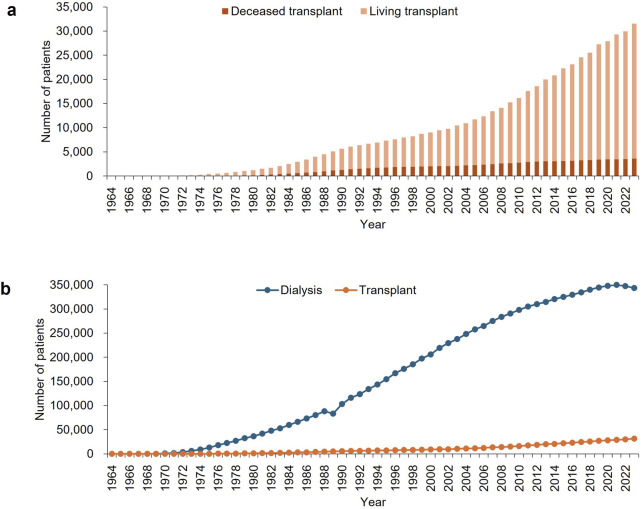 Figure 1
Peer Reviews
No public reviews on file for this paper yet. If you reviewed it on a platform where reviews are public (OpenReview, ICLR, NeurIPS, ICML), you can paste yours below so the community can read it here.
Videos
No videos yet. Explain this paper in a talk, walkthrough, or lecture? Add one.
Taxonomy
TopicsRenal Transplantation Outcomes and Treatments · Organ Donation and Transplantation · Dialysis and Renal Disease Management
Dear Editors,
Kidney transplantation is one of the primary modalities of kidney replacement therapy (KRT) for patients with kidney failure. Compared with dialysis, it offers multiple advantages, including improved survival, better quality of life, and reduced healthcare costs [1, 2]. Therefore, understanding the implementation of kidney transplantation is essential for appropriate healthcare resource allocation and policy planning in each region. In Western countries, kidney transplantation is highly prevalent, with approximately 30%–50% of patients receiving KRT being transplant recipients [3, 4]. In contrast, in Japan, kidney transplantation remains a relatively limited treatment modality, primarily due to donor shortages and potential cultural factors [5–7].
The Japan Society for Transplantation, in collaboration with the Japanese Society for Clinical Renal Transplantation, has long collected detailed data at the time of transplantation, providing accurate statistics on the number of transplants and donor types [5–7]. However, long-term post-transplant follow-up is not always complete, leaving the number of kidney transplant recipients with functioning grafts (i.e., prevalent recipients) uncertain. This lack of information represents a significant limitation for evaluating the proportion of transplant recipients relative to patients on dialysis and for conducting international comparisons.
To address this, we estimated temporal trends in the number of prevalent kidney transplant recipients in Japan using summary statistics published by the Japan Society for Transplantation [5–7]. Furthermore, using data from the Japan Society for Dialysis Therapy Renal Data Registry [8], we calculated the proportion of prevalent kidney transplant recipients among all patients receiving KRT.
The annual numbers of living- and deceased-donor kidney transplants performed from 1964 to 2023, obtained from the Japan Society for Transplantation records [5–7], are summarized in Supplementary Figure S1 and Supplementary Table S1. The number of transplants was very low in the 1960s, gradually increased from the late 1970s, and has stabilized at approximately 1,500–2,000 per year since the 2010s. By 2023, a total of 47,466 transplants had been performed, comprising 39,543 living-donor and 7,923 deceased-donor transplants.
Temporal trends in the number of prevalent kidney transplant recipients, estimated based on graft survival for each era (Supplementary Figure S2), are shown in Figure 1a and Supplementary Table S2. The estimated number of prevalent recipients increased over time, reaching 27,935 living-donor recipients, 3,617 deceased-donor recipients, and a total of 31,552 recipients by 2023.
Temporal trends in the estimated number of prevalent kidney transplant recipients, compared with the number of patients on dialysis reported by the JSDT Renal Data Registry [8], are shown in Figure 1b and Supplementary Table S3. The proportion of these patients relative to the total population in Japan is shown in Supplementary Figure S3. The estimated proportion of prevalent kidney transplant recipients among all patients receiving KRT in Japan gradually increased over time, reaching 8.4% in 2023.
This study reports that the estimated number of prevalent kidney transplant recipients in Japan has steadily increased, surpassing 30,000 in 2023 and accounting for 8.4% of all patients receiving KRT. These data provide an important reference not only for understanding the current status of kidney transplantation in Japan, but also for enabling international comparisons and contributing to global discussions on transplantation practices.
A notable finding is that, compared with Western countries [3, 4], the proportion of prevalent kidney transplant recipients in Japan remains low, primarily due to the limited number of deceased-donor transplants. Contributing factors include delayed societal recognition of brain-dead organ donation, regulatory constraints, and challenges in obtaining family consent [9]. In addition, population aging and advances in chronic kidney disease management have led to an older demographic among patients requiring KRT [8], which may limit eligibility for kidney transplantation. Nonetheless, we observed a steady increase in prevalent recipients, likely reflecting both the gradual increase in the number of kidney transplants and the favorable long-term outcomes of kidney transplantation in Japan [5–7].
This study has several limitations. Most importantly, the estimates were derived from registry-reported transplant numbers and graft survival rates, rather than from a direct count of prevalent recipients. The graft survival rates were based on recipients with available follow-up, so outcomes of those lost to follow-up may differ. Furthermore, this secondary analysis relied entirely on summary data without access to individual-level information. Further investigation is needed to collect comprehensive patient-level data on prevalent kidney transplant recipients. The newly developed national transplant registry system, TRACER (TRAnsplant CEntral Registry), may help address these gaps.
In conclusion, kidney transplantation remains a relatively uncommon KRT modality in Japan, but the number of recipients with functioning grafts has steadily increased. Continued efforts are needed to refine these estimates and to establish a robust foundation for meaningful international comparisons.
The reference list from the paper itself. Each links out to its DOI / PubMed record.
- 1Tonelli M Wiebe N Knoll G Bello A Browne S Jadhav D Systematic Review: Kidney Transplantation Compared with Dialysis in Clinically Relevant Outcomes. Am J Transpl (2011) 11(10):2093–109. 10.1111/j.1600-6143.2011.03686.x 21883901 · doi ↗ · pubmed ↗
- 2Laupacis A Keown P Pus N Krueger H Ferguson B Wong C A Study of the Quality of Life and Cost-Utility of Renal Transplantation. Kidney Int (1996) 50(1):235–42. 10.1038/ki.1996.307 8807593 · doi ↗ · pubmed ↗
- 3Boenink R Bonthuis M Boerstra BA Astley ME Montez de Sousa IR Helve J The ERA Registry Annual Report 2022: Epidemiology of Kidney Replacement Therapy in Europe, with a Focus on Sex Comparisons. Clin Kidney J (2025) 18(2):sfae 405. 10.1093/ckj/sfae 405 40008269 PMC 11852260 · doi ↗ · pubmed ↗
- 4United States Renal Data System. 2024 USRDS Annual Data Report: Epidemiology of Kidney Disease in the United States. Bethesda, MD: National Institutes of Health, National Institute of Diabetes and Digestive and Kidney Diseases (2024). Available online at: https://usrds-adr.niddk.nih.gov/2024 (Accessed October 5, 2025).
- 5Sonoda T Shikata M Miyamoto H . Proceedings of the 3rd Clinical Meeting on Kidney Transplantation. Jpn J Transpl (1970) 5(2):131–84.
- 6The Japan Society for Transplantation. Summary of Clinical Registration of Kidney Transplantation (1990). Jpn J Transpl (1991) 26(5):494–517.
- 7The Japan Society for Transplantation. Fact Book 2024 on Organ Transplantation in Japan. Available online at: https://www.asas.or.jp/jst/pdf/factbook/factbook 2024.pdf (Accessed October 5, 2025).
- 8Masaki T Hanafusa N Abe M . 2023 Annual Dialysis Data Report, JSDT Renal Data Registry. J Jpn Soc Dial Ther (2024) 57(12):543–620. 10.4009/jsdt.57.543 · doi ↗