Towards a Global Scale Quantum Information Network: A Study Applied to Satellite-Enabled Distributed Quantum Computing
Laurent de Forges de Parny, Luca Paccard, Mathieu Bertrand, Luca Lazzarini, Valentin Leloup, Raphael Aymeric, Agathe Blaise, Stéphanie Molin, Pierre Besancenot, Cyrille Laborde, Mathias van den Bossche

TL;DR
This paper explores using satellites to connect quantum processors in Paris and Nice for distributed quantum computing.
Contribution
The novel contribution is proposing and analyzing a satellite-based quantum network for teleportation-based quantum computing at a national scale.
Findings
90 end-to-end entangled photon pairs were distributed over a satellite pass of 331 seconds.
A teleportation-based controlled-Z operation achieved a fidelity of up to 82%.
Abstract
Recent developments have reported on the feasibility of interconnecting small quantum registers in a quantum information network of a few meter-scale for distributed quantum computing purposes. Small quantum processors in a network represent a promising solution to the scalability problem of manipulating more than thousands of noise-free qubits. Here, we propose and assess a satellite-enabled distributed quantum computing system at the French national scale based on existing infrastructures in Paris and Nice. We consider a system composed of both a ground and a Space segment, allowing for the distribution of end-to-end entanglement between Alice in Paris and Bob in Nice, each owning a few-qubit processor composed of trapped ions. In the context of quantum computing, this entanglement resource can be used for the teleportation of a qubit state or for gate teleportation. After having…
Genes, proteins, chemicals, diseases, species, mutations and cell lines named across the full text — each resolved to its canonical identifier and authoritative record.
Click any figure to enlarge with its caption.
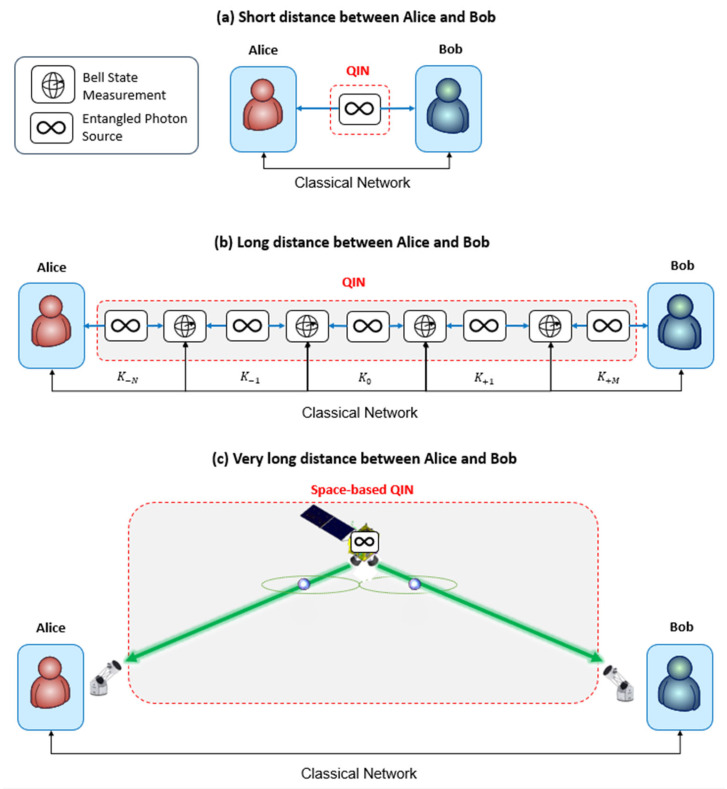 Figure 1
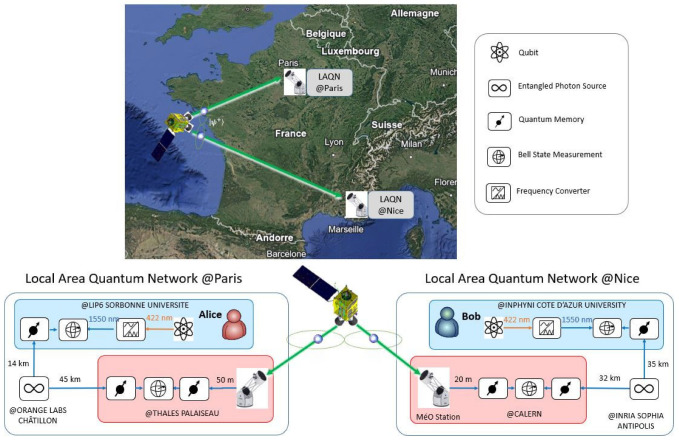 Figure 2
 Figure 3
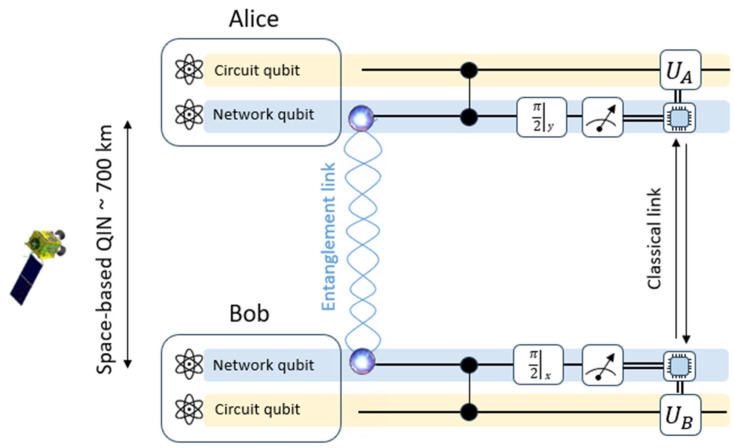 Figure 4
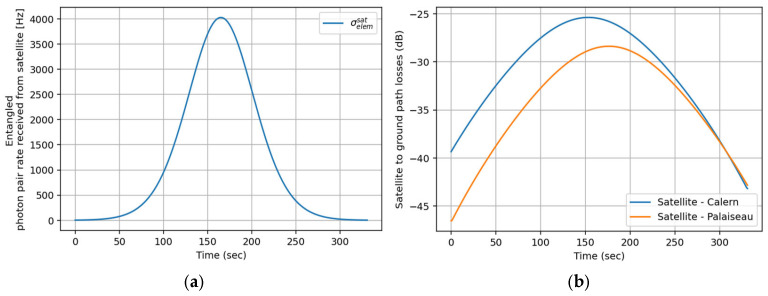 Figure 5
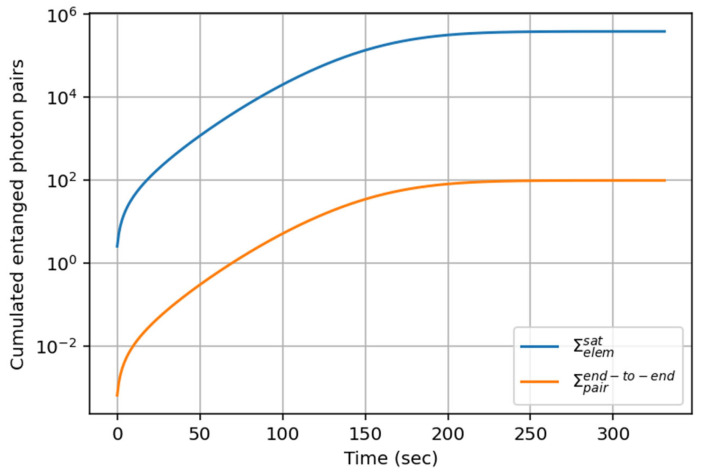 Figure 6
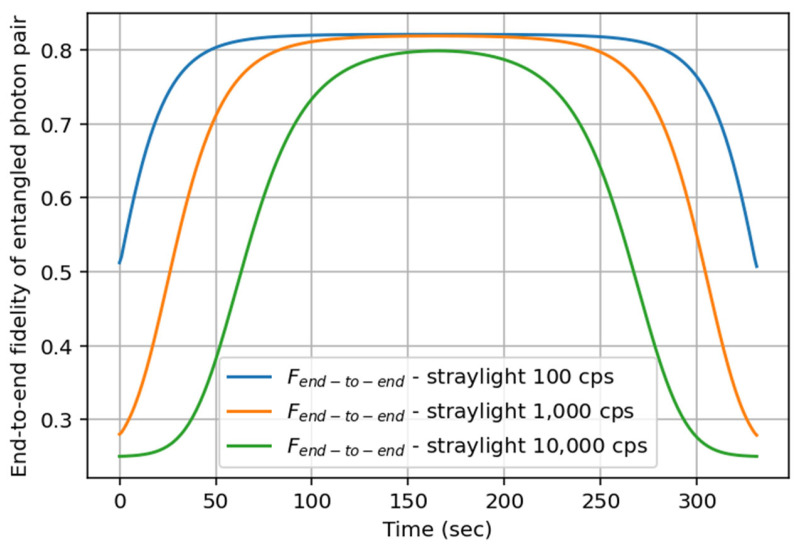 Figure 7
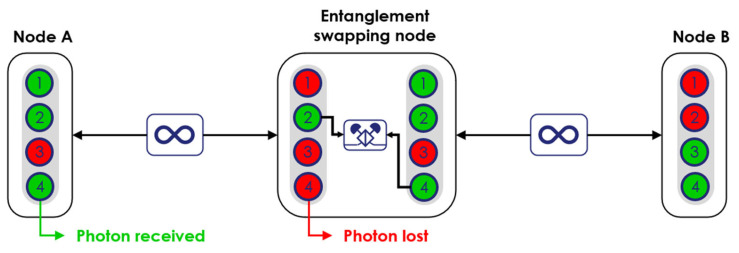 Figure 8
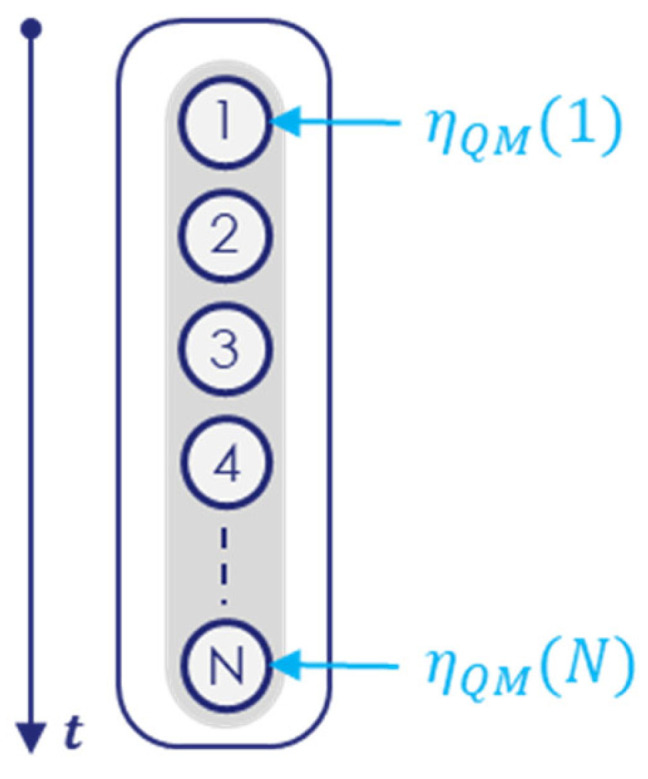 Figure 9
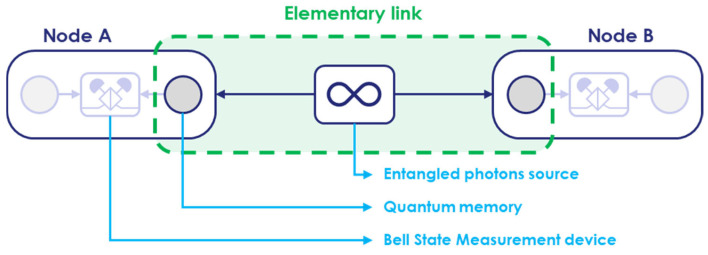 Figure 10
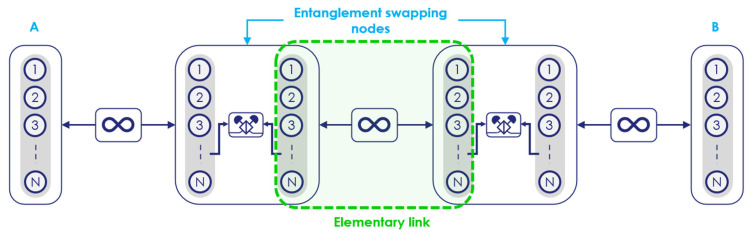 Figure 11
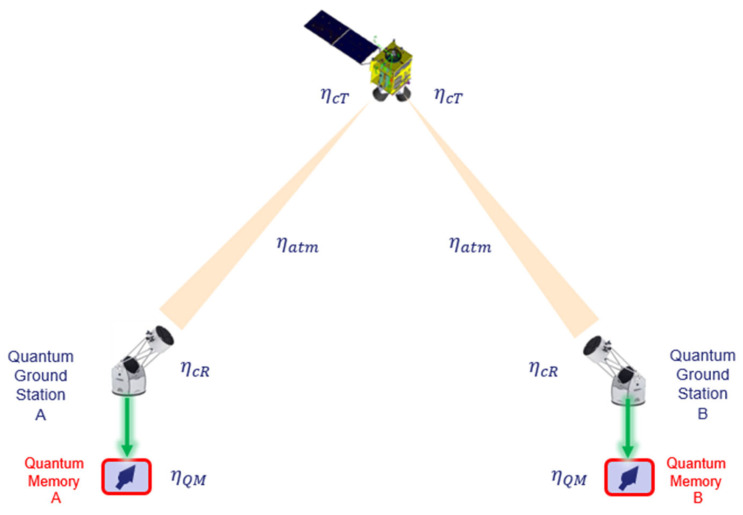 Figure 12
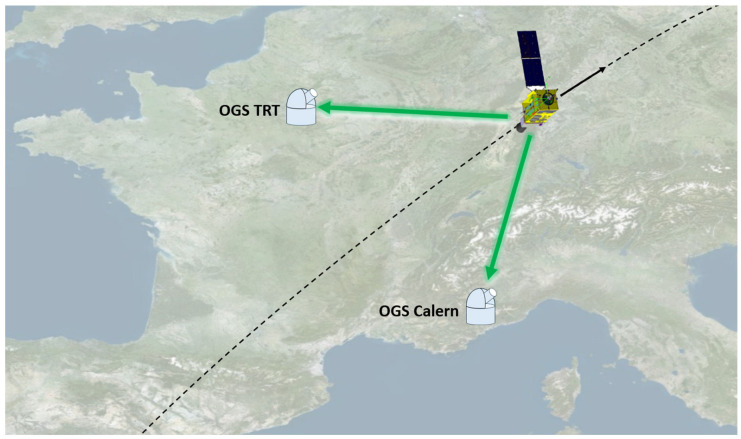 Figure 13
- —Thales Alenia Space internal funds
Peer Reviews
No public reviews on file for this paper yet. If you reviewed it on a platform where reviews are public (OpenReview, ICLR, NeurIPS, ICML), you can paste yours below so the community can read it here.
Videos
No videos yet. Explain this paper in a talk, walkthrough, or lecture? Add one.
Taxonomy
TopicsQuantum Information and Cryptography · Quantum Mechanics and Applications · Quantum Computing Algorithms and Architecture
1. Introduction
Quantum entanglement is the basic resource to be managed in quantum information networks (QINs), enabling quantum state teleportation between two distant end users. The functionalities of a QIN aim at producing, transmitting, and exploiting entanglement. The role of a QIN is, therefore, to deliver to the end users, hereafter called Alice and Bob, a sufficient amount of quantum entanglement in a well-defined state, typically one of the four Bell states, with sufficient fidelity for allowing quantum communication use cases (e.g., quantum key distribution without intermediate trusted nodes, quantum teleportation, quantum secure direct communication, etc.). A promising perspective of QINs in quantum computing [1,2,3] is their use as a connector between several quantum chipsets, each with a small number of physical qubits. Networking of quantum chipsets allows, in principle, the exponentiation of the computational resource. Furthermore, the use of quantum chipsets with a small number of qubits in a network has the advantage of easing the management of the error correction on each chipset and, therefore, reduces the overall source of noise [4]. This modular networking approach can offer a solution to the scalability problem of developing a quantum chipset with a very large number of qubits required for solving customer problems. This scaling-up approach is already investigated by Xanadu with photonic links using 35 photonic chips in a network to demonstrate the functionality and feasibility of a (sub-performant) scale model of a 12-physical qubit mode quantum computer, called Aurora [5]. Modular quantum computing is also central to IBM’s quantum roadmap [6]. IBM has designed a tunable-coupler quantum processor called Flamingo, which pairs two 156-qubit Heron processors with a built-in quantum communication link. IBM plans to connect up to seven Heron processors to create a modular Flamingo processor with more than 1000 qubits, including quantum transduction [7]. Very recently, a very basic version of Grover’s search algorithm running across two interconnected processors was demonstrated at Oxford University using a photonic connection between two trapped-ion qubits [8]. The aforementioned examples consider local connections between the qubits, typically of the order of a few meters in the laboratory.
However, the need for connections between remote qubits for a global quantum Internet [9,10] is already under active study all around the world in research labs and in industry [11,12]. Among others, we can cite the network development in the USA, Spain, China, and France. In the USA, quantum-enabling networking architectures have been implemented over 158 km [13], with entanglement distribution across 140 km of optical fiber [14] and over 34 km of deployed fiber with high-entangled rates and fidelity in automated mode [15]. Quantum memories are also integrated in these developments [16]. In Spain, similar demonstrations of entanglement distribution in fiber-based networks with integrated quantum memories are under study, with a different platform [17,18]. China is also developing a metropolitan-scale testbed for the evaluation and exploration of multi-node quantum network protocols for the quantum Internet [19]. In France, the realization of an operational entanglement-based three-node metropolitan quantum network over a total distance of 50 km has been reported [20], and commercial quantum memories are also under development [21]. All these examples clearly show the need to increase the range of the network while being affected by large losses in the optical fibers. As demonstrated by China in 2017, the low Earth orbit satellite offers a competitive solution for long-distance entanglement distribution compared to ground optical fibers [22], despite a promising strategy of range extension under development in ground fiber networks with entanglement swapping [23,24,25,26].
In this article, we investigate the level of performance of satellite-enabled distributed quantum computing at the French national scale between Paris and Nice. Alice in Paris and Bob in Nice receive quantum entanglement from a QIN made of local area quantum networks (LAQNs) in Paris and Nice connected with a low Earth orbit (LEO) satellite onboarding an entangled photon source. This end-to-end entanglement provides a physical resource allowing Alice and Bob to connect their respective small-scale quantum chipset for implementing non-local unitary coupling gates, similar to the recent Oxford experiment at lab scale [8]. We consider here a single satellite passage in the case of clear sky (i.e., no clouds). The goal of this paper is, therefore, to emphasize the role of a space-based QIN in distributing quantum entanglement for a practical distributed quantum computing application, hereafter the teleportation of a controlled-Z gate. The article is structured as follows. Section 2 describes the generic QIN network architectures as a function of the distance between the end users in order to introduce the elements of the network and the satellite requirements for long-distance entanglement distribution. Section 3 presents the architecture implementation of the space-based QIN studied in this article and the use case under consideration in terms of distributed quantum computing. Section 4 presents the QIN performance in terms of entanglement and fidelity distributed by the QIN and the number of teleportation gates between Alice and Bob. Section 5 summarizes the discussions and provides perspectives.
2. Generic QIN Network Architectures
Distributed or blind quantum computing requires the sharing of quantum entanglement distributed by the QIN. Depending on the distance between Alice and Bob, many architectures are foreseen (Figure 1). For a short distance (typically <100 km), a single entangled photon source placed between Alice and Bob could be sufficient for distributing entanglement between them. For longer distances, the optical fiber losses (0.2 dB/km at best) compromise this solution. A tricky solution considered in the literature [23], and used in different research laboratories, is to plug in a chain of entangled photon sources and Bell state measurement (BSM) with quantum memories as an entanglement swapper (improperly named “quantum repeater”) (see Figure 1b). Each entangled photon source emits pairs of photons towards a BSM device with the strategy “repeat until success” of the entanglement swapping. The role of the BSM is to measure the correlations between a pair of photons that have never interacted before, resulting in an entanglement between the remaining pair of photons. This allows us to effectively extend the range of the entanglement over the distance. The use of multimodal quantum memories located at the BSM devices is necessary for the repeater architecture to provide an advantage. Quantum memories allow for the success probability of entanglement distribution to scale with the distance of a single repeater link and the number of BSM devices, whereas without quantum memories, this success probability scales with the total distance between Alice and Bob. However, since a BSM allows for the distinction of only two of the four Bell states (at least with linear optics), the maximal theoretical BSM efficiency is ½. Therefore, the efficiency of this solution decreases with the number N of BSM devices (efficiency ), i.e., with the distance between Alice and Bob. The larger the distance between Alice and Bob, the higher the number of BSM devices. For very long distances (e.g., >500 km [27]), the satellite could offer better efficiency for distributing entanglement to the end users (Figure 1c). Particularly, a satellite at low Earth orbit with large telescopes is preferred, as demonstrated by the Chinese mission with the Micius satellite [22]. Note that the QIN is embedded in a classical communication network for all architectures of Figure 1. The classical communication network is required for the management/coordination of the equipment and for the unitary correction in the entanglement swapping protocol [28].
3. Proposal of In-Field Implementation
In this section, we propose a space-based QIN architecture with realistic constraints concerning the implementation. We suppose Alice is located in Paris and Bob is located in Nice at roughly 700 km away from Alice. The distance requires the use of a satellite in the QIN for distributing entanglement to Alice and Bob. The QIN of interest is composed of one LEO satellite and two local area quantum networks (LAQNs) in Paris [29,30] and in Nice, Côte d’Azur [20,31]. In the proposed implementation, Alice and Bob are not directly connected to a quantum ground station, thus requiring the use of both a space segment and two ground segments for entanglement distribution. Indeed, quantum ground stations with a telescope’s aperture larger than 1 m are not flexible for integration close to the user, unfortunately [32]. The architecture is, therefore, a mixture of the architectures depicted in Figure 1b,c. The network design also takes into account recent developments in France, in Paris and in Nice. Although BSM and quantum memories have not yet been implemented in this network, some nodes and optical ground stations already exist, as explained hereafter.
The LAQN in Paris comprises three nodes as follows:
- Alice, a quantum chip, with one BSM and one quantum memory, located at LIP6 Sorbonne University Laboratory;
- An entangled photon source at ORANGE LAB at Châtillon;
- A BSM device, with two quantum memories and with an optical ground station (i.e., a telescope), at THALES Palaiseau.
The LAQN in Nice Côte d’Azur also comprises three nodes as follows:
- Bob, a quantum chip, with one BSM and one quantum memory, located at INPHYNI Côte d’Azur University Laboratory;
- An entangled photon source at INRIA Sophia Antipolis;
- A BSM device, with two quantum memories and an optical ground station (MéO [32]), at Calern.
Connecting those two local areas, separated by roughly 700 km, with a single optical fiber link will introduce more than 140 dB loss—assuming 0.2 dB/km losses at best—and will require the use of many BSM nodes on the ground for entanglement swapping. Propagating entanglement with ground links over such distances will be highly inefficient and is not yet allowed with state-of-the-art technologies. However, using a LEO satellite to connect two nodes at such distances offers much better performance, as already shown by the Chinese demonstration with the Micius satellite [22]. We, therefore, propose to use a LEO satellite at 600 km altitude to connect the Paris and Nice LAQNs (see Ref. [12] for system trade-offs). This network scheme is depicted in Figure 2.
For the sake of simplicity, all the sources (Alice and Bob, and the entangled photon sources), quantum memories, and BSM are supposed to have the same performance; see the parameters in Table A1 in Appendix A. All the sources of the quantum network have the same rate for the sake of simplicity. The entangled photon sources are supposed to be based on the spontaneous parametric down conversion nonlinear process with a quasi-degenerate idler and a signal at 1550 nm in polarization encoding. The BSM uses state-of-the-art Superconducting Nanowire Single Photon Detectors (SNSPDs) with ideal theoretical BSM efficiency, i.e., . In our model, we assume multimodal quantum memories with very optimistic quantum memory fidelity and time storage (see Table A1). Also, we suppose having a writing announcement (heralding) function. These assumptions on quantum memories are by far the strongest hypothesis of this present study. Furthermore, we suppose the BSM devices embedded into a classical communication network (e.g., Internet) for the required classical communication in the quantum teleportation protocol (Bell state measurement announcement and associated unitary operation correction [28]) and BSM management.
3.1. Entanglement Distribution Model
We have developed a model for the number of received entangled photon pairs at the end-user nodes and a model for the associated fidelity. The particularity of our models is that we consider multimodal quantum memories for increasing the success probability of the entanglement swaps.
The rate of the end-to-end received entangled photon pairs to Alice and Bob is given by the following equation:
with
being the swapping rate, given by the source rate divided by the number of modes of the quantum memories (the swaps are performed after time steps; see the entanglement swapping procedure discussion below); , with being the wavelength conversion efficiency from 422 nm to 1550 nm (see use case section) and being the efficiency of quantum memory, given by Equation (A1) in the Appendix A; , with being the efficiency of the Bell state measurement device and being the single photon SNSPD detector efficiency; and being the efficiency of an elementary ground path, given by Equation (A4) in the Appendix A; being the efficiency of the elementary space path, given by Equation (A5) in the Appendix A.
The fidelity of the end-to-end received entangled photon pairs, based on the Werner states, is given by [33,34] as follows:
with being the Werner parameter of the end-to-end path given by Equation (A14) in the Appendix. For the space distribution of entangled photons, we take into account the stray photons mixing with qubits from the satellite. However, the field of view used in our model takes into account single mode fiber coupling at the ground level, which results in a small percentage of stray photons entering the quantum memories. Other elements degrading the fidelity are the source and quantum memory imperfections, as well as the free space channel imperfection (misalignment). Concerning the ground path, the fidelity degradation is due to the quantum repeater imperfections, as well as the impairments in the optical fibers.
The list of all the parameters used in our simulations is provided in Table A1 in Appendix A. The parameters used for the quantum memories are significantly optimistic but seem like a good target for an operational QIN. The orbital simulations are performed with ANSYS Systems Tool Kit^®^ (Systems Tool Kit 12), a powerful commercial software enabling a mission scenario description, including a detailed and realistic orbital propagation, taking into account, e.g., the non-sphericity of Earth, the residual atmosphere drag on the satellite as a function of its weight, geometry, and orientation (attitude sequences), as well as the ground station locations. We do not consider entanglement purification in this study.
3.2. Entanglement Swapping Procedure
Our time-iterative simulations are performed with a discrete time step , with being the entangled photon pair source rate. At each time step, the entangled photon pair sources can send an entangled photon pair on each elementary link of the network. We voluntarily choose a sub-optimal procedure—associated with the lower bound for the rate of end-to-end received entangled photon pairs—for the entanglement swapping, assuming the Bell state measurements are synchronized after the timeslot duration of Δ , with being the number of memory storage modes. While an optimal procedure would require an optimization of the Bell state management considering the successful storage on each elementary link over each time step, our procedure gives a rough idea of the lower non-trivial performance of the whole chain. In other words, after time Δ , the end-to-end (Alice–Bob) entanglement can be successfully established, according to our hypotheses.
3.3. Quantum Distributed Computing Use Case
We propose to focus on the distributed quantum computing use case of Ref. [8], where the entangled photon pairs received at the end points of the QIN, i.e., at Alice and Bob nodes, will be used for non-local two-qubit gates teleportation. The simplest use case is the quantum teleportation of a non-local controlled-Z gate requiring only two qubits on each quantum chipset: one network qubit and one circuit qubit. Such a gate teleportation consumes, in principle, only one Bell pair and the exchange of two classical bits. It is, therefore, very practical to focus on the teleportation of a controlled-Z gate as a key performance indicator, while we should keep in mind that any arbitrary two-qubit unitary operation can be decomposed into at most three controlled-Z gates, with three instances of quantum gate teleportation [8]. An example of a physical platform compatible with QINs is trapped ions, which could be plugged into a photonic QIN without transducers, as shown in Ref. [8], where the ^88^Sr^+^ (^43^Ca^+^) ion is used as a network (circuit) qubit. However, a wavelength conversion, with efficiency is necessary at the output of the quantum chipset for conversion from 422 nm to 1550 nm. With the trapped ion being emissive, both Alice and Bob need a local BSM for interfacing with the space-based QIN.
As depicted in Figure 2, the space-based QIN provides entanglement to Alice and Bob’s network nodes in the state , which is in agreement with Ref. [8]. Figure 2 can be simplified as shown in Figure 3, where the entangled photon pair in the state is sent to Alice and Bob nodes.
We suppose the Alice and Bob qubits in a hybrid spin–photon entangled state of the forms and , respectively.
The four-state photon is given by the following:
This formula shows which spin–spin Bell state is selected as a function of the results of the photonic Bell state measurements at Alice’s and Bob’s locations. For instance, the selection of the states and after Bob’s and Alice’s Bell state measurement will project the spin–spin state in the entangled state All the photons are measured in the user’s BSM device and leave a spin–spin entangled state between Alice’s and Bob’s network ions.
At this step, the photonic network has successfully established an entanglement between the trapped ions, and the quantum circuit can begin. Local controlled-Z gates can be performed between the network and the circuit ion qubits, at both Alice’s and Bob’s side (Figure 4). Afterwards, mid-circuit measurements of the network qubits in the X and Y bases in Alice and Bob are performed, respectively. Alice and Bob exchange the measurement outcomes in real time and perform single-qubit feed-forward operations ( ) conditioned on the exchanged bits to complete the gate teleportation protocol (see Methods in Ref. [8] for the values of and , depending on the results of the measurements). This procedure implements the non-local gate , with being the initial circuit qubits arbitrary state. The number of the teleported controlled-Z gates is, therefore, proportional to the number of entangled states delivered by the space-based QIN, assuming a good enough fidelity.
Note that the use case under consideration could be extended to blind quantum computing, which provides a way for a client to execute a quantum computation using one or more remote quantum servers while keeping the structure of the computation hidden [35]. Information privacy is naturally ensured by the use of quantum teleportation for sending the quantum gate instruction to be performed in the distant server. Ref. [35] gives an example of how to use a two-qubit teleportation circuit in a blind quantum computing scheme.
4. Space-Based QIN Performances
Our main goal is to give a rough order of the number of controlled-Z gates that could be teleported during the satellite passage over the two quantum ground stations in Calern and in Palaiseau in dual visibility and clear sky (i.e., no clouds). This passage with dual quantum ground station visibility represents roughly s in our simulation, with our selected parameters in Table A1 in Appendix A.
Before considering the entire chain from Alice to Bob, we start by focusing on the number of entangled photon pairs sent by the satellite and received between Calern and Palaiseau quantum ground stations during the satellite pass. Figure 5a shows the rate of entangled photon pairs
received at the two quantum ground stations over time during the satellite pass. We observe a maximum of ~4000 entangled photon pairs received at the quantum ground station per second at the maximum satellite elevation, and the single path link budget (Equation (A7)) has lower losses; see Figure 5b.
Figure 6 shows the associated cumulated rate
between the two quantum ground stations (blue curve) and between Alice and Bob
at the end of the QIN chain (orange curve) distributed over time during the satellite pass.
We observe a saturation of the curves at ~230 s at of entangled photons and 99 entangled photon pairs. In other words, Alice and Bob receive only 0.025% of the entangled photon pairs received from the satellite at the quantum ground stations. The ground network introduces ~99.975% of losses, among which 93.75% of losses are inherent to the four BSM, and the rest come from the optical fiber losses, the quantum memory losses, the frequency conversion losses, etc. This result emphasizes the limitation in performance of using many BSMs in a chain, although it is a strategic advantage for entanglement swapping. In summary, with our system parameters, 99 entangled photon pairs could be used for controlled-Z gate teleportation between Alice and Bob during the satellite passage of 331 s.
As explained above, the entangled photon rate is not the only key driver. The signal quality, very often quantified by the fidelity, is a second key performance indicator that should be assessed. Indeed, two users can receive a high number of entangled photon pairs but with low fidelity, thus making the signal unusable. Figure 7 shows the end-to-end fidelity (Equation (2)) during the satellite pass, considering different straylight levels. We clearly see the negative impact at the beginning and at the end of the satellite pass, when the losses are maximized; see Figure 5b. Indeed, the signal-to-noise ratio reaches its lowest values and the detector dark count rate introduces noise in the fidelity, leading to the minimal value, i.e., , for the higher straylight level, thus justifying the need for strong straylight filtering. The maximal value of the fidelity is obtained around for higher elevations. The exploitable entangled photon pairs resource for controlled-Z gate teleportation will be mainly available when the satellite is at higher elevations.
5. Conclusions
This theoretical study emphasizes the role of the satellite in quantum information networks for the distribution of entanglement towards two remote end users, Alice and Bob. Particularly, we have focused on the use case of quantum computing where gate teleportation is required. We have extrapolated the spatial range of a state-of-the-art study based on a 2 m remote trapped-ion qubits setup [8]. We, rather, consider the range of the France scale for which a fiber-based QIN is highly inefficient, thus requiring the use of a low Earth orbit satellite. We have proposed and assessed theoretically a space-based quantum information network based on existing infrastructures in Paris and Nice. The proposed system allows for the distribution of end-to-end entanglement between Alice in Paris and Bob in Nice, each owning a few-qubit processor based on trapped ions. We have developed a model for calculating the rate and fidelity of entanglement distribution to remote end users through a space-based QIN. We show that, with our system parameters, the system can distribute roughly 90 entangled photon pairs that can be used for controlled-Z gate teleportation between Alice and Bob over the satellite visibility of 331 s, reaching the maximal fidelity of 82% for higher elevations of the satellite (during ~100 s) and for low straylight levels. In this work, we considered mostly realistic system parameters, although our strong hypotheses on quantum memories have never been demonstrated yet. We have considered a lower performance bond for the entanglement swapping strategy, which could be optimized in a further study to have better end-to-end performances. This study should be considered as a preliminary attempt at proposing a realistic space-based quantum information network on a national scale, and it gives a rough idea of the service level that could be reached with the considered system parameters. Such a system clearly requires the maturation of quantum memories and entanglement swappers. Our intent is to show that a path exists towards a global quantum information network and perhaps to spur efforts to reach the quantum memory specifications considered here.
The reference list from the paper itself. Each links out to its DOI / PubMed record.
- 1Einstein A. Podolsky B. Rosen N. Can Quantum-Mechanical Description of Physical Reality Be Considered Complete?Phys. Rev.19354777778010.1103/Phys Rev.47.777 · doi ↗
- 2Steane A. Quantum computing Rept. Prog. Phys.19986111717310.1088/0034-4885/61/2/002 · doi ↗
- 3Nielsen M. Chuang I. Quantum Computation and Quantum Information Cambridge University Press Cambridge, UK 2000
- 4Jiang L. Taylor J.M. Sorensen A.S. Lukin M.D. Distributed quantum computation based on small quantum registers. Satellite-to-ground quantum key distribution Phys. Rev. A 20077606232310.1103/Phys Rev A.76.062323 · doi ↗
- 5Rad H.A. Ainsworth T. Alexander R.N. Altieri B. Askarani M.F. Baby R. Banchi L. Baragiola B.Q. Bourassa J.E. Chadwick R.S. Scaling and networking a modular photonic quantum computer Nature 202563891291910.1038/s 41586-024-08406-939843755 PMC 11864973 · doi ↗ · pubmed ↗
- 6Available online: https://www.ibm.com/roadmaps/quantum/2025/(accessed on 1 November 2025)
- 7Available online: https://spectrum.ieee.org/quantum-computers(accessed on 27 February 2025)
- 8Main D. Drmota P. Nadlinger D.P. Ainley E.M. Agrawal A. Nichol B.C. Srinivas R. Araneda G. Lucas D.M. Distributed quantum computing across an optical network link Nature 202563838338810.1038/s 41586-024-08404-x 39910308 PMC 11821536 · doi ↗ · pubmed ↗