Genetic Surfaceome E. coli Reprogramming Enables Selective Water Oxidation
Graziela C. Sedenho, Jéssica C. Pacheco, Melanie Gut, Filipe C. D. A. Lima, Sunanda Dey, Frank N. Crespilho, Ariel L. Furst

TL;DR
Scientists engineered E. coli to perform efficient water oxidation, a key step in artificial photosynthesis.
Contribution
A synthetic operon in E. coli was engineered to reprogram its surfaceome for selective water oxidation using a fungal bilirubin oxidase.
Findings
The engineered E. coli achieved water oxidation at near-zero overpotential (27 mV at pH 9.1).
The system completely suppressed the oxygen reduction reaction.
The material enables regenerable microbial platforms for selective catalysis and artificial photosynthesis.
Abstract
Programming catalytic behavior at the microbial genome level is a frontier in synthetic biology with direct impact on bioelectrocatalysis. A key challenge is the coordinated control of gene expression, localization, folding, and cofactor maturation required to achieve proper bioelectrocatalytic activity. Here, a synthetic operon in Escherichia coli is engineered to reprogram its surfaceome for selective water oxidation. Using orthogonal IPTG‐inducible control and codon‐optimized expression, a fungal bilirubin oxidase (BOD) displayed at the cell surface is produced by ice nucleation protein anchoring (BOD‐E. coli). Post‐overexpression copper catalytic site reconstitution provides an active holoenzyme. The developed engineered living material performs water oxidation at near‐zero overpotential (27 mV at pH 9.1), with complete suppression of the oxygen reduction reaction. These results…
Genes, proteins, chemicals, diseases, species, mutations and cell lines named across the full text — each resolved to its canonical identifier and authoritative record.
Click any figure to enlarge with its caption.
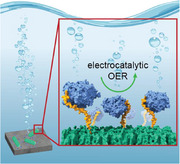 Figure 1
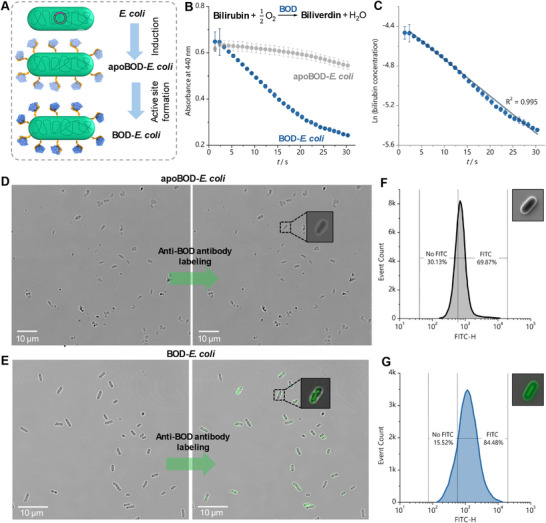 Figure 2
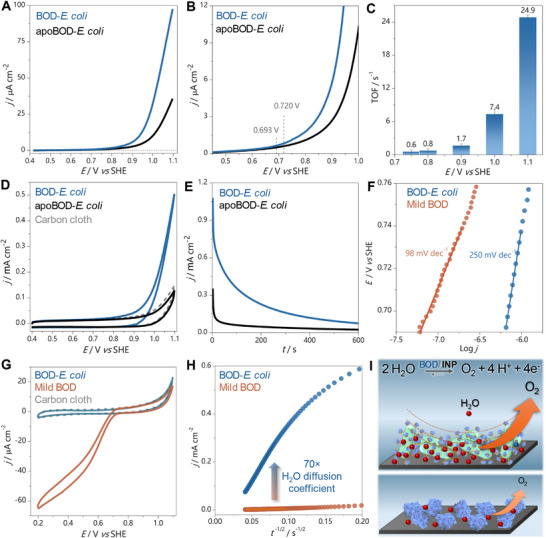 Figure 3
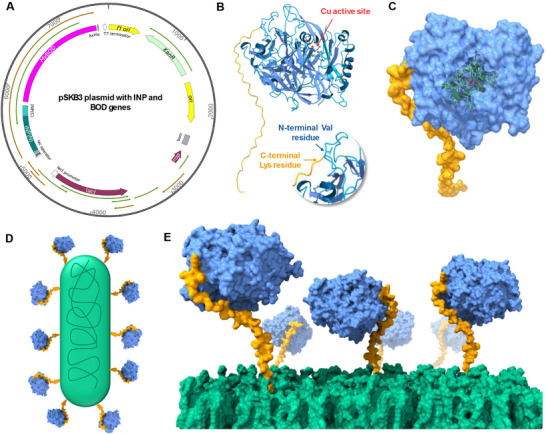 Figure 4
Peer Reviews
No public reviews on file for this paper yet. If you reviewed it on a platform where reviews are public (OpenReview, ICLR, NeurIPS, ICML), you can paste yours below so the community can read it here.
Videos
No videos yet. Explain this paper in a talk, walkthrough, or lecture? Add one.
Taxonomy
TopicsMicrobial Metabolic Engineering and Bioproduction · Microbial Fuel Cells and Bioremediation · Gene Regulatory Network Analysis