MSDTCN-Net: A Multi-Scale Dual-Encoder Network for Skin Lesion Segmentation
Da Li, Xinyang Wu, Qin Wei

TL;DR
This paper introduces MSDTCN-Net, a new network for skin lesion segmentation that improves accuracy by combining local and global features.
Contribution
The novel MSDTCN-Net integrates ConvNeXt, Deformable Transformer, and a multi-scale module for better skin lesion segmentation.
Findings
MSDTCN-Net outperforms existing methods on multiple skin lesion datasets.
The network achieves high IoU, Dice, and ACC metrics, showing strong generalization.
The HFT mechanism improves boundary reconstruction in lesion segmentation.
Abstract
Background/Objectives: Accurate segmentation of skin lesions is essential for early skin cancer detection. However, traditional CNNs are limited in modeling long-range dependencies, leading to poor performance on lesions with complex shapes. Methods: We propose MSDTCN-Net, a dual-encoder network that integrates ConvNeXt and Deformable Transformer to extract both local details and global semantic information. A Squeeze-and-Excitation (SE) mechanism is introduced to adaptively emphasize important channels. To address scale variation in lesions, we design a Multi-Scale Receptive Field (MSRF) module combining multi-branch and dilated convolutions. Furthermore, a Hierarchical Feature Transfer (HFT) mechanism is employed to guide high-level semantics progressively to shallow layers, enhancing boundary reconstruction in the decoder. Results: Extensive experiments on the ISIC 2016, ISIC 2017,…
Genes, proteins, chemicals, diseases, species, mutations and cell lines named across the full text — each resolved to its canonical identifier and authoritative record.
Click any figure to enlarge with its caption.
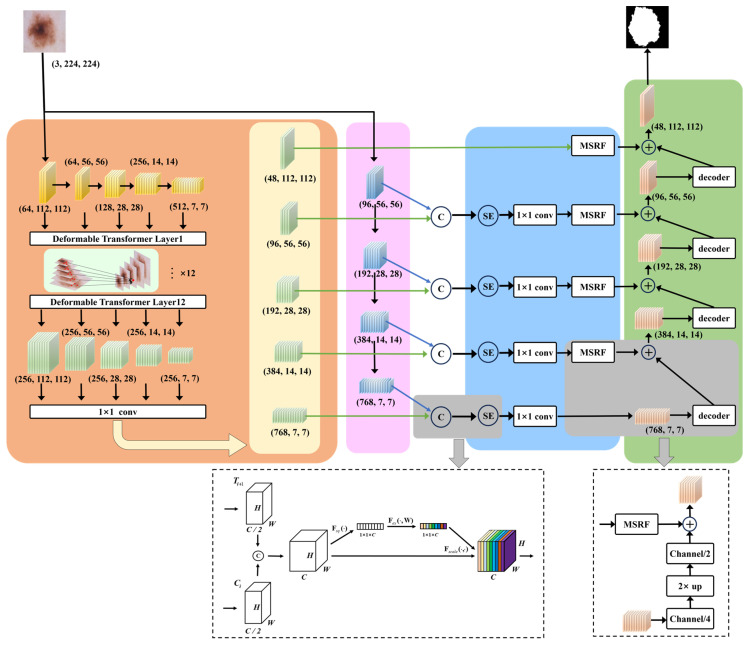 Figure 1
 Figure 2
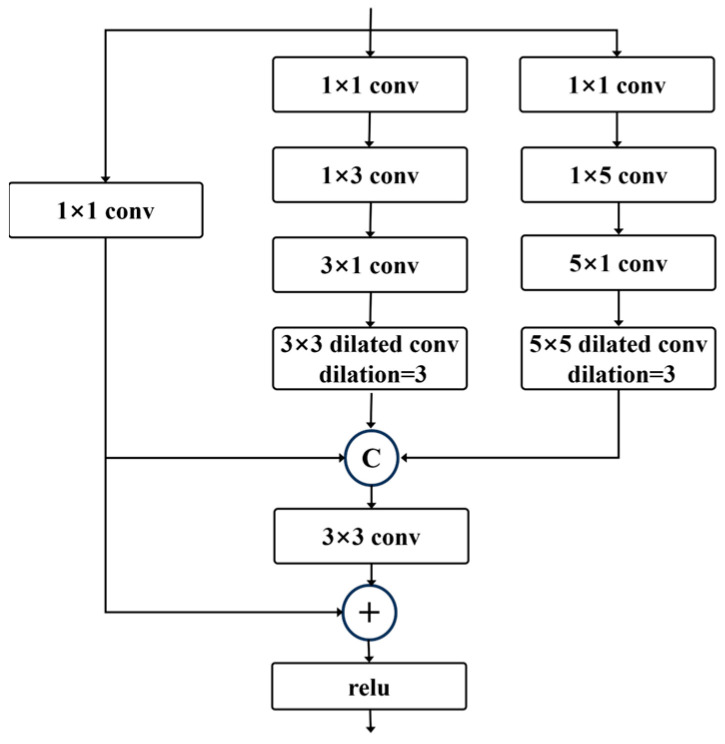 Figure 3
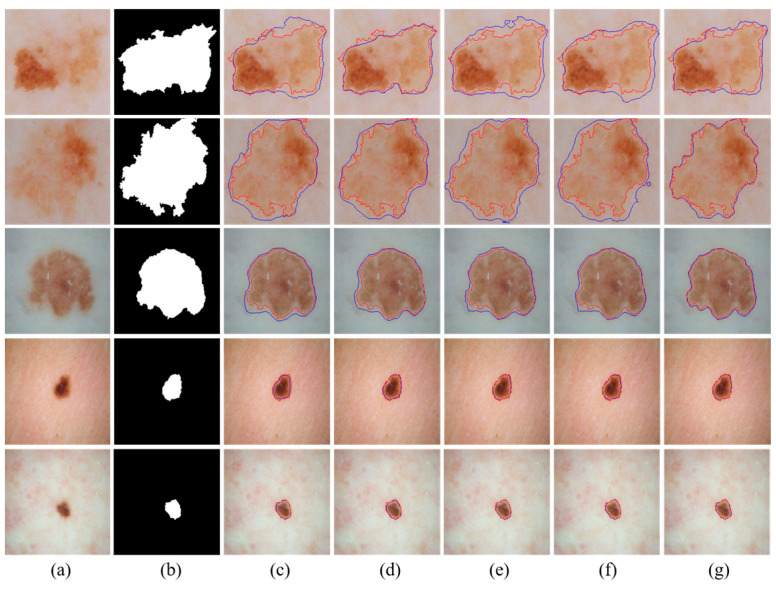 Figure 4
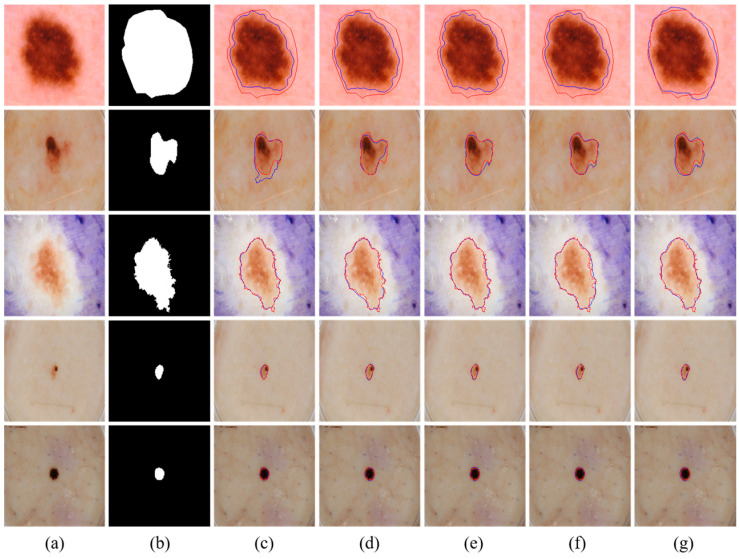 Figure 5
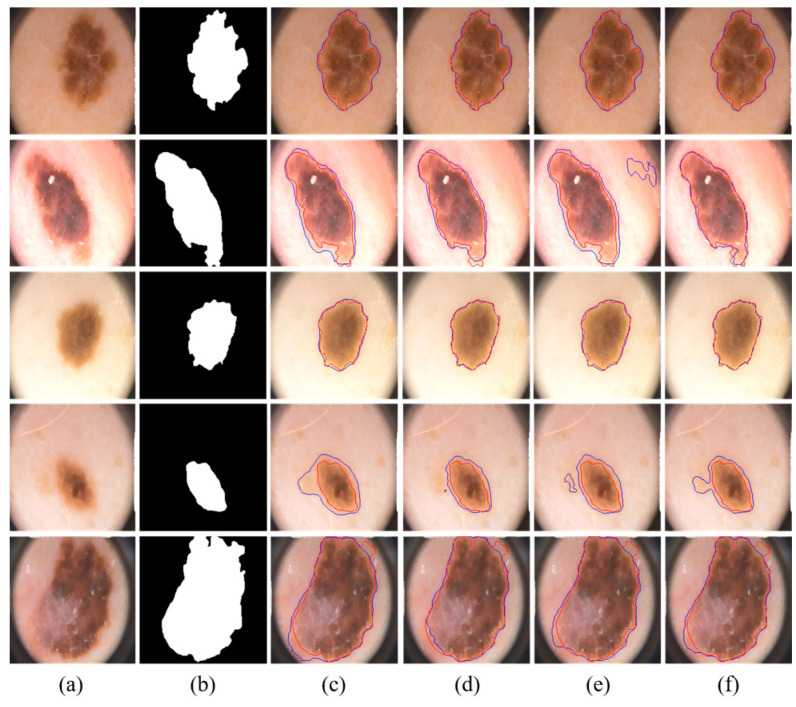 Figure 6
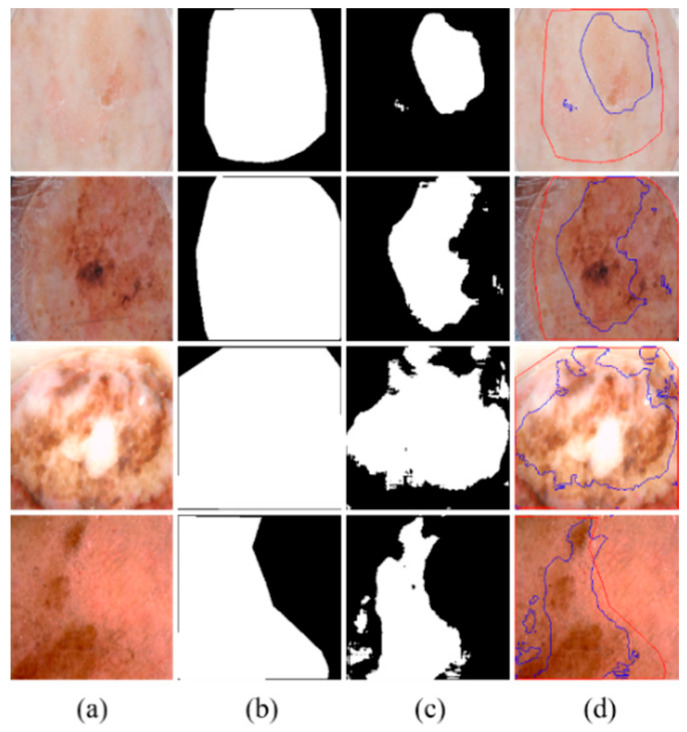 Figure 7
Peer Reviews
No public reviews on file for this paper yet. If you reviewed it on a platform where reviews are public (OpenReview, ICLR, NeurIPS, ICML), you can paste yours below so the community can read it here.
Videos
No videos yet. Explain this paper in a talk, walkthrough, or lecture? Add one.
Taxonomy
TopicsCutaneous Melanoma Detection and Management · Advanced Neural Network Applications · Face recognition and analysis