Entanglement Islands in 1D and 2D Lattices with Defects
Ivan P. Christov

TL;DR
This paper studies how quantum entanglement is affected by defects in 1D and 2D lattices using a new computational method.
Contribution
The study introduces a scalable method to analyze real-space quantum entanglement in defective lattices.
Findings
Entanglement concentrates near defects in 1D systems.
2D systems show bridge-like and radially symmetric entanglement domains.
TDQMC provides a transparent framework for quantum information analysis.
Abstract
We investigate the spatial structure of quantum entanglement in one- and two-dimensional lattice systems containing structural defects, using the Time-Dependent Quantum Monte Carlo (TDQMC) method. By constructing reduced density matrices from ensembles of guide waves, we resolve spatial variations in both Coulomb-mediated entanglement and coherence without requiring full many-body wavefunctions. This approach reveals localized regions, entanglement islands, where quantum correlations are enhanced or suppressed due to the presence of vacancies or interaction inhomogeneities. In 1D systems, entanglement tends to concentrate near defects, while in 2D systems, we observe bridge-like and radially symmetric domains. Our results demonstrate that TDQMC offers a scalable and physically transparent framework for real-space quantum information analysis, with implications for information transfer…
Genes, proteins, chemicals, diseases, species, mutations and cell lines named across the full text — each resolved to its canonical identifier and authoritative record.
Click any figure to enlarge with its caption.
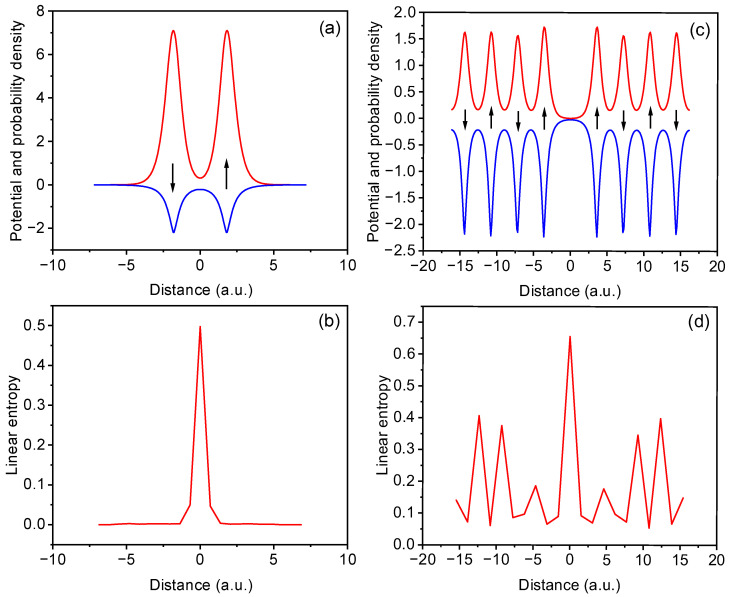 Figure 1
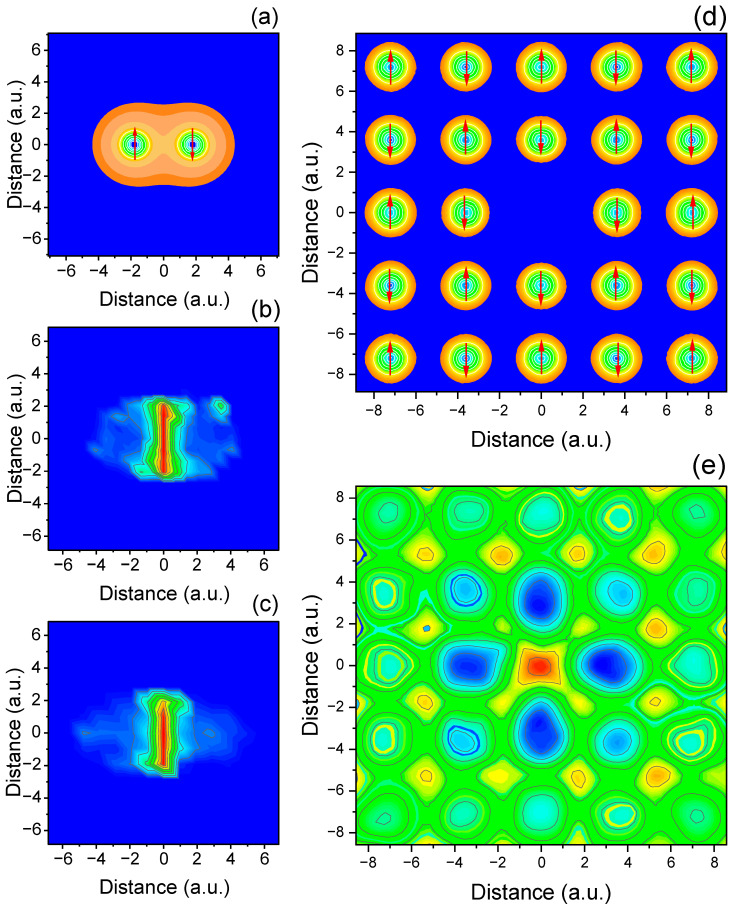 Figure 2
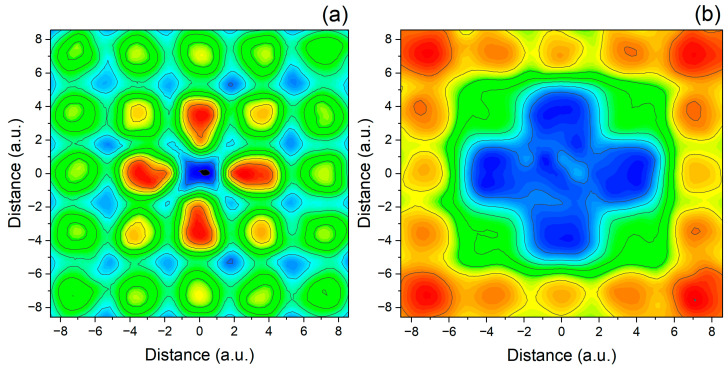 Figure 3
Peer Reviews
No public reviews on file for this paper yet. If you reviewed it on a platform where reviews are public (OpenReview, ICLR, NeurIPS, ICML), you can paste yours below so the community can read it here.
Videos
No videos yet. Explain this paper in a talk, walkthrough, or lecture? Add one.
Taxonomy
TopicsQuantum many-body systems · Quantum Computing Algorithms and Architecture · Quantum and electron transport phenomena