Sleep Disturbance as a Mediator Between Problematic Social Media Use and Depressive Symptoms Among Mexican Undergraduate Nursing Students: A Multicenter Study
José Ángel Hernández-Mariano, Ana Cristina Castañeda-Márquez, Gledy Manuela Olmos-Rivera, Rocío Castillo-Díaz, Fani Villa-Rivas, Edith Araceli Cano-Estrada, Yaneth Citlalli Orbe-Orihuela, Miguel Trujillo-Martínez, Monica Alethia Cureño-Díaz

TL;DR
This study finds that sleep problems partly explain how heavy social media use leads to depression in Mexican nursing students.
Contribution
It identifies sleep disturbance as a key mediator linking social media addiction and depression in a nursing student population.
Findings
51.7% of students experienced sleep disturbance, and 27.5% reported depressive symptoms.
Problematic social media use showed a dose–response relationship with both sleep disturbance and depression.
Sleep disturbance mediated 31.4% of the effect of social media use on depression.
Abstract
Background: Social media addiction is a growing concern among undergraduates, with nursing students particularly vulnerable as their stressful academic and clinical context may promote excessive use, impaired sleep, and higher depression risk. Therefore, we aimed to evaluate whether sleep disturbance mediates the association between problematic social media use and symptoms of depression among nursing students in Mexico. Methods: We conducted a multicenter, cross-sectional, analytical study using a random sample of 638 nursing students from three Mexican public universities. Between August and December 2024, participants completed validated scales for social media addiction, sleep quality, and depression. Counterfactual causal mediation analysis was performed using logistic regression with robust errors. Results: Sleep disturbance affected 51.7% of students, and 27.5% reported…
Genes, proteins, chemicals, diseases, species, mutations and cell lines named across the full text — each resolved to its canonical identifier and authoritative record.
Click any figure to enlarge with its caption.
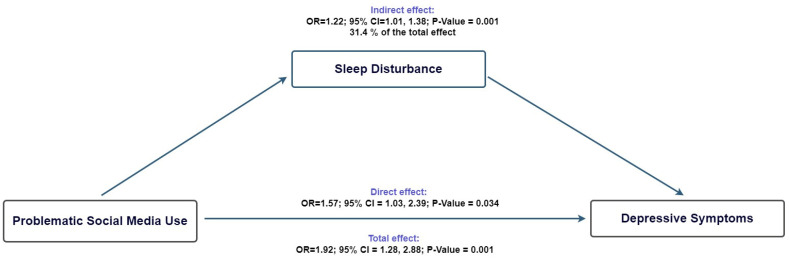 Figure 1
Peer Reviews
No public reviews on file for this paper yet. If you reviewed it on a platform where reviews are public (OpenReview, ICLR, NeurIPS, ICML), you can paste yours below so the community can read it here.
Videos
No videos yet. Explain this paper in a talk, walkthrough, or lecture? Add one.
Taxonomy
TopicsImpact of Technology on Adolescents · Mental Health via Writing · Social Media in Health Education