Patient-Oriented Priorities for Pediatric Erythromelalgia: A Priority-Setting Process
Don Daniel Ocay, Meghan Halpin, Ella Ford, Karen Keighley, Neva Keighley, Nikki Ramsay, Tayla Ramsay, Camelia M. Sheridan, Sarah M. Sheridan, Kirsten R. Tice, Deirdre De Ranieri, See Wan Tham, Catherine A. Brownstein, Jacqui Clinch, Dawn Marie Davis, Carolina Donado

TL;DR
This study identifies the top 10 research priorities for pediatric erythromelalgia from the perspectives of patients, families, and clinicians.
Contribution
It presents the first international patient-centered research agenda for childhood-onset erythromelalgia.
Findings
The top priorities focused on treatment, underlying mechanisms, and associations with body systems.
The final list was developed through a consensus process involving participants from multiple countries.
The study highlights the need for improved research and care for pediatric erythromelalgia.
Abstract
Background/Objectives: Erythromelalgia is a rare condition characterized by burning pain, redness, and warmth primarily in the extremities, usually worsened by heat and alleviated by cold. The objective of this study was to identify the top 10 priorities in pediatric erythromelalgia from multiple perspectives, including clinicians, people with lived experience of childhood-onset erythromelalgia, and their family members. Methods: A modified James Lind Alliance Priority-Setting Process was conducted. The top priorities were identified through four phases: (1) an international online survey to gather priorities, (2) data processing, (3) an interim prioritization online survey, and (4) a virtual workshop to set the final priorities. Results: In phase 1, 185 potential priorities were submitted by 74 respondents (53% patients, 24% family members, and 23% clinicians) that were developed into…
Genes, proteins, chemicals, diseases, species, mutations and cell lines named across the full text — each resolved to its canonical identifier and authoritative record.
Click any figure to enlarge with its caption.
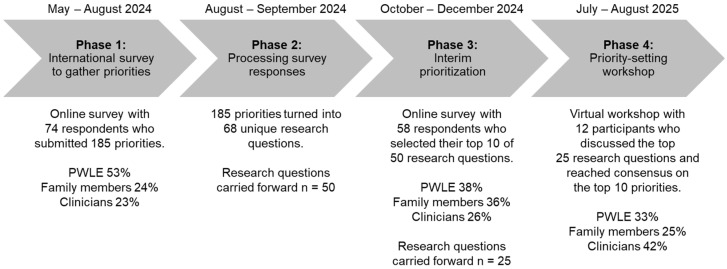 Figure 1
Peer Reviews
No public reviews on file for this paper yet. If you reviewed it on a platform where reviews are public (OpenReview, ICLR, NeurIPS, ICML), you can paste yours below so the community can read it here.
Videos
No videos yet. Explain this paper in a talk, walkthrough, or lecture? Add one.
Taxonomy
TopicsPain Mechanisms and Treatments · Fibromyalgia and Chronic Fatigue Syndrome Research · Botulinum Toxin and Related Neurological Disorders