Umbilical Hernia Probe-Induced Cocco Sign: Color Doppler During Pressure and Release in Standing Position
Corrado Tagliati, Marco Fogante, Claudio Ventura, Stefania Lamja, Roberto Esposito, Marco Di Serafino, Antonio Corvino, Giulio Argalia, Ernesto Di Cesare, Andrea Delli Pizzi, Giulio Cocco

TL;DR
A new ultrasound technique called the probe-induced Cocco sign was used to detect an umbilical hernia in a standing patient.
Contribution
The paper introduces a novel ultrasound method for diagnosing umbilical hernias using pressure and release in a standing position.
Findings
Applying pressure and releasing it with the ultrasound probe revealed the Cocco sign.
The technique was performed with the patient in a standing position, which is uncommon for such ultrasounds.
Abstract
We describe a case of an ultrasound-detected umbilical hernia in a 56-year-old female patient who underwent a skin ultrasound. With the patient in a standing position, the probe was positioned at the level of the umbilicus. Pressure was applied with the probe and then it was released; probe-induced Cocco sign was revealed.
Genes, proteins, chemicals, diseases, species, mutations and cell lines named across the full text — each resolved to its canonical identifier and authoritative record.
Click any figure to enlarge with its caption.
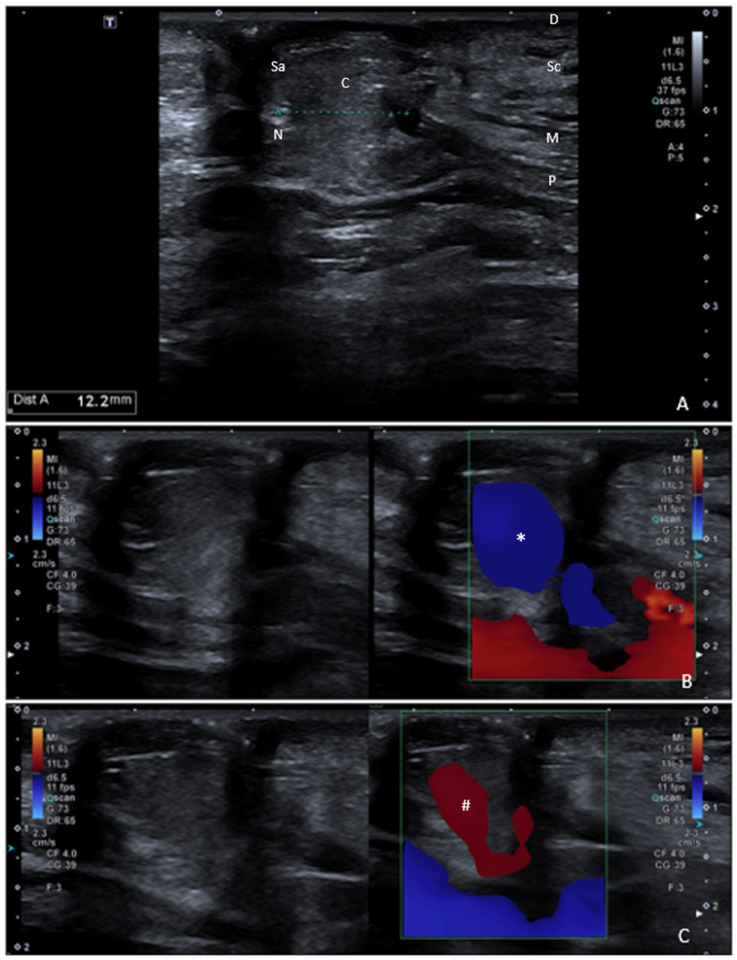 Figure 1
Peer Reviews
No public reviews on file for this paper yet. If you reviewed it on a platform where reviews are public (OpenReview, ICLR, NeurIPS, ICML), you can paste yours below so the community can read it here.
Videos
No videos yet. Explain this paper in a talk, walkthrough, or lecture? Add one.
Taxonomy
TopicsHernia repair and management · Minimally Invasive Surgical Techniques · Congenital Diaphragmatic Hernia Studies