Performance Comparison of In-House and Commercial Biosynex Helmints AMPLIQUICK® Real-Time PCR Assays for the Diagnosis of Schistosoma mansoni and Strongyloides stercoralis in Stool Samples
Davide Treggiari, Francesca Tamarozzi, Fabio Formenti, Salvatore Scarso, Barbara Pajola, Lavinia Nicolini, Cristina Mazzi, Francesca Perandin

TL;DR
This study compares in-house and commercial PCR tests for diagnosing two parasitic infections using stool samples, finding similar overall performance but some discrepancies in specific cases.
Contribution
The study provides a direct performance comparison of in-house versus commercial RT-PCR assays for Schistosoma mansoni and Strongyloides stercoralis under regulatory compliance requirements.
Findings
Sensitivity and specificity were not significantly different between the two RT-PCR assays for both parasites.
Concordance was perfect for controls but poor for S. mansoni cases and good for S. stercoralis cases.
The study highlights the need for careful evaluation of molecular targets to address clinically significant discrepancies.
Abstract
Background/Objectives: The timely diagnosis of schistosomiasis and strongyloidiasis is important because of their potentially severe, even lethal, consequences. European diagnostic laboratories must comply with the European In Vitro Diagnostic (IVD) Regulation, which requires justifying the use of in-house assays when CE-IVD-marked kits are available. We aimed to compare the performance of the Biosynex Helminths AMPLIQUICK® RT-PCR and the multiplex in-house RT-PCR for the diagnosis of Schistosoma mansoni and Strongyloides stercoralis currently used in our department, an Italian reference centre for tropical diseases. Methods: We conducted a performance comparison study on biobanked frozen stool samples classified as cases or controls according to PCR and/or copromicroscopy at diagnosis. Both RT-PCRs were performed on DNA re-extracted from the same stool aliquot. Sensitivity and…
Genes, proteins, chemicals, diseases, species, mutations and cell lines named across the full text — each resolved to its canonical identifier and authoritative record.
Click any figure to enlarge with its caption.
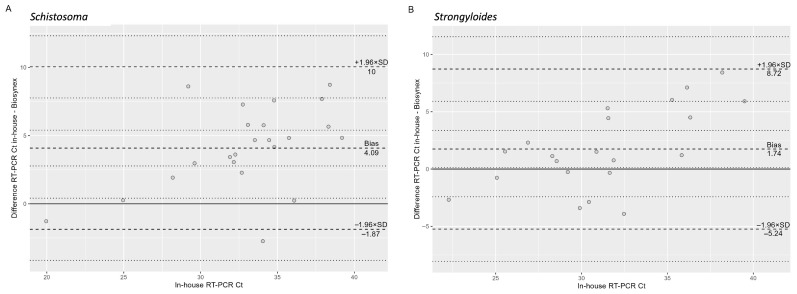 Figure 1
Peer Reviews
No public reviews on file for this paper yet. If you reviewed it on a platform where reviews are public (OpenReview, ICLR, NeurIPS, ICML), you can paste yours below so the community can read it here.
Videos
No videos yet. Explain this paper in a talk, walkthrough, or lecture? Add one.
Taxonomy
TopicsParasites and Host Interactions · Parasite Biology and Host Interactions · Global Health and Epidemiology