Late Morbidity and Mortality in Survivors of Childhood Ependymoma: A Report from the Childhood Cancer Survivor Study (CCSS)
Katharine R. Lange, Peter de Blank, Mengqi Xing, Sedigheh Mirzaei, Deo Kumar Srivastava, Kevin Oeffinger, Joseph Neglia, Kevin Krull, Paul C. Nathan, Rebecca Howell, Kirsten K. Ness, Lucie M. Turcotte, Wendy Leisenring, Gregory T. Armstrong, Tara Brinkman, Daniel C. Bowers

TL;DR
This study finds that long-term health outcomes for childhood ependymoma survivors have not improved despite changes in treatment approaches over time.
Contribution
The study provides the most comprehensive evaluation of long-term outcomes in ependymoma survivors and highlights the impact of treatment changes on late mortality and morbidity.
Findings
Late mortality rates remained similar across decades despite treatment changes.
Whole-brain radiation was associated with higher late mortality and chronic health conditions.
Reduced radiation volumes were linked to lower late mortality and morbidity.
Abstract
This study provides the most comprehensive evaluation to date of long term outcomes among five year survivors of pediatric ependymoma. Between 1970 and 1999, treatment for pediatric ependymoma evolved to reduce cranial radiation volumes and incorporate chemotherapy for some patients. But, late morbidity and mortality have not improved among pediatric ependymoma survivors despite these treatment changes. Reduced cranial radiation volume was associated with a reduced risk for late mortality and decreased grade 3–4 chronic health conditions. Our findings reveal that rates of late mortality and serious chronic health conditions have not substantially improved over the decades studied though reduced whole-brain radiation exposure is associated with lower late mortality and morbidity, supporting efforts to minimize radiation fields when safe and feasible. Background/Objectives: Treatment of…
Genes, proteins, chemicals, diseases, species, mutations and cell lines named across the full text — each resolved to its canonical identifier and authoritative record.
Click any figure to enlarge with its caption.
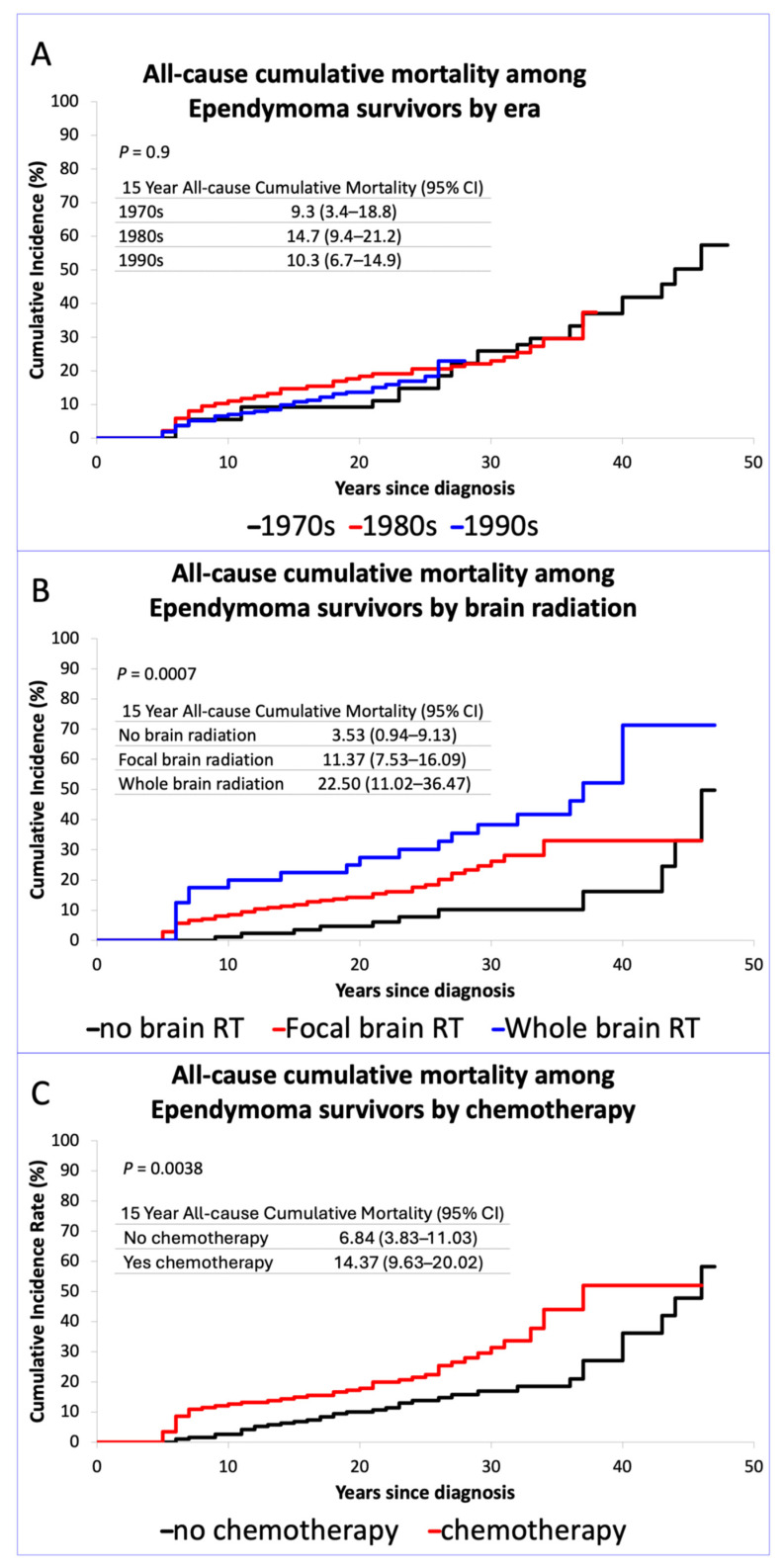 Figure 1
Peer Reviews
No public reviews on file for this paper yet. If you reviewed it on a platform where reviews are public (OpenReview, ICLR, NeurIPS, ICML), you can paste yours below so the community can read it here.
Videos
No videos yet. Explain this paper in a talk, walkthrough, or lecture? Add one.
Taxonomy
TopicsGlioma Diagnosis and Treatment · Childhood Cancer Survivors' Quality of Life · Acute Lymphoblastic Leukemia research