A New Lower Bound for Noisy Permutation Channels via Divergence Packing
Lugaoze Feng, Guocheng Lv, Xunan Li, Ye Jin

TL;DR
This paper introduces a tighter lower bound for noisy permutation channels, improving coding efficiency in communication systems.
Contribution
A novel achievability bound is derived using divergence packing and error event analysis for noisy permutation channels.
Findings
The new bound improves the lower bound of channel coding significantly.
A Gaussian approximation effectively replaces complex computations for a wide parameter range.
Abstract
Noisy permutation channels are applied in modeling biological storage systems and communication networks. For noisy permutation channels with strictly positive and full-rank square matrices, new achievability bounds are given in this paper, which are tighter than existing bounds. To derive this bound, we use the ϵ-packing with Kullback–Leibler divergence as a distance and introduce a novel way to illustrate the overlapping relationship of error events. This new bound shows analytically that for such a matrix W, the logarithm of the achievable code size with a given block n and error probability ϵ is closely approximated by ℓlogn−Φ−1(ϵ/G)+logV(W), where ℓ=rank(W)−1, G=2ℓ+12, and V(W) is a characteristic of the channel referred to as channel volume ratio. Our numerical results show that the new achievability bound significantly improves the lower bound of channel coding. Additionally, the…
Genes, proteins, chemicals, diseases, species, mutations and cell lines named across the full text — each resolved to its canonical identifier and authoritative record.
Click any figure to enlarge with its caption.
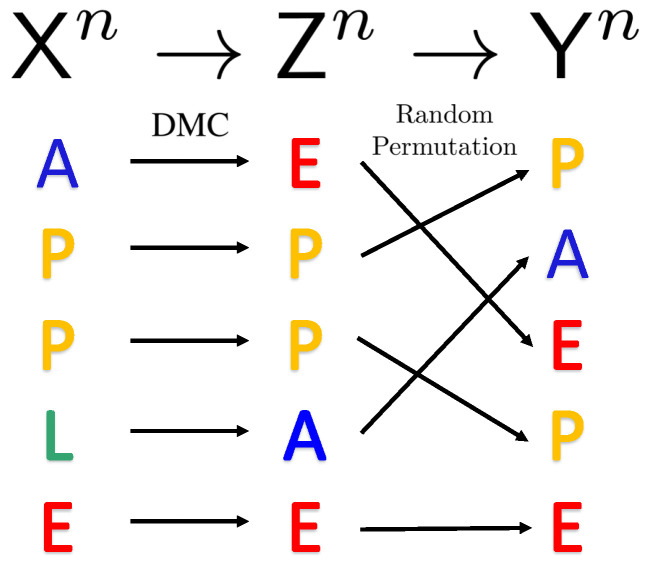 Figure 1
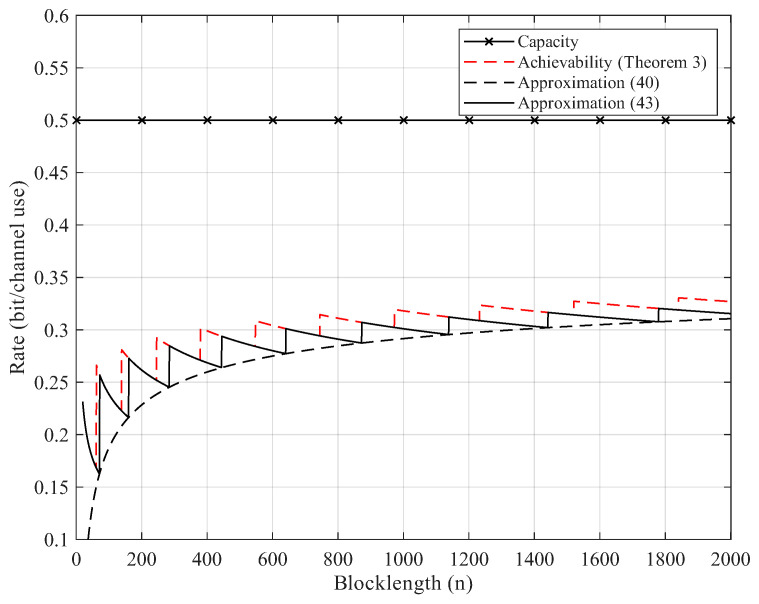 Figure 2
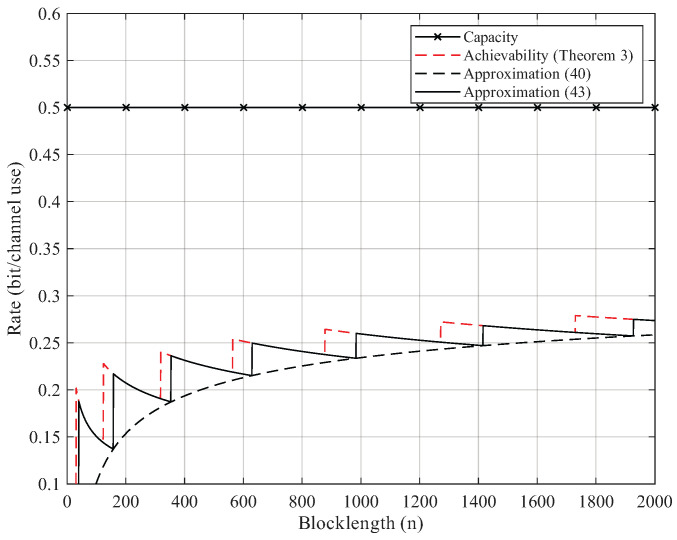 Figure 3
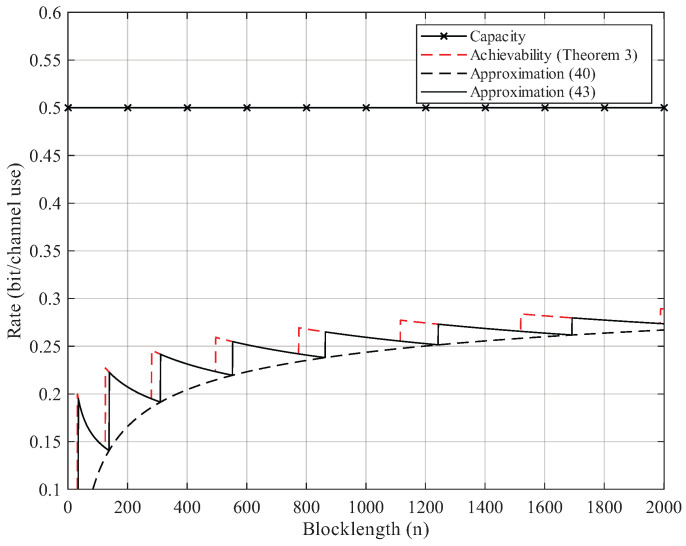 Figure 4
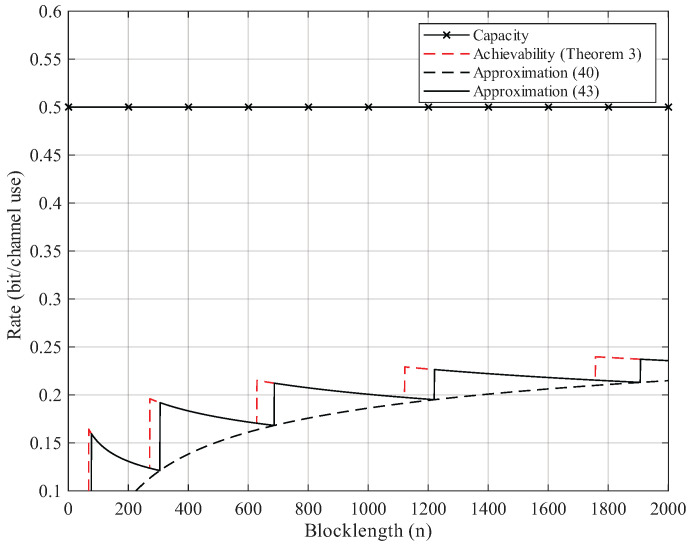 Figure 5
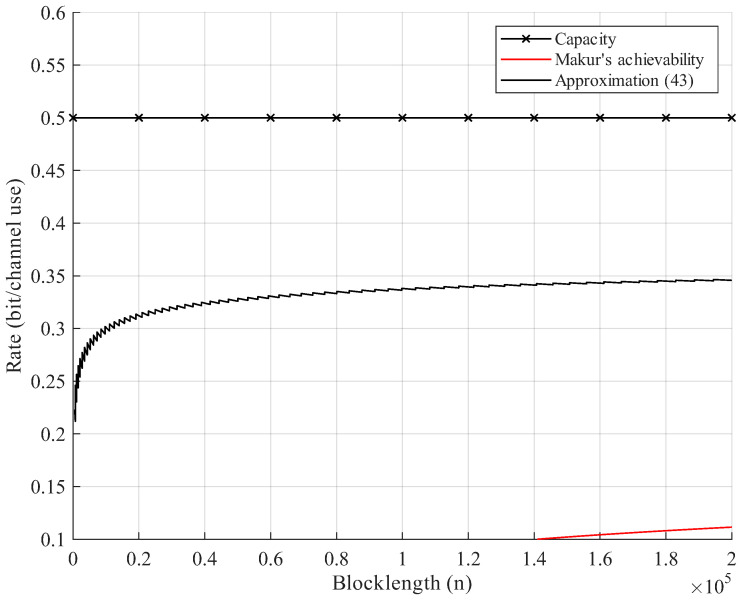 Figure 6
Peer Reviews
No public reviews on file for this paper yet. If you reviewed it on a platform where reviews are public (OpenReview, ICLR, NeurIPS, ICML), you can paste yours below so the community can read it here.
Videos
No videos yet. Explain this paper in a talk, walkthrough, or lecture? Add one.
Taxonomy
TopicsError Correcting Code Techniques · Wireless Communication Security Techniques · Cooperative Communication and Network Coding