In-Depth Study of Low-Complexity Domains: From Structural Diversity to Disease Mechanisms
Haixia Xu, Kaili Zhou, Lianren Xia, Kejin Ren, Yongjie Xu

TL;DR
Low-complexity domains in proteins are now recognized as important for cellular functions and disease mechanisms, with roles in protein interactions and neurodegenerative disorders.
Contribution
This review systematically explores structural, functional, and pathological aspects of low-complexity domains and highlights recent methodological advances.
Findings
LCDs exhibit intrinsic disorder and conformational dynamics, influencing β-sheet formation and phase separation.
Dysfunction in LCDs is linked to diseases like ALS, AD, and Ewing sarcoma through mechanisms like aggregation and aberrant phase separation.
Advances in methods like cryo-EM, fluorescence microscopy, and AI simulations are enhancing LCD research.
Abstract
Low-complexity domains (LCDs) are protein regions characterized by a simple amino acid composition and low sequence complexity, as they are typically composed of repeats or a limited set of a few amino acids. Historically dismissed as “garbage sequences”, these regions are now acknowledged as critical functional elements. This review systematically explores the structural characteristics, biological functions, pathological roles, and research methodologies associated with LCDs. Structurally, LCDs are marked by intrinsic disorder and conformational dynamics, with their amino acid composition (e.g., G/Y-rich, Q-rich, S/R-rich, P-rich) dictating structural tendencies (e.g., β-sheet formation, phase separation ability). Functionally, LCDs mediate protein–protein interactions, drive liquid–liquid phase separation (LLPS) to form biomolecular condensates, and play roles in signal transduction,…
Genes, proteins, chemicals, diseases, species, mutations and cell lines named across the full text — each resolved to its canonical identifier and authoritative record.
Click any figure to enlarge with its caption.
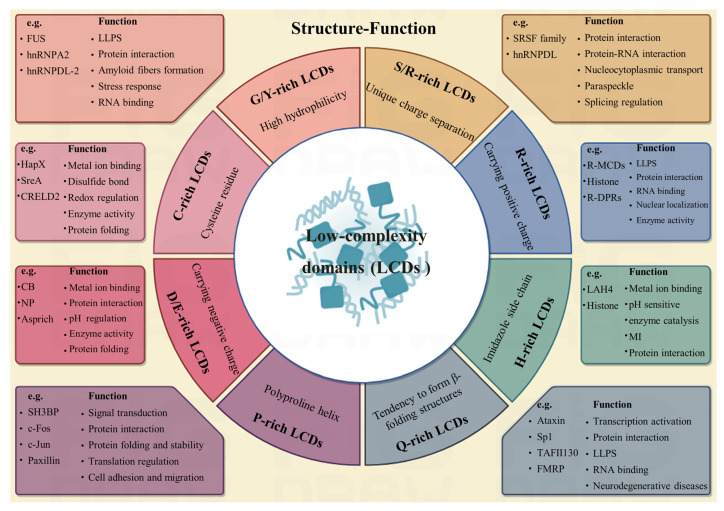 Figure 1
 Figure 2
Peer Reviews
No public reviews on file for this paper yet. If you reviewed it on a platform where reviews are public (OpenReview, ICLR, NeurIPS, ICML), you can paste yours below so the community can read it here.
Videos
No videos yet. Explain this paper in a talk, walkthrough, or lecture? Add one.
Taxonomy
TopicsRNA Research and Splicing · Nuclear Structure and Function · Skin and Cellular Biology Research