Exploring Different Extrapolation Approaches for the Critical Temperature of the 2D-Ising Model Based on Exactly Solvable Finite-Sized Lattices
Daniel Markthaler, Kai Peter Birke

TL;DR
This paper explores methods to estimate the critical temperature of the 2D-Ising model using small, exactly solvable lattices and compares their effectiveness.
Contribution
A novel single-parameter model for extrapolating the critical temperature using the N/(N+1)-law is introduced and validated.
Findings
Both scaling models and envelope constructions converge to the same asymptotic critical temperature value.
The proposed N/(N+1)-law model provides robust convergence with high accuracy.
Highly accurate finite-size results are sufficient for precise extrapolation of the critical temperature.
Abstract
The fact that the Ising model in higher dimensions than 1D features a phase transition at the critical temperature Tc despite its apparent simplicity is one of the main reasons why it has lost none of its fascination and remains a central benchmark in modeling physical systems. Building on our previous work, where an approximative analytic free-energy expression for finite 2D-Ising lattices was introduced, we investigate different extrapolation strategies for estimating Tc of the infinite system from exactly solvable small lattices. Finite square lattices of linear dimension N with free and periodic boundary conditions were analyzed, exploiting their exactly accessible density of states to compute the heat capacity profiles C(T). Different approaches were compared, including scaling models for the peak temperature Tmax(N) and an envelope construction across the set of C(T)-profiles. We…
Genes, proteins, chemicals, diseases, species, mutations and cell lines named across the full text — each resolved to its canonical identifier and authoritative record.
Click any figure to enlarge with its caption.
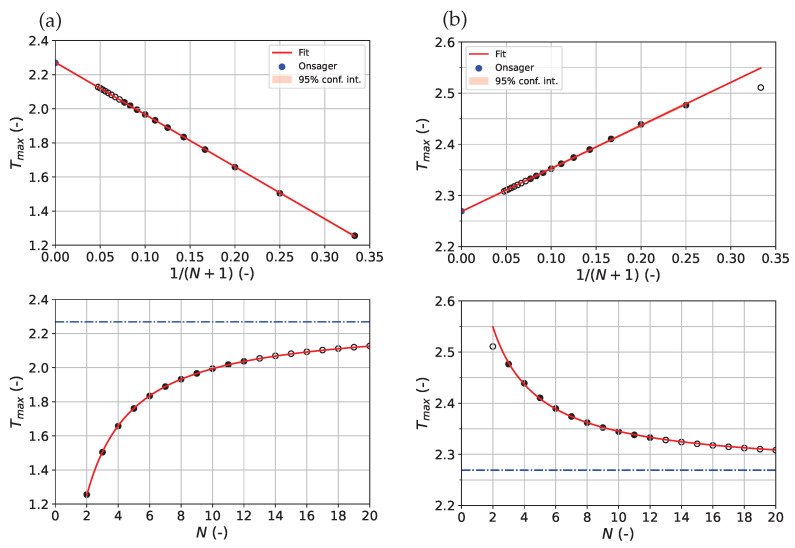 Figure 1
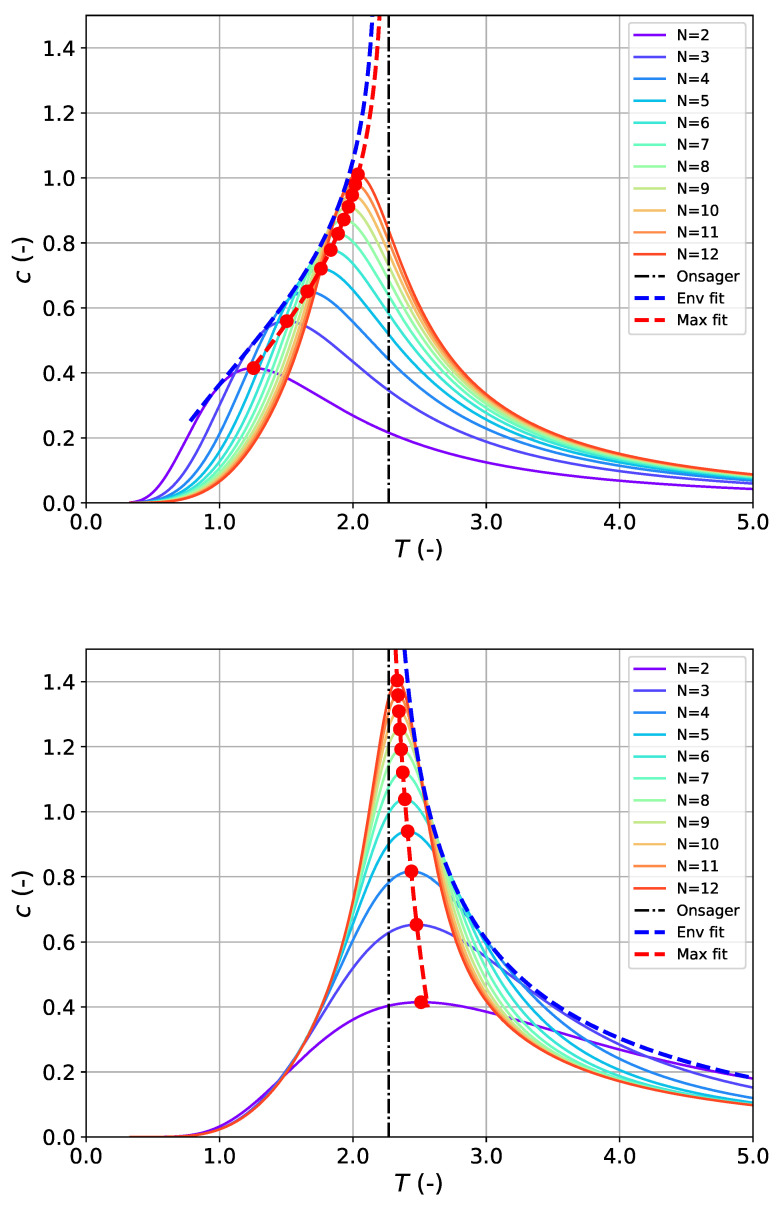 Figure 2
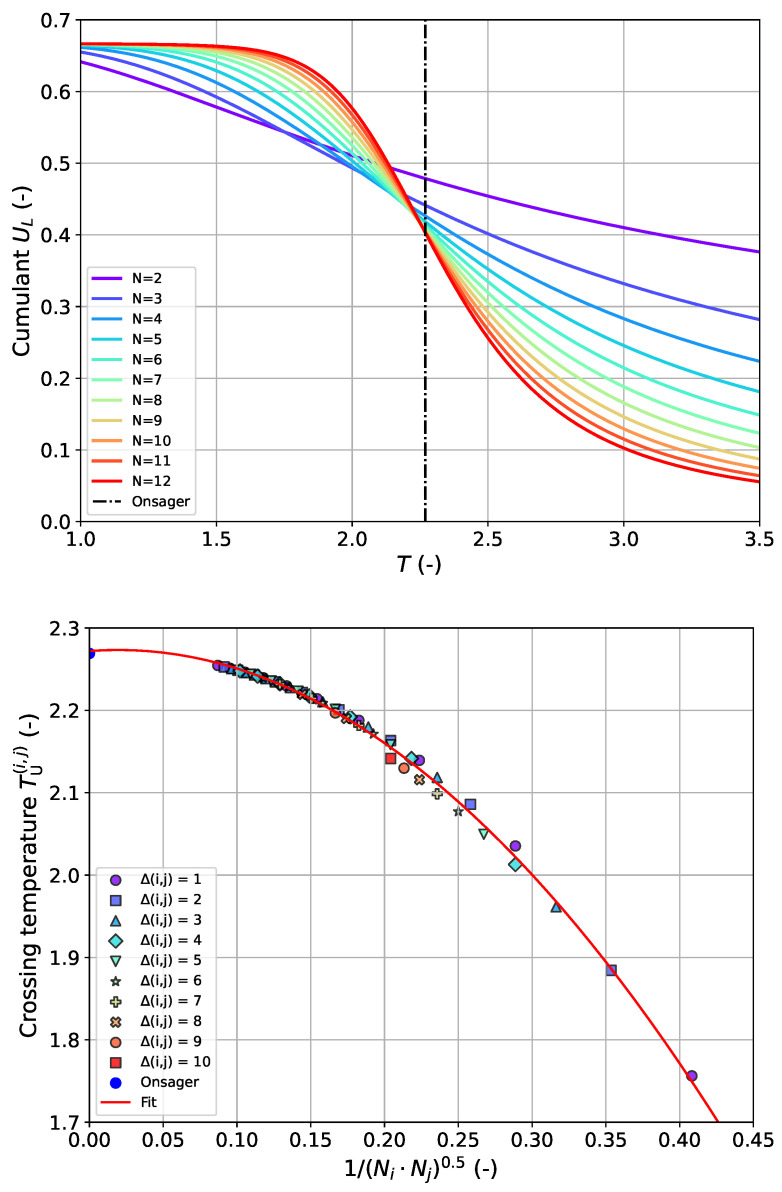 Figure 3
Peer Reviews
No public reviews on file for this paper yet. If you reviewed it on a platform where reviews are public (OpenReview, ICLR, NeurIPS, ICML), you can paste yours below so the community can read it here.
Videos
No videos yet. Explain this paper in a talk, walkthrough, or lecture? Add one.
Taxonomy
TopicsTheoretical and Computational Physics · Opinion Dynamics and Social Influence · Stochastic processes and statistical mechanics