Circulating Tumor DNA (ctDNA) in Gastroesophageal Adenocarcinoma (GEA): Evidence and Emerging Applications
Oudai Sahwan, Lin Batha, Fares Jamal, Mohamad Bassam Sonbol

TL;DR
This paper reviews how circulating tumor DNA (ctDNA) can be used non-invasively to monitor and guide treatment in gastroesophageal cancer patients.
Contribution
The paper provides a comprehensive review of ctDNA's emerging clinical applications in gastroesophageal adenocarcinoma, including recurrence prediction and resistance detection.
Findings
Postoperative ctDNA can detect high recurrence risk in gastroesophageal cancer months before imaging.
ctDNA can reveal actionable biomarkers like ERBB2 and FGFR2 in metastatic gastroesophageal cancer.
ctDNA levels correlate with prognosis and treatment response in advanced gastroesophageal adenocarcinoma.
Abstract
Circulating tumor DNA (ctDNA) has emerged as a promising non-invasive biomarker that can be detected in the blood of patients with gastroesophageal adenocarcinoma (GEA). Measuring ctDNA levels can help identify patients at high risk of recurrence after surgery, evaluate treatment response, and detect molecular changes that signal resistance to therapy. ctDNA can also uncover actionable biomarkers such as ERBB2 or MSI-H and reveal resistance mechanisms. In this review, we summarize recent studies on the clinical applications of ctDNA in resectable and advanced GEA. The role of circulating tumor DNA (ctDNA) in gastroesophageal adenocarcinoma (GEA) has expanded in recent years. In resectable disease, postoperative ctDNA is able to detect patients at highest risk of recurrence months before scans. Tumor-informed assays provide the best sensitivity and emerging methylation assays are useful…
Genes, proteins, chemicals, diseases, species, mutations and cell lines named across the full text — each resolved to its canonical identifier and authoritative record.
Click any figure to enlarge with its caption.
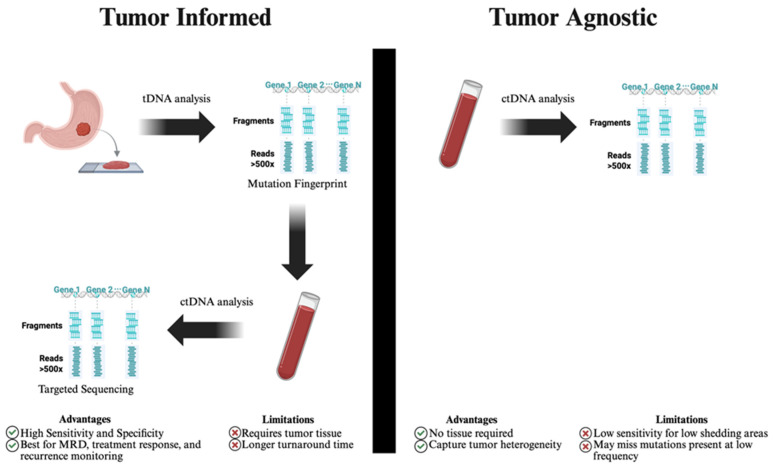 Figure 1
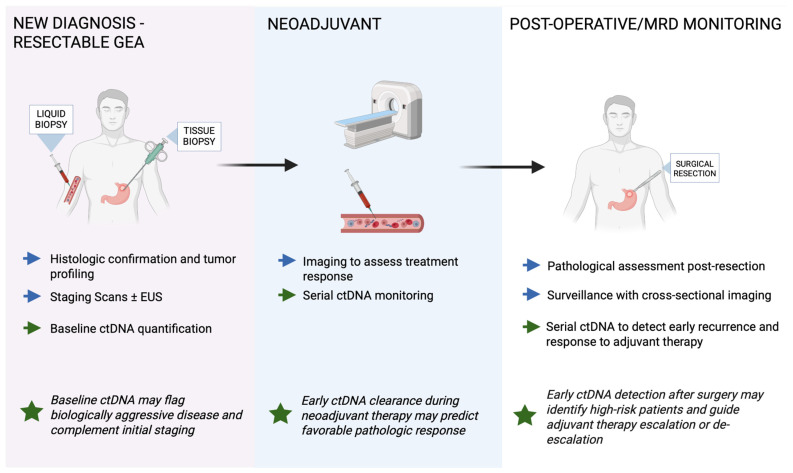 Figure 2
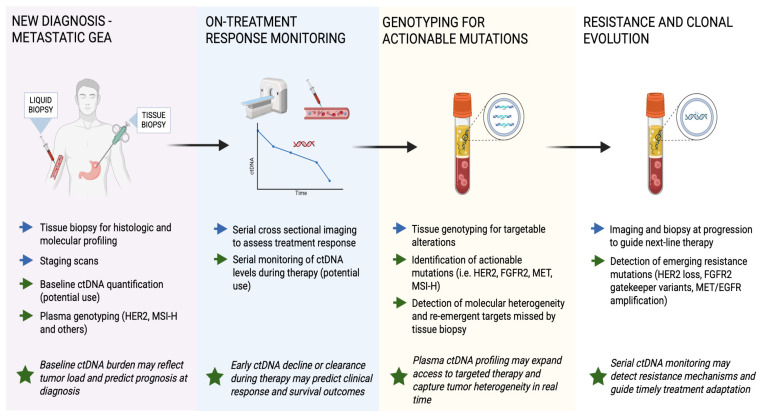 Figure 3
Peer Reviews
No public reviews on file for this paper yet. If you reviewed it on a platform where reviews are public (OpenReview, ICLR, NeurIPS, ICML), you can paste yours below so the community can read it here.
Videos
No videos yet. Explain this paper in a talk, walkthrough, or lecture? Add one.
Taxonomy
TopicsCancer Genomics and Diagnostics · Cancer Cells and Metastasis · Epigenetics and DNA Methylation