Context-Dependent Roles of Siglec-F+ Neutrophils
Kisung Sheen, Taesoo Choi, Man S. Kim

TL;DR
Siglec-F+ neutrophils are a unique type of immune cell that behaves differently in various diseases, and could be important for new treatments.
Contribution
The paper reviews the distinct roles and regulatory mechanisms of Siglec-F+ neutrophils across different contexts.
Findings
Siglec-F+ neutrophils have extended lifespans and remain in tissues longer than conventional neutrophils.
These cells show functional plasticity, aiding in bacterial clearance, tumor progression, and tissue remodeling.
Targeting Siglec-F+ neutrophil pathways may enable precision immunomodulation for disease treatment.
Abstract
Recent studies in murine disease models have identified Siglec-F+ neutrophils, which express a marker traditionally associated with eosinophils, as a functionally distinct population characterized by extended lifespans and context-dependent roles. While conventional neutrophils typically return to the bone marrow or undergo apoptosis at the site of inflammation, these cells remain in tissues for extended periods. These cells demonstrate remarkable functional plasticity, promote bacterial clearance and immune activation during infections, foster immunosuppression and tumor progression in cancer, and contribute to tissue remodeling in fibrotic diseases. In this review, we examine the key features governing Siglec-F+ neutrophil differentiation and function—including Siglec-F signaling, metabolic programming, and upstream cytokine cues—and explore how targeting these pathways may offer…
Genes, proteins, chemicals, diseases, species, mutations and cell lines named across the full text — each resolved to its canonical identifier and authoritative record.
Click any figure to enlarge with its caption.
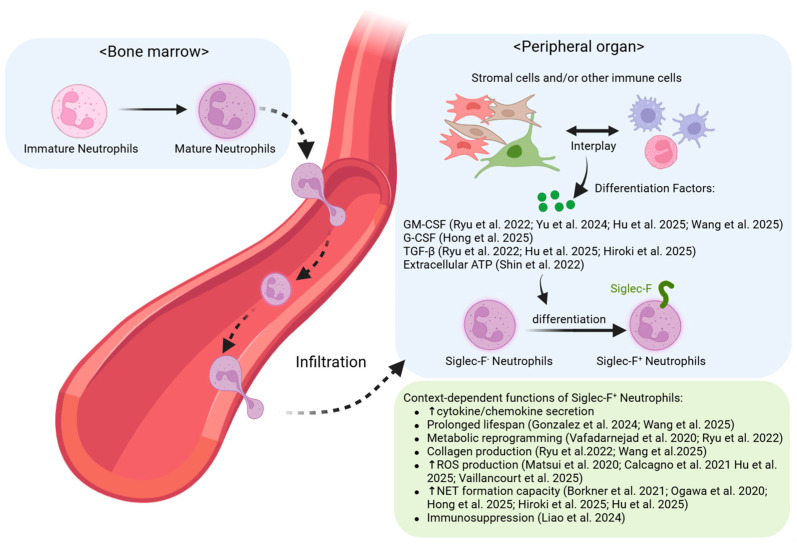 Figure 1
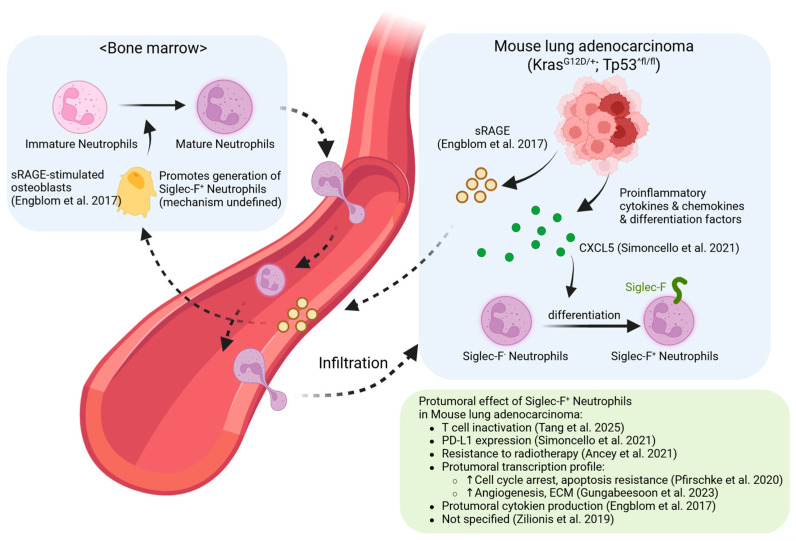 Figure 2
Peer Reviews
No public reviews on file for this paper yet. If you reviewed it on a platform where reviews are public (OpenReview, ICLR, NeurIPS, ICML), you can paste yours below so the community can read it here.
Videos
No videos yet. Explain this paper in a talk, walkthrough, or lecture? Add one.
Taxonomy
TopicsNeutrophil, Myeloperoxidase and Oxidative Mechanisms · S100 Proteins and Annexins · Immune cells in cancer