Automatic Change Detection of Human Attractiveness: Comparing Visual and Auditory Perception
Meng Liu, Jin Gao, Werner Sommer, Weijun Li

TL;DR
This study explores how people automatically detect changes in facial and vocal attractiveness, finding that unattractive cues are detected more strongly than attractive ones.
Contribution
The study introduces a novel ERP-based approach to compare automatic processing of facial and vocal attractiveness.
Findings
Mismatch negativities (MMNs) were elicited by both high- and low-attractive faces and voices.
Low-attractive voices induced larger MMNs than high-attractive ones, while low-attractive faces induced larger P3 amplitudes.
Results suggest a negativity bias in attractiveness processing, with stronger responses to unattractive stimuli.
Abstract
Background/Objectives: Change detection of social cues across individuals plays an important role in human interaction. Methods: Here we investigated the automatic change detection of facial and vocal attractiveness in 19 female participants by recording event-related potentials (ERPs). We adopted a ‘deviant-standard-reverse’ oddball paradigm where high- or low-attractive items were embedded as deviants in a sequence of opposite attractive standard stimuli. Results: Both high- and low-attractive faces and voices elicited mismatch negativities (MMNs). Furthermore, low-attractive versus high-attractive items induced larger mismatch negativities in the voice condition but larger P3 amplitudes in the face condition. Conclusions: These data indicate that attractiveness can be automatically detected but that differences exist between facial and vocal attractiveness processing. Generally,…
Genes, proteins, chemicals, diseases, species, mutations and cell lines named across the full text — each resolved to its canonical identifier and authoritative record.
Click any figure to enlarge with its caption.
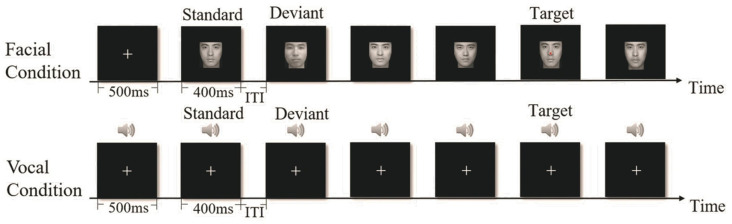 Figure 1
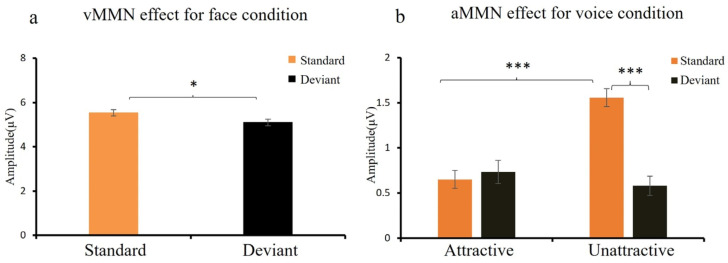 Figure 2
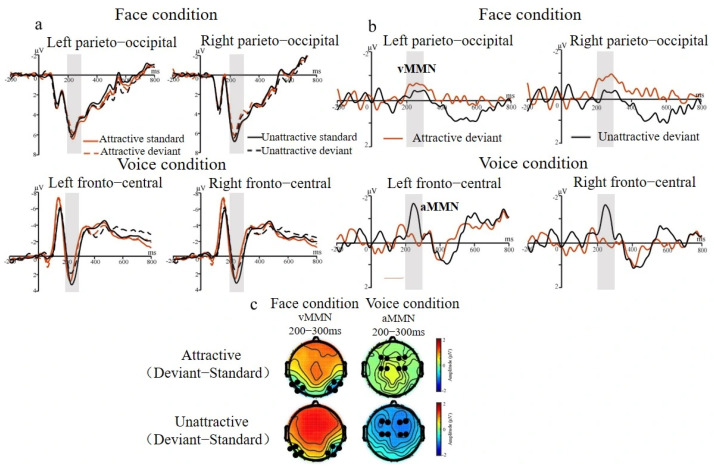 Figure 3
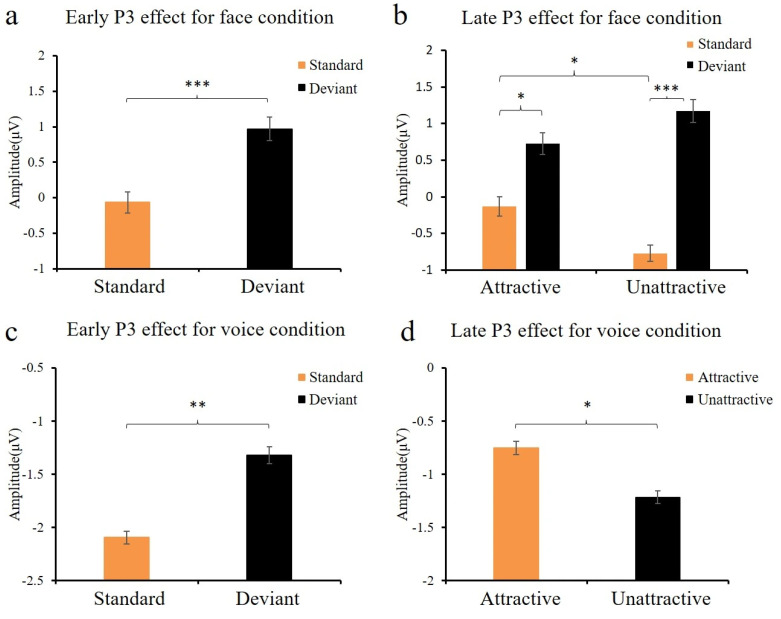 Figure 4
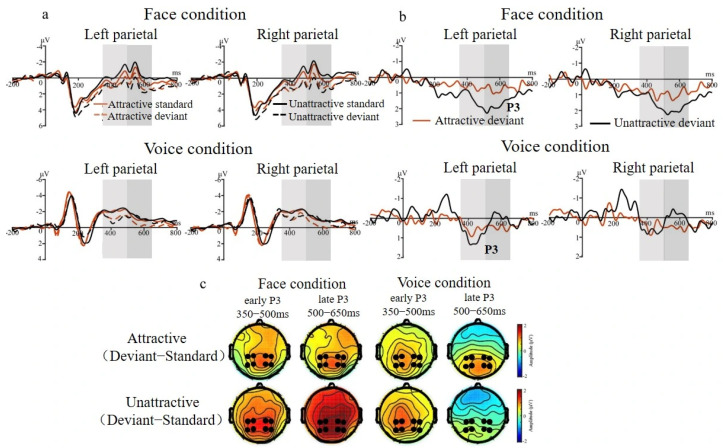 Figure 5
Peer Reviews
No public reviews on file for this paper yet. If you reviewed it on a platform where reviews are public (OpenReview, ICLR, NeurIPS, ICML), you can paste yours below so the community can read it here.
Videos
No videos yet. Explain this paper in a talk, walkthrough, or lecture? Add one.
Taxonomy
TopicsEvolutionary Psychology and Human Behavior · Face Recognition and Perception · Personality Traits and Psychology