Routine Hair Testing Unmasks Hidden Synthetic Cannabinoid Use in Forensic Psychiatric Patients: A 10-Year Comparative Study in Two Bavarian Clinics
Michael Fritz, Hannah Funk, Felipe Montiel, Judith Streb, Manuela Dudeck

TL;DR
A 10-year study found that hair testing in forensic psychiatric patients revealed much higher use of synthetic cannabinoids compared to urine testing, especially when combined with strict monitoring.
Contribution
The study demonstrates that hair analysis is significantly more effective than urine testing for detecting hidden synthetic cannabinoid use in forensic psychiatric patients.
Findings
Hair analysis detected seven times more synthetic cannabinoid use compared to urine testing in Guenzburg.
Patients with a history of violence were four times more likely to test positive for synthetic cannabinoids.
The stricter monitoring regime in Guenzburg led to a significant increase in the number of tests conducted after 2022.
Abstract
Background: Germany provides a worldwide almost unique legal framework for offenders with substance use disorders through § 64 of the German Criminal Code, mandating a two-year multimodal therapy including an in-house clinical treatment period followed by a reintegration phase with gradually reduced supervision. During this phase, lapses are often concealed, with synthetic cannabinoids (SCs) serving as a potential tool due to limited detection in routine screenings and heterogeneous monitoring practices across forensic psychiatric clinics. Methods: This study compared two forensic hospitals, Guenzburg and Kaufbeuren, over a ten-year period, from 2014 to 2024, to evaluate monitoring strategies. While Kaufbeuren applied a case-dependent testing approach, including unannounced urine screenings, Guenzburg introduced a stricter regime in 2019, combining mandatory hair analysis three months…
Genes, proteins, chemicals, diseases, species, mutations and cell lines named across the full text — each resolved to its canonical identifier and authoritative record.
Click any figure to enlarge with its caption.
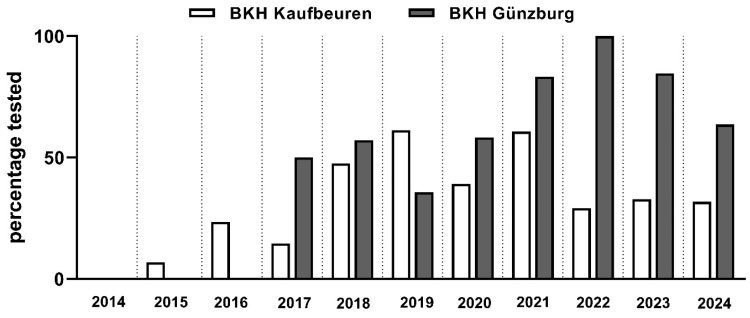 Figure 1
Peer Reviews
No public reviews on file for this paper yet. If you reviewed it on a platform where reviews are public (OpenReview, ICLR, NeurIPS, ICML), you can paste yours below so the community can read it here.
Videos
No videos yet. Explain this paper in a talk, walkthrough, or lecture? Add one.
Taxonomy
TopicsForensic Toxicology and Drug Analysis · Neurotransmitter Receptor Influence on Behavior · Psychopathy, Forensic Psychiatry, Sexual Offending