Deep Brain Stimulation: Mechanisms, Cost-Effectiveness, and Precision Applications Across Neurology and Psychiatry
Horia Petre Costin, Felix-Mircea Brehar, Antonio-Daniel Corlatescu, Viorel Mihai Pruna

TL;DR
Deep Brain Stimulation (DBS) is advancing from treating Parkinson's to a broader, personalized therapy in neurology and psychiatry, with a focus on cost-effectiveness and new technologies.
Contribution
The paper reviews recent advancements in DBS, emphasizing new targets, adaptive technologies, and cost-effectiveness across neurological and psychiatric applications.
Findings
DBS is expanding beyond Parkinson's to treat psychiatric and metabolic conditions like depression and anorexia nervosa.
Rechargeable DBS devices show cost-effectiveness in treatment-resistant depression and OCD.
New DBS targets and adaptive technologies like closed-loop systems are improving patient outcomes and personalization.
Abstract
In less than 30 years, Deep Brain Stimulation (DBS) has evolved from an antiparkinsonian rescue intervention into a flexible neuromodulatory therapy with the potential for personalized, adaptive, and enhancement-focused interventions. In this review we collected evidence from seven areas: (i) modern eligibility criteria, and ways to practically improve on these, outside of ‘Core Assessment Program of Surgical Interventional Therapies in Parkinson’s Disease’ (CAPSIT-PD); (ii) cost-effectiveness, where long-horizon models now show positive incremental net monetary benefit for Parkinson’s disease, and rechargeable-devices lead the way in treatment-resistant depression and obsessive–compulsive disorder; (iii) anatomical targets, from canonical subthalamic nucleus (STN) / globus pallidus internus (GPi) sites, to new dual-node and cortical targets; (iv) mechanistic theories from informational…
Genes, proteins, chemicals, diseases, species, mutations and cell lines named across the full text — each resolved to its canonical identifier and authoritative record.
Click any figure to enlarge with its caption.
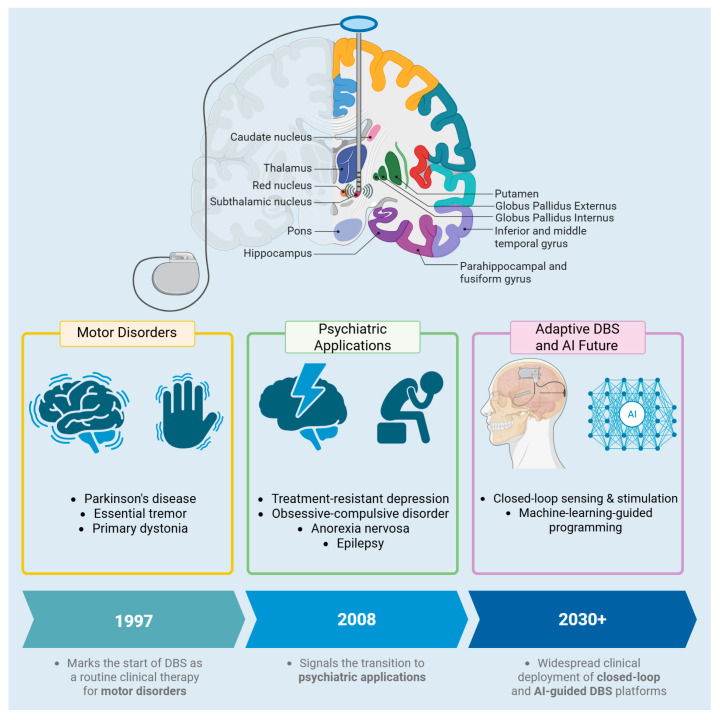 Figure 1
Peer Reviews
No public reviews on file for this paper yet. If you reviewed it on a platform where reviews are public (OpenReview, ICLR, NeurIPS, ICML), you can paste yours below so the community can read it here.
Videos
No videos yet. Explain this paper in a talk, walkthrough, or lecture? Add one.
Taxonomy
TopicsNeurological disorders and treatments · Parkinson's Disease Mechanisms and Treatments · Transcranial Magnetic Stimulation Studies