Behavioral Variant Frontotemporal Dementia in the Context of Progressive Apraxia of Speech: A Clinico-Neuroimaging Case–Control Study
Nadia Hossain, Jerusha Bhaskaran, Joseph R. Duffy, Heather M. Clark, Mary M. Machulda, Dennis W. Dickson, Jennifer L. Whitwell, Keith A. Josephs

TL;DR
This study finds that behavioral issues linked to bvFTD can appear alongside speech problems in PAOS patients, and are tied to more prefrontal brain atrophy.
Contribution
The study identifies clinical and neuroimaging features of bvFTD in PAOS patients, revealing greater prefrontal atrophy compared to PAOS-only cases.
Findings
PAOS-bvFTD participants showed worse behavioral scores compared to PAOS-only participants.
PAOS-bvFTD participants exhibited greater prefrontal cortex atrophy than PAOS-only participants.
Seven of eleven PAOS-bvFTD participants developed bvFTD features within three years of symptom onset.
Abstract
Objective: Progressive apraxia of speech (PAOS) is a neurodegenerative syndrome characterized by impaired motor speech planning and programming, whereas behavioral variant frontotemporal dementia (bvFTD) is characterized by deviant behavioral (e.g., personality and social) features. Clinical and anatomic characteristics of bvFTD in the context of PAOS are understudied. Methods: We identified 12 participants with PAOS and features that were consistent with bvFTD at baseline or follow-up. Eleven completed a head MRI scan. We compared clinical features and anatomical patterns of atrophy in these 11 PAOS-bvFTD participants to 11 matched PAOS participants without bvFTD and 22 age- and sex-matched healthy controls. Statistical Parametric Mapping (SPM) was applied to visualize gray matter volume across both groups compared to controls and each other. Medians and 25th and 75th percentiles were…
Genes, proteins, chemicals, diseases, species, mutations and cell lines named across the full text — each resolved to its canonical identifier and authoritative record.
Click any figure to enlarge with its caption.
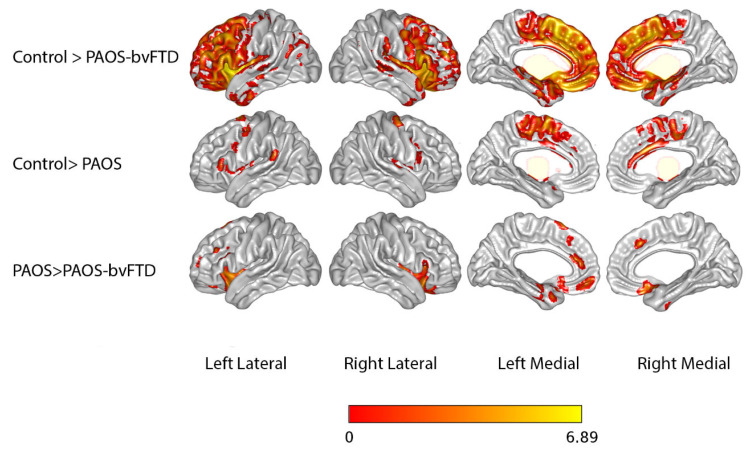 Figure 1
Peer Reviews
No public reviews on file for this paper yet. If you reviewed it on a platform where reviews are public (OpenReview, ICLR, NeurIPS, ICML), you can paste yours below so the community can read it here.
Videos
No videos yet. Explain this paper in a talk, walkthrough, or lecture? Add one.
Taxonomy
TopicsNeurobiology of Language and Bilingualism · Action Observation and Synchronization · Dementia and Cognitive Impairment Research