A Single-Center Clinical Experience with Fully Percutaneous, Minimally Invasive Fetoscopic Surgery for Spina Bifida Aperta
Robert Brawura Biskupski Samaha, Mirosław Wielgoś, Thomas Kohl, Michal Lipa, Ksawery Goławski, Katarzyna Kosińska-Kaczyńska, Katarzyna Luterek, Przemysław Kosiński, Julia Sienczyk

TL;DR
This study reports on the successful implementation of minimally invasive fetoscopic surgery for spina bifida aperta in Poland, showing positive outcomes for mothers and babies.
Contribution
The study presents a single-center clinical experience of implementing fetoscopic surgery for spina bifida aperta in Poland using a tailored curriculum.
Findings
The procedure was completed in 34 out of 38 cases with encouraging maternal and neonatal outcomes.
More than 70% of babies had a functional motor level equal to or better than the anatomical level.
Preterm delivery was common but typically occurred beyond 30 weeks with rare complications from prematurity.
Abstract
Background/Objectives: Following a tailored curriculum, minimally invasive fetoscopic coverage for spina bifida aperta (SBA) was introduced in Poland in 2017. This study aims to present the results of the first patients that underwent this procedure in the 1st Department of Obstetrics and Gynecology, Medical University of Warsaw and compare them with the results obtained in other studies. Methods: We reviewed our data of 38 expectant mothers whose fetuses with SBA and normal karyotype underwent minimally invasive fetoscopic coverage at our center between September 2017 and February 2022. All procedures were carried out between 24 + 4 and 28 + 1 weeks of gestation employing general materno-fetal anesthesia. New methods were implemented with time, moving from the patch technique to the skin-to-skin technique suture. The results of the study were compared with the available literature on…
Genes, proteins, chemicals, diseases, species, mutations and cell lines named across the full text — each resolved to its canonical identifier and authoritative record.
Click any figure to enlarge with its caption.
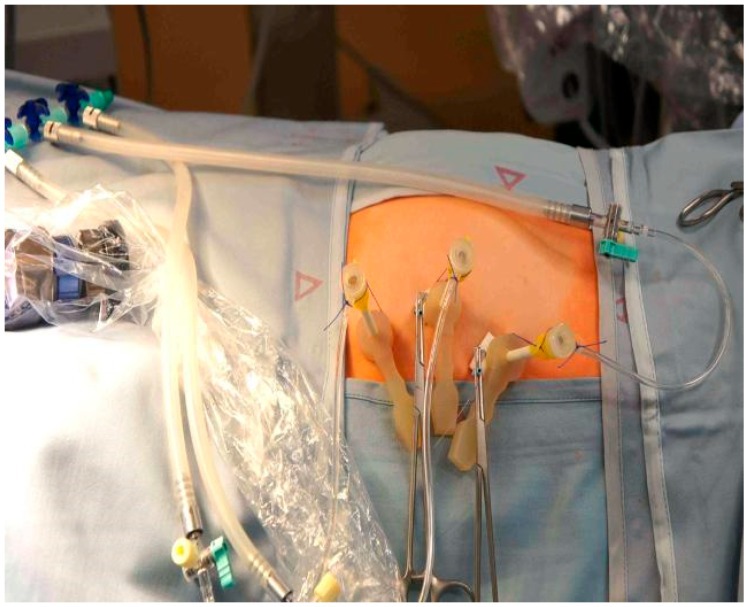 Figure 1
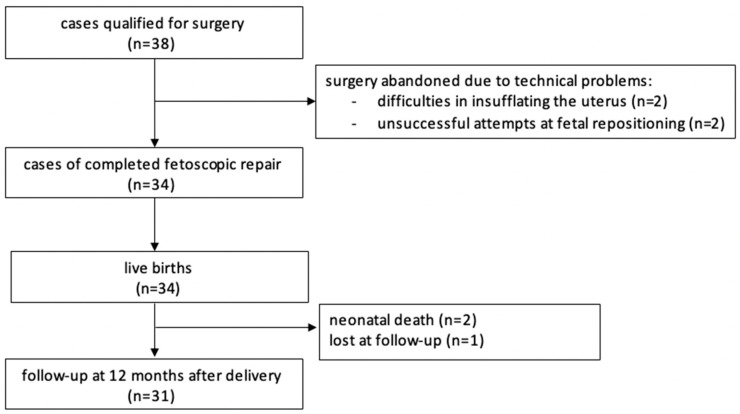 Figure 2
Peer Reviews
No public reviews on file for this paper yet. If you reviewed it on a platform where reviews are public (OpenReview, ICLR, NeurIPS, ICML), you can paste yours below so the community can read it here.
Videos
No videos yet. Explain this paper in a talk, walkthrough, or lecture? Add one.
Taxonomy
TopicsSpinal Dysraphism and Malformations · Congenital Anomalies and Fetal Surgery · Assisted Reproductive Technology and Twin Pregnancy