Determinants of QTc Interval Prolongation in Patients with Hypopituitarism and Other Pituitary Disorders
Valentina Gasco, Daniela Cuboni, Sergio Siclari, Francesca Mocellini, Michela Sibilla, Silvia Grottoli, Ezio Ghigo, Mauro Maccario

TL;DR
This study finds that age and certain brain lesions are linked to prolonged QTc intervals in patients with pituitary disorders, which may increase heart risks.
Contribution
The study identifies new predictors of QTc prolongation in pituitary disease patients beyond prior case reports.
Findings
Age was a significant predictor of QTc prolongation in most models.
Expansive lesions other than pituitary adenomas were strongly associated with QTc prolongation.
Low potassium and calcium levels showed borderline associations with QTc prolongation.
Abstract
Background: Long QT syndrome (LQTS) is characterized by delayed myocardial repolarization, predisposing to malignant arrhythmias such as torsades de pointes, ventricular fibrillation, and cardiac arrest. Recent reports suggest that acquired LQTS (aLQTS) may represent an early manifestation of hypopituitarism, potentially contributing to its increased cardiovascular mortality, although evidence remains limited to 16 published case reports. Objective: The objective was to investigate the relationship between hypopituitarism and corrected QT (QTc) interval. Methods: We retrospectively analyzed data from 185 patients (121 males) with hypothalamic–pituitary disorders who underwent a 12-lead electrocardiogram between April 2023 and September 2024. Clinical characteristics, hormone replacement therapy, and same-day laboratory parameters (electrolytes, fT3, fT4, IGF-I, testosterone) were…
Genes, proteins, chemicals, diseases, species, mutations and cell lines named across the full text — each resolved to its canonical identifier and authoritative record.
Click any figure to enlarge with its caption.
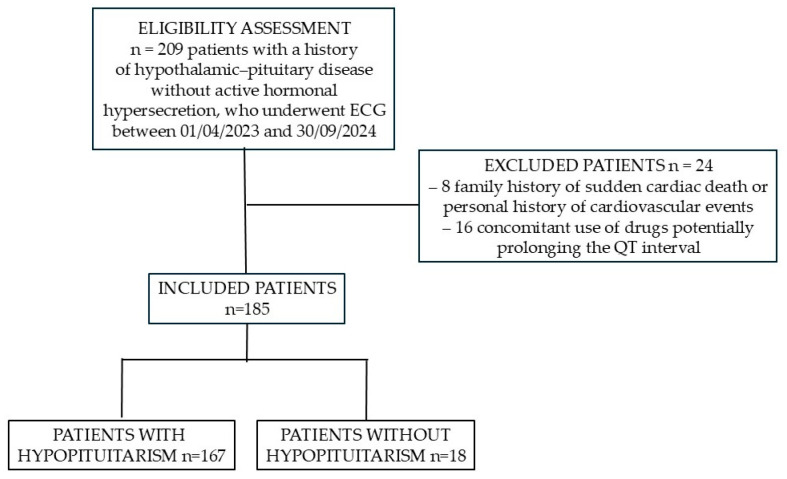 Figure 1
Peer Reviews
No public reviews on file for this paper yet. If you reviewed it on a platform where reviews are public (OpenReview, ICLR, NeurIPS, ICML), you can paste yours below so the community can read it here.
Videos
No videos yet. Explain this paper in a talk, walkthrough, or lecture? Add one.
Taxonomy
TopicsTakotsubo Cardiomyopathy and Associated Phenomena · Cardiac electrophysiology and arrhythmias · Heart Rate Variability and Autonomic Control