Assessment of Comprehensive Patient-Reported Outcomes Before and After CPAP Therapy in Obstructive Sleep Apnea
Adriana Loredana Pintilie, Andreea Zabara Antal, Ruxandra Stirbu, Marius Traian Dragos Marcu, David Toma, Raluca Tiron, Carina Adina Afloarei, Mihai Lucian Zabara, Radu Crisan Dabija

TL;DR
CPAP therapy improves sleepiness, mood, and quality of life in OSA patients, with better results linked to treatment adherence rather than residual breathing issues.
Contribution
This study provides new insights into how CPAP adherence, not residual apnea, drives improvements in patient-reported outcomes in OSA.
Findings
CPAP therapy significantly reduced daytime sleepiness and improved mood, anxiety, and quality of life over six months.
Higher CPAP adherence predicted greater reductions in sleepiness and better mood improvements.
Residual apnea levels did not correlate with changes in patient-reported outcomes or cognitive performance.
Abstract
Background: Obstructive sleep apnea (OSA) impacts daytime alertness, mood, cognition, and quality of life (QoL). Initial alterations in these patient-reported outcomes (PROs) following CPAP therapy, along with their association with adherence and residual respiratory events, are only partially understood. Materials and methods: We conducted a retrospective, observational study from January 2024 to May 2025 involving adult patients with OSA. Standardized assessments were performed at baseline and at six months following the initiation of CPAP: Epworth Sleepiness Scale (ESS), WHOQOL-BREF, MoCA, DASS-21, GAD-7, and PHQ-9. The primary endpoint was the change in Patient-Reported Outcomes (PROs) and cognitive performance. The second was to identify associations between these improvements and the degree of adherence to CPAP therapy and residual AHI. Results: Seventy-two patients (median age,…
Genes, proteins, chemicals, diseases, species, mutations and cell lines named across the full text — each resolved to its canonical identifier and authoritative record.
Click any figure to enlarge with its caption.
 Figure 1
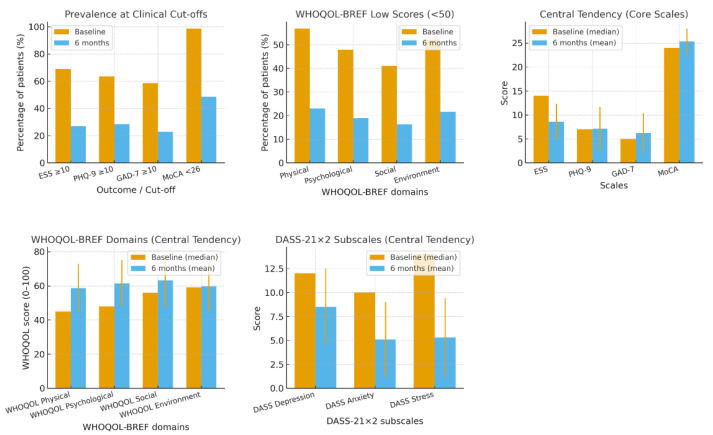 Figure 2
Peer Reviews
No public reviews on file for this paper yet. If you reviewed it on a platform where reviews are public (OpenReview, ICLR, NeurIPS, ICML), you can paste yours below so the community can read it here.
Videos
No videos yet. Explain this paper in a talk, walkthrough, or lecture? Add one.
Taxonomy
TopicsObstructive Sleep Apnea Research · Sleep and related disorders · Restless Legs Syndrome Research