High-Throughput Sequencing-Based Assessment of Intestinal Parasitic Infections in Economically and Medicinally Valuable Captive Tokay Gecko (Gekko gecko) and Chinese Blue-Tailed Skink (Plestiodon chinensis)
Zichao Yu, Yi Xiong, Guanping Xie, Zhengjun Wu

TL;DR
This study uses high-throughput sequencing to assess intestinal parasites in two commercially farmed reptiles, finding host-specific infection patterns and highlighting the need for better health management.
Contribution
The study introduces high-throughput sequencing as a novel method for parasite surveillance in economically valuable reptiles, revealing host-specific infection patterns.
Findings
Cryptosporidium was detected exclusively in Chinese blue-tailed skinks, showing a highly significant host-specific pattern.
Co-occurrence network analysis revealed significant positive associations between parasites and gut fungi and protozoa.
Six pathogenic genera were identified, with varying prevalence rates between the two reptile species.
Abstract
Captive reptiles raised for economic and medicinal purposes are frequently exposed to intestinal parasites, which can compromise their health and reduce reproductive success. Because their economic value largely derives from medicinal use, they are described as reptiles with medicinally driven economic value. In this study, we examined fecal samples from two commercially farmed species, the tokay gecko (Gekko gecko) and the Chinese blue-tailed skink (Plestiodon chinensis), using high-throughput sequencing to profile their intestinal eukaryotic communities and identify pathogenic parasitic genera. The overall parasite infection proportion was 57.1% (12/21) in Chinese blue-tailed skinks and 42.9% (9/21) in tokay geckos. Notably, Cryptosporidium was detected exclusively in Chinese blue-tailed skinks, with its prevalence showing a highly significant difference between the two hosts (p =…
Genes, proteins, chemicals, diseases, species, mutations and cell lines named across the full text — each resolved to its canonical identifier and authoritative record.
Click any figure to enlarge with its caption.
 Figure 1
 Figure 2
 Figure 3
 Figure 4
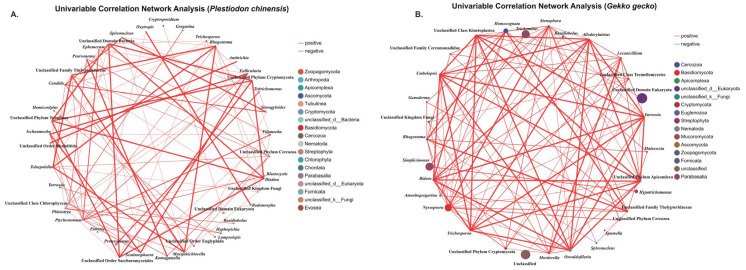 Figure 5
Peer Reviews
No public reviews on file for this paper yet. If you reviewed it on a platform where reviews are public (OpenReview, ICLR, NeurIPS, ICML), you can paste yours below so the community can read it here.
Videos
No videos yet. Explain this paper in a talk, walkthrough, or lecture? Add one.
Taxonomy
TopicsParasitic Infections and Diagnostics · Leech Biology and Applications · Coccidia and coccidiosis research