EEG-Based Local–Global Dimensional Emotion Recognition Using Electrode Clusters, EEG Deformer, and Temporal Convolutional Network
Hyoung-Gook Kim, Jin-Young Kim

TL;DR
This paper introduces a new EEG-based framework for emotion recognition that combines local and global brain activity patterns to improve accuracy and interpretability.
Contribution
The novel framework uses electrode clusters, EEG Deformer, and a TCN to model both local and global emotional signals in EEG data.
Findings
The proposed model outperforms existing methods on three public EEG datasets.
Cluster-based learning captures structural patterns and improves physiological validity.
Inter-cluster integration enhances global signal modeling for dimensional emotion analysis.
Abstract
Emotions are complex phenomena arising from cooperative interactions among multiple brain regions. Electroencephalography (EEG) provides a non-invasive means to observe such neural activity; however, as it captures only electrode-level signals from the scalp, accurately classifying dimensional emotions requires considering both local electrode activity and the global spatial distribution across the scalp. Motivated by this, we propose a brain-inspired EEG electrode-cluster-based framework for dimensional emotion classification. The model organizes EEG electrodes into nine clusters based on spatial and functional proximity, applying an EEG Deformer to each cluster to learn frequency characteristics, temporal dynamics, and local signal patterns. The features extracted from each cluster are then integrated using a bidirectional cross-attention (BCA) mechanism and a temporal convolutional…
Genes, proteins, chemicals, diseases, species, mutations and cell lines named across the full text — each resolved to its canonical identifier and authoritative record.
Click any figure to enlarge with its caption.
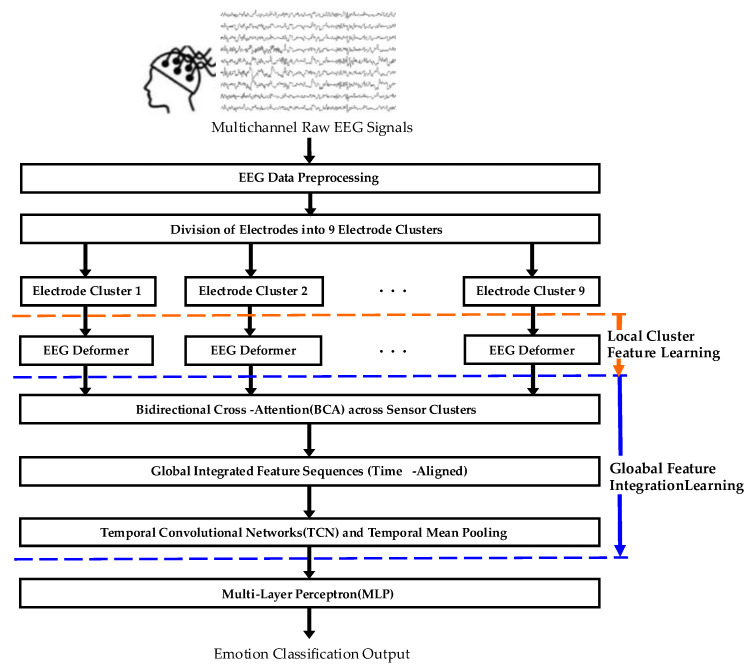 Figure 1
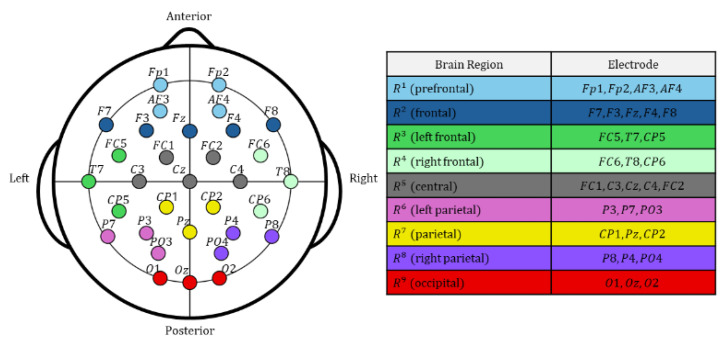 Figure 2
 Figure 3
 Figure 4
 Figure 5
 Figure 6
Peer Reviews
No public reviews on file for this paper yet. If you reviewed it on a platform where reviews are public (OpenReview, ICLR, NeurIPS, ICML), you can paste yours below so the community can read it here.
Videos
No videos yet. Explain this paper in a talk, walkthrough, or lecture? Add one.
Taxonomy
TopicsEmotion and Mood Recognition · EEG and Brain-Computer Interfaces · Functional Brain Connectivity Studies