The Evolutionary Psychology of Breaking Informal Versus Formal Contracts: Effects of Group Size and Area of Upbringing
Glenn Geher, Ethan Eisenberg, Michael DeMaio, Olivia Casa, Anthony J. Caserta, Katherine Cochran, Leah Cohen, Aliza Dewan, Stephanie Dickinson-Frevola, Lauryn Fenigstein, Chloe Giboyeaux, Mia Goren, Emma Jerabek, Julia Lieberstein, Lindsay Marr, Brandon Staccio, Nadia Tamayo

TL;DR
This study explores how people's decisions to break contracts depend on whether the contracts are informal or formal, and how this relates to group size and upbringing.
Contribution
The study introduces a novel experimental approach to test how evolutionary psychology influences contract-breaking behavior in different social contexts.
Findings
Participants in small-scale contexts gave more weight to informal agreements like handshakes.
Participants in large-scale contexts prioritized written contracts over informal ones.
Urban-upbringing participants were more likely to break any type of contract.
Abstract
The social context for human social interactions between modern urban contexts and ancestral, small-scale contexts is different in many important ways. Before the advent of agriculture, all people lived in small-scale social contexts and were surrounded by kin and other familiar others. As these conditions characterized the lion’s share of human evolutionary history, we can expect much of our social psychology to be more designed for such small-scale contexts than for large-scale contexts. The study described here specifically predicted that informal forms of making an agreement (such as a handshake, which is more similar to how contracts are sealed in small-scale societies) would be weighted more heavily by people who are given an option to break a contract in a small-scale context. On the other hand, we predicted that people who are framed to think about large-scale social contexts…
Genes, proteins, chemicals, diseases, species, mutations and cell lines named across the full text — each resolved to its canonical identifier and authoritative record.
Click any figure to enlarge with its caption.
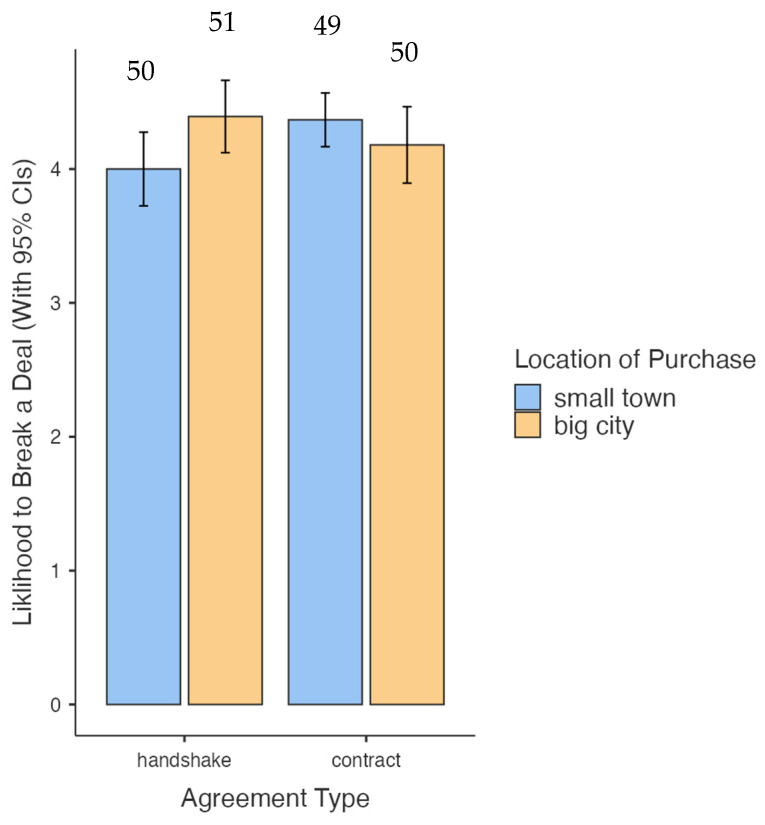 Figure 1
Peer Reviews
No public reviews on file for this paper yet. If you reviewed it on a platform where reviews are public (OpenReview, ICLR, NeurIPS, ICML), you can paste yours below so the community can read it here.
Videos
No videos yet. Explain this paper in a talk, walkthrough, or lecture? Add one.
Taxonomy
TopicsEvolutionary Psychology and Human Behavior · Evolutionary Game Theory and Cooperation · Experimental Behavioral Economics Studies