Capturing Compensatory Reserve in Sarcopenia: A Bioengineering Framework for Multidimensional Temporal Analysis of Center-of-Pressure Signals
Qinghe Zhao, Qing Xiao, Yu Chen, Muyu Yang, Lunzhi Dai, Yan Xiong, Jirong Yue

TL;DR
This study introduces a new method to detect balance issues in sarcopenia patients by analyzing subtle changes in their center-of-pressure signals.
Contribution
A novel bioengineering framework using multidimensional temporal analysis of COP signals to quantify compensatory reserve in sarcopenia.
Findings
Semi-tandem stance COP analysis achieved 0.84 ± 0.04 accuracy in distinguishing sarcopenia patients from controls.
DTW-based features were identified as key indicators of compensatory reserve and correlated with clinical severity.
The framework outperformed conventional kinematic features in detecting balance impairments.
Abstract
Conventional balance assessments often miss subtle deficits in sarcopenia patients due to compensatory strategies. This study develops a computational framework using multidimensional temporal analysis of center-of-pressure (COP) signals to quantify variations in compensatory reserve—the capacity to mask balance impairments—within these patients. COP data were collected from 82 older adults (sarcopenia vs. controls) during static standing on a standard clinical force platform (routine for geriatric balance testing). The framework integrates Dynamic Time Warping distances from a healthy template, fixed-weight LSTM embeddings, and statistical metrics, with feature selection and 5-fold cross-validation (SMOTE) to mitigate overfitting. Semi-tandem stance was most discriminative, achieving 0.84 ± 0.04 accuracy and 0.86 ± 0.05 ROC-AUC—outperforming conventional kinematic features. SHAP…
Genes, proteins, chemicals, diseases, species, mutations and cell lines named across the full text — each resolved to its canonical identifier and authoritative record.
Click any figure to enlarge with its caption.
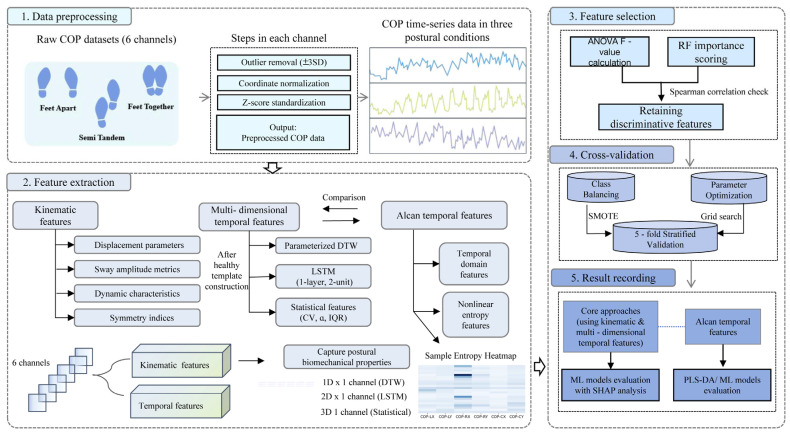 Figure 1
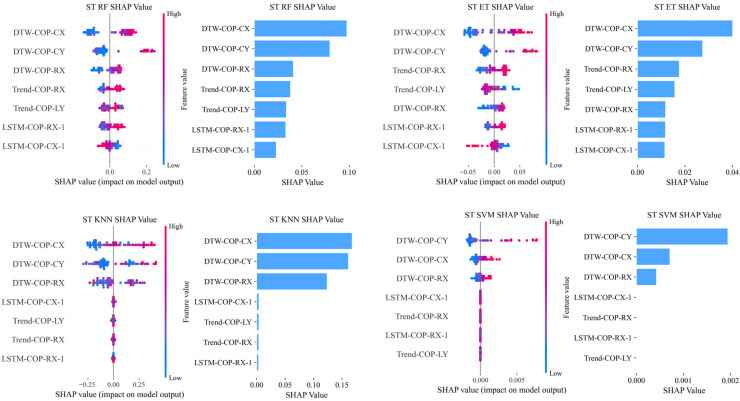 Figure 2
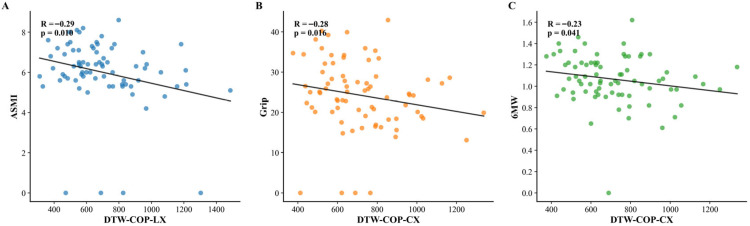 Figure 3
Peer Reviews
No public reviews on file for this paper yet. If you reviewed it on a platform where reviews are public (OpenReview, ICLR, NeurIPS, ICML), you can paste yours below so the community can read it here.
Videos
No videos yet. Explain this paper in a talk, walkthrough, or lecture? Add one.
Taxonomy
TopicsNutrition and Health in Aging · Body Composition Measurement Techniques · Cardiovascular and exercise physiology