Assessing Particle Release from Intraocular Lenses with a Combination of OptoFluidic Force Induction, μ-Raman and μ-FTIR
Andreas F. Borkenstein, Leon Ranz, Christian Neuper, Eva-Maria Borkenstein, Harald Fitzek

TL;DR
This study examines whether common intraocular lenses release particles over time, finding no significant emissions from the lenses themselves.
Contribution
A novel combination of OF2i, μ-FTIR, and Raman microscopy is used to assess particle release from medical implants.
Findings
No significant particle emission was detected from seven types of IOLs over 30 days.
Over 500 particles analyzed showed no IOL-related material, only packaging-related microplastics.
Abstract
Intraocular lenses (IOLs) are among the most common medical implants that remain in the body long-term, with millions of IOLs implanted into patients every year. In addition, there are rapidly growing concerns about microplastic pollution, including particle emission from medical implants directly inside the body. Against this backdrop, we analyze the particle emission of seven common types of IOLs over a 30-day period under laboratory conditions. To accomplish both particle counting over a long period and chemical identification, we combine OptoFluidic Force Induction (OF2i), a novel online particle counting method, with micro Fourier Transform Infrared Spectroscopy with Attenuated Total Reflection (μ-FTIR-ATR) and Raman microscopy. Encouragingly, over the 30-day period, no significant particle emission from the IOLs was detectable. Neither was any increase in particle count detectable…
Genes, proteins, chemicals, diseases, species, mutations and cell lines named across the full text — each resolved to its canonical identifier and authoritative record.
Click any figure to enlarge with its caption.
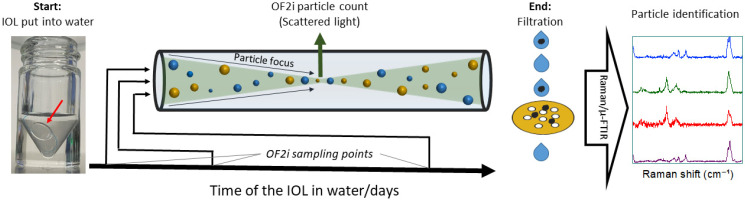 Figure 1
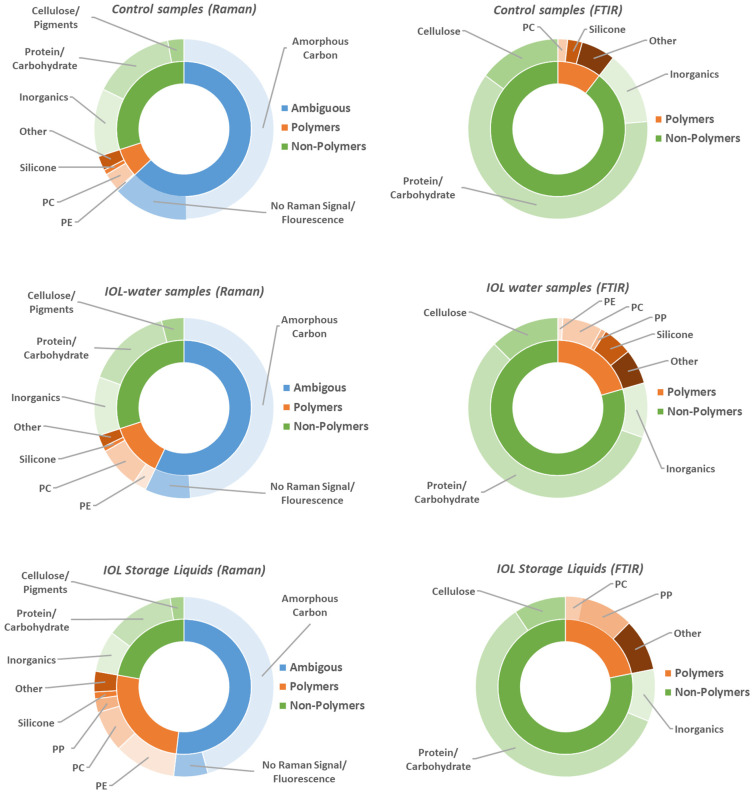 Figure 2
Peer Reviews
No public reviews on file for this paper yet. If you reviewed it on a platform where reviews are public (OpenReview, ICLR, NeurIPS, ICML), you can paste yours below so the community can read it here.
Videos
No videos yet. Explain this paper in a talk, walkthrough, or lecture? Add one.
Taxonomy
TopicsMicroplastics and Plastic Pollution · Graphene and Nanomaterials Applications