Advancing Wildlife Conservation Through Biobanking in South America
Carla B. Madelaire, Alexsandra F. Pereira, Adrián J. Sestelo, Aléxia P. Bom-Conselho, Carolina Vaj, Felipe C. Mosalve, Larissa S. Brandão-Souza, Marcela R. Tavares, Matteo Duque Rodriguez, Raquel O. Restrepo, Roberta F. Leite, Yann Locatelli, Thyara Deco-Souza

TL;DR
Biobanks in South America help preserve wildlife by storing biological samples, supporting future conservation and species restoration.
Contribution
This review highlights biobanking as a novel conservation strategy in South America, emphasizing its potential to safeguard biodiversity.
Findings
Biobanking can preserve genetic diversity and support long-term conservation of endangered species.
Key challenges include technical standardization, funding, and policy integration.
Recent advances show biobanking's growing importance in wildlife conservation.
Abstract
Biobanks are special collections that keep animal cells, tissues, and genetic material stored under safe conditions for long periods of time. In South America, this is very important because the region has one of the greatest biodiversities in the world, but several wild animals are facing serious threats such as habitat loss, climate change, and illegal hunting. By saving biological samples today, biobanks create opportunities to study, protect, and even restore species in the future. This review explores how biobanking is developing in South America, the progress already achieved, and the difficulties that still need to be overcome. It also highlights how connecting biotechnology with conservation can open new paths to protect endangered wildlife and ensure that the region’s natural heritage is preserved for the generations. South America harbors one of the world’s richest…
Genes, proteins, chemicals, diseases, species, mutations and cell lines named across the full text — each resolved to its canonical identifier and authoritative record.
Click any figure to enlarge with its caption.
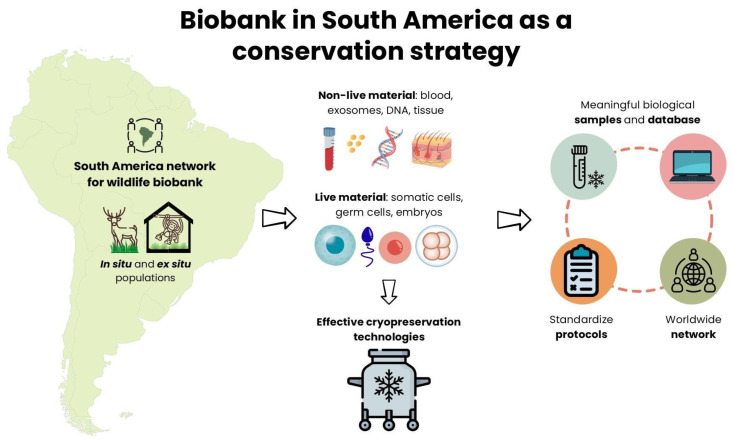 Figure 1
Peer Reviews
No public reviews on file for this paper yet. If you reviewed it on a platform where reviews are public (OpenReview, ICLR, NeurIPS, ICML), you can paste yours below so the community can read it here.
Videos
No videos yet. Explain this paper in a talk, walkthrough, or lecture? Add one.
Taxonomy
TopicsIdentification and Quantification in Food · Environmental DNA in Biodiversity Studies · Wood and Agarwood Research