Evaluating the Effects of Strategic Use of High Phytase Levels on Growth Performance and Carcass Characteristics of Late-Finishing Pigs Exposed to Limited Floor Space
Izadora Batista Kuneff, Pete Wilcock, Eric van Heugten

TL;DR
This study found that adding high levels of phytase to pig feed did not improve growth performance in pigs housed under limited floor space.
Contribution
The study evaluates the impact of hyper-dosing phytase on late-finishing pigs under space restriction, a novel approach in swine nutrition and housing research.
Findings
Space restriction reduced growth rate, final body weight, and feed intake in pigs.
Hyper-dosing phytase increased inositol and serum glucose but did not improve growth performance.
Phytase supplementation had no effect on feed efficiency or carcass characteristics.
Abstract
The reduction in available floor space per unit of pig body weight reduces growth performance during the late-finishing stage of pig production. Feeding elevated levels of phytase has the potential to destroy the anti-nutrient phytate present in grains and oilseeds, thereby increasing nutrient availability. Applying high doses of phytase in swine diets is a strategy to reduce feed costs and environmental phosphorus pollution, while promoting increased growth performance of pigs. In addition, the associated increase in inositol and other nutrients may improve growth performance and become an important strategy to reduce the stress of heavy weight pigs housed under restricted space. Therefore, this study evaluated the impacts of hyper-dosing dietary phytase (5000 FTU/kg of feed) on the growth performance, carcass characteristics, inositol concentrations, and serum chemistry of…
Genes, proteins, chemicals, diseases, species, mutations and cell lines named across the full text — each resolved to its canonical identifier and authoritative record.
Click any figure to enlarge with its caption.
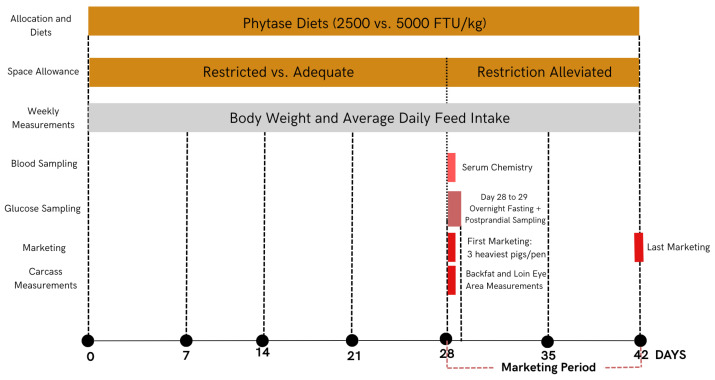 Figure 1
Peer Reviews
No public reviews on file for this paper yet. If you reviewed it on a platform where reviews are public (OpenReview, ICLR, NeurIPS, ICML), you can paste yours below so the community can read it here.
Videos
No videos yet. Explain this paper in a talk, walkthrough, or lecture? Add one.
Taxonomy
TopicsAnimal Nutrition and Physiology · Animal Behavior and Welfare Studies · Meat and Animal Product Quality