Determinants of Outcome Variability in Ischemic Stroke: A Focus on Routinely Collected Biomarkers
Alexandru Gerdanovics, Sorana D. Bolboacă, Ioana Cristina Stănescu, Camelia Manuela Mîrza, Gabriela Bombonica Dogaru, Cristina Ariadna Nicula, Paul Mihai Boarescu, Cezara-Andreea Gerdanovics, Adriana-Elena Bulboacă

TL;DR
The study explores how biomarkers like CRP and HDL cholesterol relate to stroke outcomes, revealing sex-specific differences and metabolic influences.
Contribution
The study identifies low HDL cholesterol as an independent predictor of disability severity in ischemic stroke patients.
Findings
Men with ischemic stroke were younger, more likely to smoke, and had lower LDL cholesterol compared to women.
Low HDL cholesterol was the sole independent predictor of disability severity in ischemic stroke patients.
Higher CRP levels were associated with moderate disability, but not independently predictive in multivariable analysis.
Abstract
Ischemic stroke remains a leading cause of mortality and disability, with proinflammatory, metabolic, and oxidative stress-related factors contributing to outcome variability. We conducted a retrospective cross-sectional study of 124 consecutive patients (53 women, 71 men; median age 71 [62–76]) discharged with ICD-10 code I69.3 from the Neurology Department of the Clinical Rehabilitation Hospital in Cluj-Napoca (January 2023–September 2024). Men were younger (median age of 69 vs. 73 years, p-value = 0.010), more frequently smokers (42% vs. 9%, p < 0.001), and alcohol consumers (21% vs. 4%, p-value = 0.007) than women. In contrast, women were more frequently sedentary (68% vs. 49%, p-value = 0.038) and had higher LDL cholesterol (89 vs. 74 mg/dL, p = 0.026) than men. Patients with at least moderate disability (n = 84) presented higher levels of C-Reactive Protein (CRP), 1.4 vs. 1.1…
Genes, proteins, chemicals, diseases, species, mutations and cell lines named across the full text — each resolved to its canonical identifier and authoritative record.
Click any figure to enlarge with its caption.
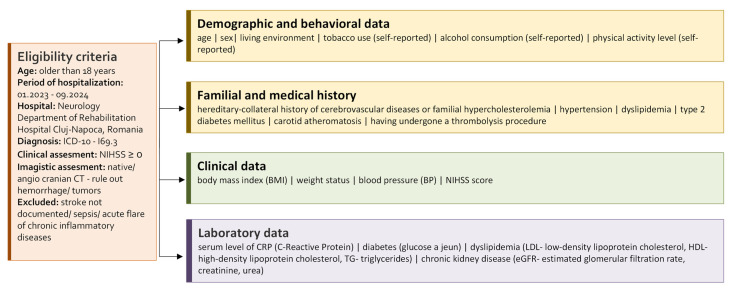 Figure 1
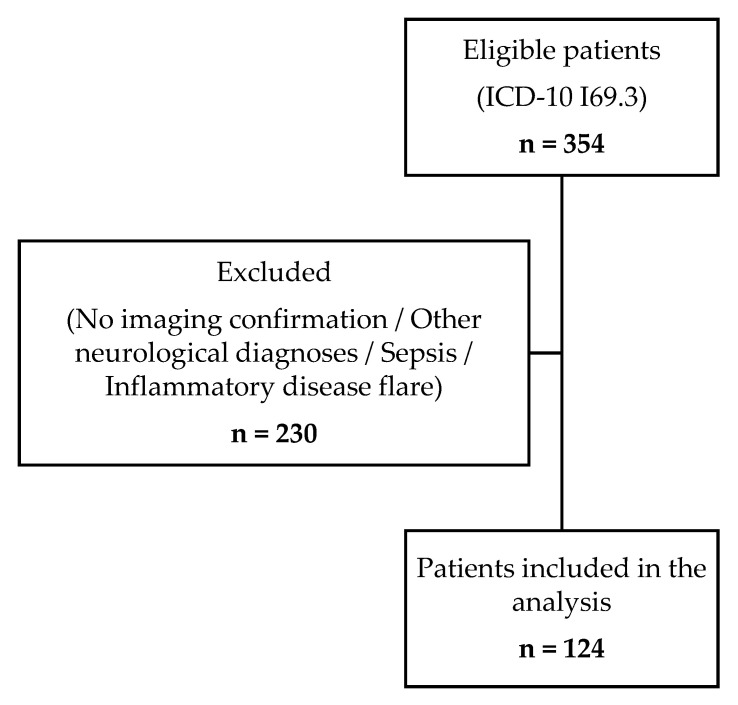 Figure 2
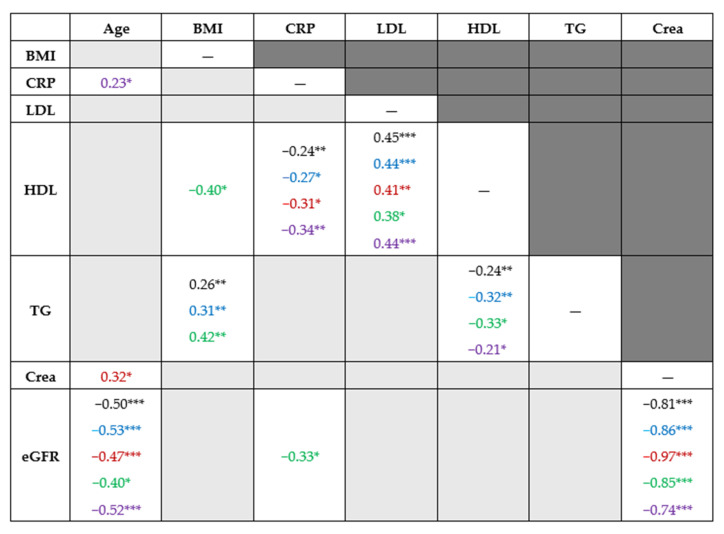 Figure 3
Peer Reviews
No public reviews on file for this paper yet. If you reviewed it on a platform where reviews are public (OpenReview, ICLR, NeurIPS, ICML), you can paste yours below so the community can read it here.
Videos
No videos yet. Explain this paper in a talk, walkthrough, or lecture? Add one.
Taxonomy
TopicsAcute Ischemic Stroke Management · Adipokines, Inflammation, and Metabolic Diseases · Neuroinflammation and Neurodegeneration Mechanisms