What Makes Us React to the Abuse of Pets, Protected Animals, and Farm Animals: The Role of Attitudes, Norms, and Moral Obligation
Cristina Ruiz, Andrea Vera, Christian Rosales, Ana M. Martín

TL;DR
This study explores how people react to animal abuse based on their attitudes, social norms, and sense of moral obligation, finding that moral obligation is the strongest predictor of such reactions.
Contribution
The paper introduces a validated model linking moral obligation and social norms to reactions against animal abuse, extending theories from environmental behavior research.
Findings
Moral obligation is the strongest predictor of reactions to animal abuse and activates personal norms.
Personal norms are influenced by attitudes toward animals and injunctive social norms.
The model explains 77% of the variance in reactions to animal abuse and fits well statistically.
Abstract
This study uses structural equation analysis to test a model explaining reactions to animal abuse in terms of attitudes, norms, and moral obligation. This model was based on research concerning pro-environmental and anti-ecological behavior, as offenses against animals are considered environmental crimes in legal terms. The sample consisted of 624 people from the general population, aged 18 to 93, 64.1% of whom were female. Participants were recruited by the snowball technique using Students of Social Work and Psychology degrees, who were asked to contact people of different genders, ages, and areas of residence and spread the link to access the questionnaire in exchange for extra points in some subjects. They were randomly assigned one of three versions of the same scenario, differing in the category of abused animal (protected/pet/farm), to be rated on several items. These items…
Genes, proteins, chemicals, diseases, species, mutations and cell lines named across the full text — each resolved to its canonical identifier and authoritative record.
Click any figure to enlarge with its caption.
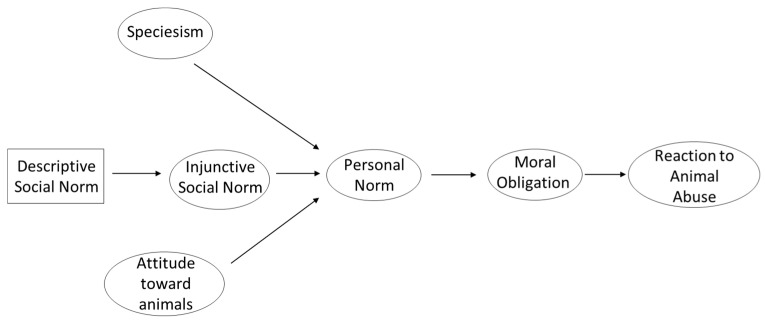 Figure 1
 Figure 2
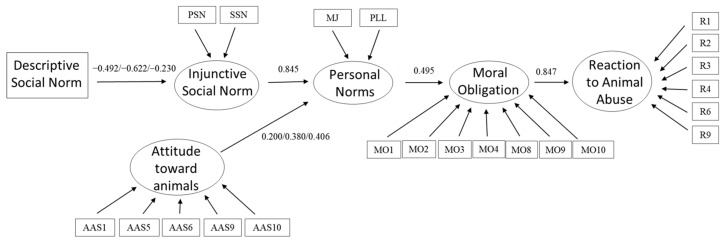 Figure 3
Peer Reviews
No public reviews on file for this paper yet. If you reviewed it on a platform where reviews are public (OpenReview, ICLR, NeurIPS, ICML), you can paste yours below so the community can read it here.
Videos
No videos yet. Explain this paper in a talk, walkthrough, or lecture? Add one.
Taxonomy
TopicsWildlife Conservation and Criminology Analyses · Human-Animal Interaction Studies · Animal Behavior and Welfare Studies