When Home Helps or Hurts: A Moderated Mediation Analysis of Work Meaning, Intrinsic Motivation, and Life Satisfaction Across Family Flexibility Profiles
Tiberiu Dughi, Dana Rad, Alina Roman, Dana Dughi, Camelia Daciana Stoian, Nicolae Radu Stoian, Cristian Măduța, Remus Runcan, Alina Costin, Anca Egerău, Claudiu Coman, Sonia Ignat, Evelina Balaș, Maria Sinaci, Gavril Rad

TL;DR
This study explores how home influences work and life satisfaction through motivation and work meaning, depending on family flexibility.
Contribution
The study introduces a moderated mediation model showing how family flexibility affects psychological processes linking home-work spillover to life satisfaction.
Findings
Negative home-to-work spillover reduces life satisfaction via reduced work meaning, especially for those with low family flexibility.
Positive home-to-work spillover increases life satisfaction through enhanced work meaning, more so when family flexibility is low.
Intrinsic motivation boosts life satisfaction only when family flexibility is high.
Abstract
The present study investigates the twofold effect of home–work spillover on life satisfaction through intrinsic work motivation and meaning derived from work, with family flexibility as a moderator. Based on Self-Determination Theory and the Work–Home Resources model, we test a moderated parallel mediation model whereby both positive and negative spillover from home affect life satisfaction through motivational and meaning pathways, depending on the level of family flexibility. 735 working adults completed validated measures of work-related flow, work meaning, home–work interaction (negative and positive), family flexibility, and life satisfaction. PROCESS macro (Model 59) via 5000 bootstrapped samples indicated that home negatively influencing work was associated with lower life satisfaction, mainly via reduced work meaning, particularly for individuals with low family flexibility.…
Genes, proteins, chemicals, diseases, species, mutations and cell lines named across the full text — each resolved to its canonical identifier and authoritative record.
Click any figure to enlarge with its caption.
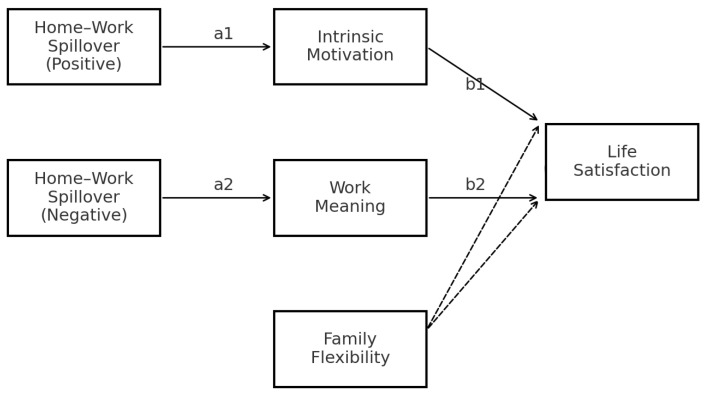 Figure 1
Peer Reviews
No public reviews on file for this paper yet. If you reviewed it on a platform where reviews are public (OpenReview, ICLR, NeurIPS, ICML), you can paste yours below so the community can read it here.
Videos
No videos yet. Explain this paper in a talk, walkthrough, or lecture? Add one.
Taxonomy
TopicsWork-Family Balance Challenges · Retirement, Disability, and Employment · Perfectionism, Procrastination, Anxiety Studies