A Novel Technique of Overtube‐assisted Ultrathin Endoscopic Biliary Drainage Using Multi‐Hole Self‐Expandable Metal Stents: A Case Report
Akinobu Koiwai, Morihisa Hirota, Kei Ishikawa, Chihiro Yunomura, Takuro Nakaya, Yuki Miyashita, Nana Inomata, Kennichi Satoh

TL;DR
A new endoscopic technique using an overtube and ultrathin scope successfully drains bile in a patient with complex anatomy.
Contribution
A novel overtube-assisted ultrathin endoscopic biliary drainage technique is introduced for challenging cases.
Findings
The novel technique successfully accessed the papilla when ERCP and EUS-BD were not feasible.
The method allowed for removal and replacement of stents, resolving cholangitis and liver abscesses.
The approach may serve as an alternative in patients with altered anatomy or prior hepatic resection.
Abstract
Endoscopic retrograde cholangiopancreatography (ERCP) is the standard procedure for biliary drainage; however, access can be challenging in patients with altered anatomy or tumor‐related distortion. Endoscopic ultrasound‐guided biliary drainage (EUS‐BD) is a common alternative, yet it is not always feasible, particularly in patients with prior hepatic resection or severe gastrointestinal deformation. A 67‐year‐old woman developed obstructive jaundice due to hilar biliary stricture secondary to peritoneal dissemination following colorectal cancer surgery. Initial ERCP achieved side‐by‐side placement of multi‐hole self‐expandable metal stents (MHSEMSs), resulting in effective drainage. At recurrence of cholangitis, repeat ERCP failed because of anatomical distortion, and EUS‐BD was not feasible due to the patient's prior left hepatectomy. We therefore employed a novel technique: a…
Genes, proteins, chemicals, diseases, species, mutations and cell lines named across the full text — each resolved to its canonical identifier and authoritative record.
Click any figure to enlarge with its caption.
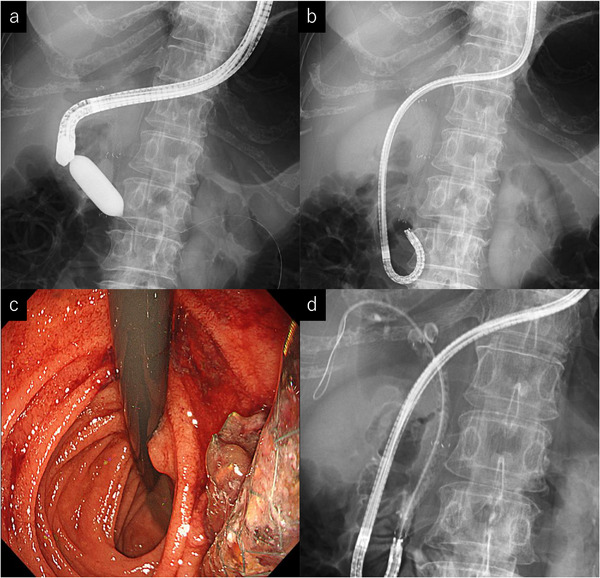 Figure 1
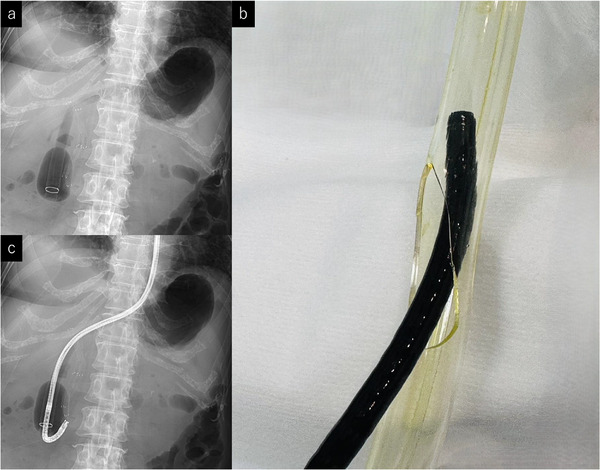 Figure 2
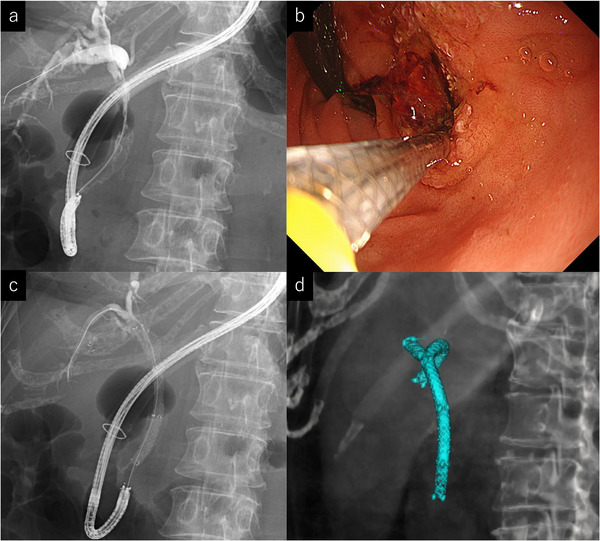 Figure 3
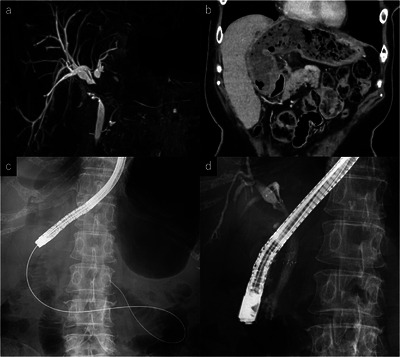 Figure 4
Peer Reviews
No public reviews on file for this paper yet. If you reviewed it on a platform where reviews are public (OpenReview, ICLR, NeurIPS, ICML), you can paste yours below so the community can read it here.
Videos
No videos yet. Explain this paper in a talk, walkthrough, or lecture? Add one.
Taxonomy
TopicsGallbladder and Bile Duct Disorders · Esophageal and GI Pathology · Pancreatic and Hepatic Oncology Research