Unravelling the causal link between gut microbiota and acne risk using a genetic approach
Fangyuan Cao, Natalia S Ogonowski, Santiago Díaz-Torres, Brittany L Mitchell, Puya Gharhakhani, Nicholas G Martin, Michael A Simpson, Jue-Sheng Ong, Miguel E Rentería

TL;DR
This study finds that certain gut bacteria, like Bifidobacterium, are linked to lower acne risk, while others, like Streptococcus, are linked to higher risk, suggesting gut microbiota may play a causal role in acne.
Contribution
The study uses Mendelian randomization to establish a causal link between specific gut microbes and acne risk, accounting for confounding factors like diet.
Findings
Higher abundances of Bifidobacterium and related taxa are associated with reduced acne risk (ORs 0.54–0.63).
Increased levels of Streptococcus and related taxa are linked to higher acne risk (ORs 1.12–1.36).
The associations for Bifidobacterium remain robust even after adjusting for dietary factors.
Abstract
Acne is a common inflammatory dermatological condition that can have detrimental psychological consequences due to its visible lesions and scarring. Recent studies suggest a potential role of gut microbiota in acne development; however, the evidence remains inconclusive and might be subject to various confounders. To investigate the causal relationship between gut microbiota and acne. This study investigated the causal relationship between gut microbiota and acne using a two-sample Mendelian randomization (MR) approach with large-scale genome-wide association study summary statistics. To ascertain the direction of causality and the independent effect of gut microbiota, reverse MR and multivariable MR accounting for dietary phenotypes were performed. Higher abundances of the Actinobacteria phylum and class, Bifidobacteriales order, Bifidobacteriaceae family and Bifidobacterium genus…
Genes, proteins, chemicals, diseases, species, mutations and cell lines named across the full text — each resolved to its canonical identifier and authoritative record.
Click any figure to enlarge with its caption.
 Figure 1
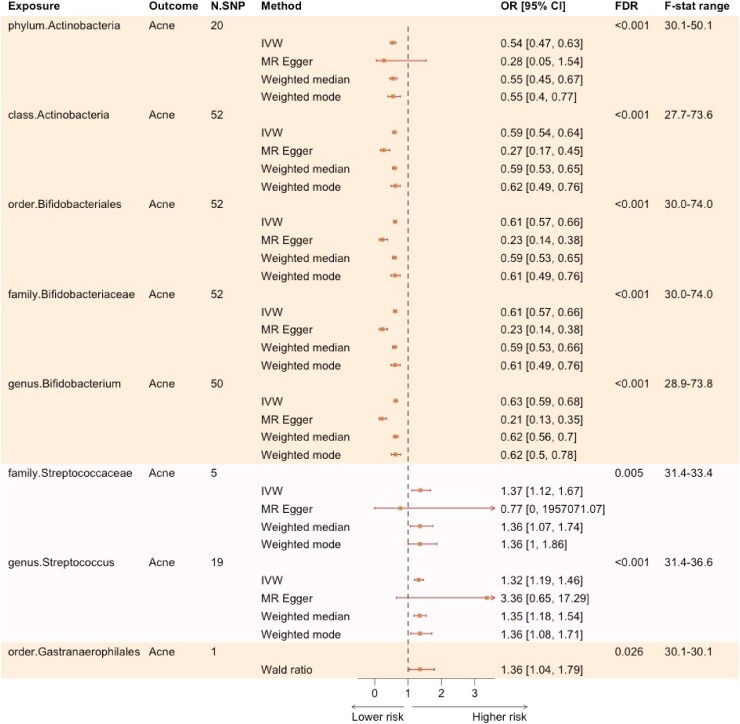 Figure 2
 Figure 3
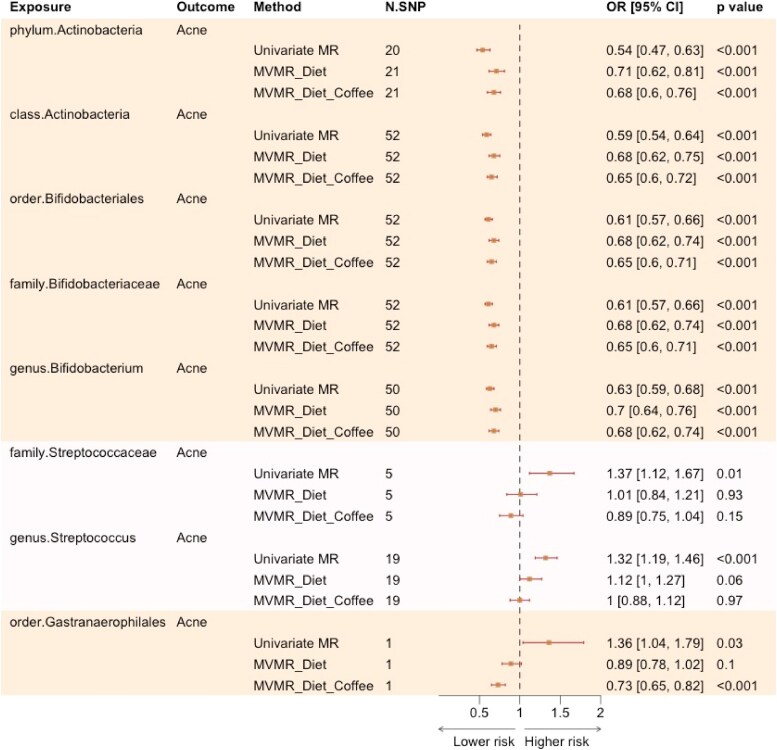 Figure 4
Peer Reviews
No public reviews on file for this paper yet. If you reviewed it on a platform where reviews are public (OpenReview, ICLR, NeurIPS, ICML), you can paste yours below so the community can read it here.
Videos
No videos yet. Explain this paper in a talk, walkthrough, or lecture? Add one.
Taxonomy
TopicsAcne and Rosacea Treatments and Effects · Gut microbiota and health · Dermatology and Skin Diseases